
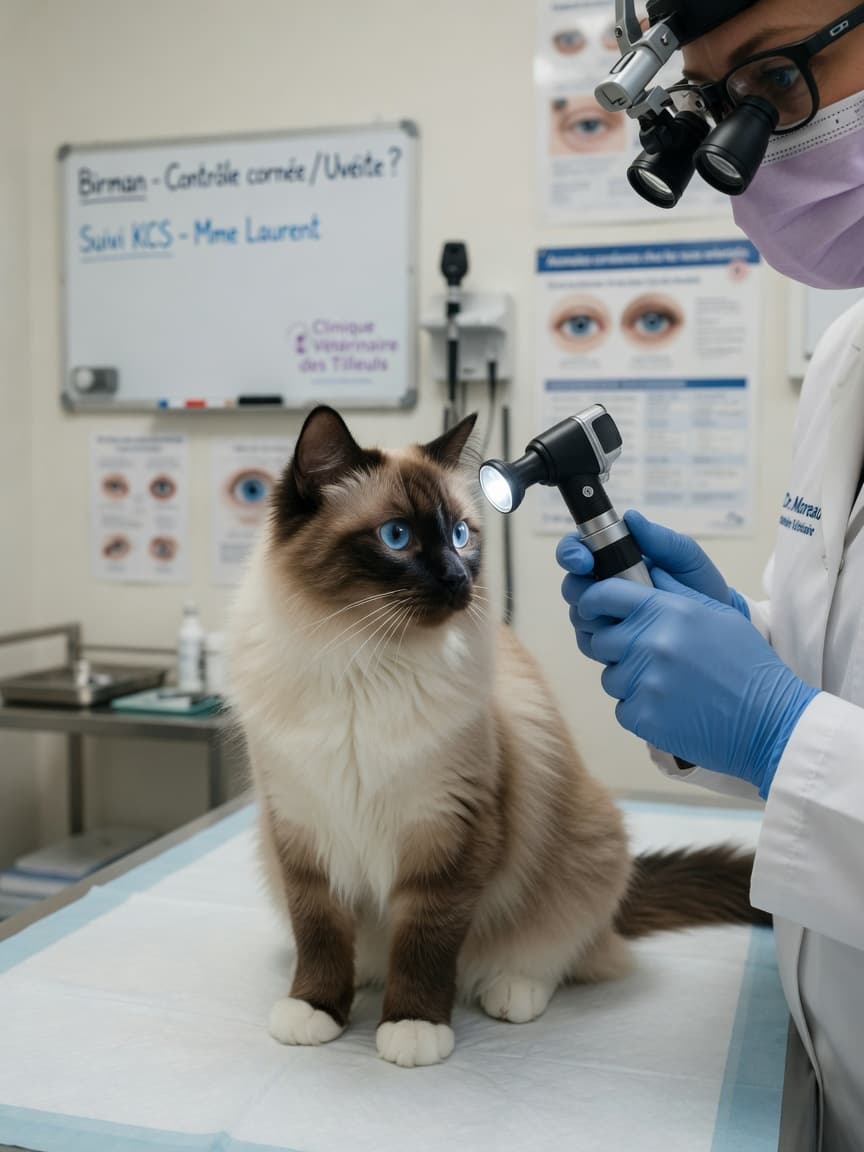
The Sacred Cat of Burma and Its Hidden Health Challenges
With its silky semi-long coat, blue eyes, and distinctive white "gloves" on each paw, the Birman is frequently described as one of the most beautiful domestic breeds. It is also a breed with a temperament that suits family life well — calm, affectionate, and less demanding than Siamese-derived breeds. However, beneath the striking exterior lie three health areas that owners should understand thoroughly: corneal dermoids, kidney disease, and the practical challenge of coat matting.
Corneal Dermoids in the Birman
A dermoid is a benign tissue mass containing elements normally found in skin — hair follicles, sebaceous glands, and sometimes hair itself — occurring in an abnormal location. In the Birman, dermoids are documented to occur on the cornea (the clear front surface of the eye) and the conjunctiva (the membrane lining the eyelids and covering the white of the eye).
How Dermoids Affect the Eye
Corneal dermoids can cause significant irritation. Hairs growing from the dermoid rub directly against the corneal surface with every blink, causing chronic discomfort, tearing, squinting, and — if untreated — corneal ulceration and scarring that can impair vision. The condition is congenital, meaning kittens are born with the predisposition, though the dermoid may not become clinically apparent until the cat is a few weeks or months old.
Diagnosis and Treatment
Veterinary ophthalmological examination confirms the diagnosis. Surgical removal (keratectomy or conjunctivectomy depending on location) is the definitive treatment and generally carries a good prognosis when performed by an experienced veterinary ophthalmologist before significant corneal scarring has developed. Early intervention is strongly preferable. If you notice your Birman kitten squinting, tearing excessively, or rubbing at its eye, seek veterinary assessment without delay rather than waiting to see if the problem resolves.
Kidney Disease: A Documented Breed Risk
The Birman breed has been identified in research literature as carrying an increased risk for congenital and juvenile kidney disease. Studies examining breed-specific renal disease prevalence have placed the Birman among the breeds with higher rates of renal dysplasia — abnormal kidney development — and other forms of early-onset chronic kidney disease (CKD).
Congenital Versus Age-Related Kidney Disease
Congenital renal dysplasia can present in young cats — sometimes within the first year of life — with symptoms including stunted growth, excessive thirst, frequent urination, vomiting, and weight loss. This differs from the age-related CKD that commonly affects cats over ten years of age, though Birmans are at elevated risk for both forms. The distinction matters because management strategies and prognosis differ.
Monitoring and Dietary Support
Annual kidney function screening — including creatinine, BUN, SDMA, and urinalysis — is recommended for Birmans from an early age. The SDMA marker provides earlier detection than traditional markers and is increasingly standard in routine senior panels. For young Birmans showing any symptoms of ill-thrift or excessive thirst, earlier and more frequent screening is warranted.
Dietary management of CKD involves ensuring adequate hydration through wet food, and — under veterinary supervision — phosphorus restriction as the disease progresses. Do not implement a phosphorus-restricted diet without veterinary guidance; it is not appropriate for cats with normal kidney function and can be harmful if misapplied. A moisture-rich, high-quality protein diet is the appropriate foundation for kidney health in all Birmans, regardless of whether disease is present.
Coat Matting: Prevention and Practical Management
The Birman's coat is one of its most admired features — silky, moderately long, and said to have a texture that resists matting better than the Persian's dense double coat. In practice, however, Birman coats absolutely do mat, particularly behind the ears, in the armpits, around the collar area, and along the flanks. Left unmanaged, mats tighten against the skin, causing discomfort, restricting movement, and creating humid environments where bacterial and fungal skin infections can develop.
Grooming Frequency and Technique
Twice-weekly brushing with a wide-toothed metal comb is the minimum for mat prevention during normal periods, increasing to daily during seasonal coat changes. Work through the coat methodically from root to tip, holding the skin above the area being combed to prevent tugging. Pay particular attention to friction points — armpits, groin, and behind the ears — where mats form most readily.
Managing Existing Mats
Small, superficial mats can often be teased apart with fingers and a comb, working from the outer edges inward. Never attempt to cut a mat with scissors without professional guidance — skin tents up into mats invisibly, and lacerations are more common than owners expect. Severe or numerous mats require professional grooming or veterinary intervention, where sedation may be necessary to clip them safely. Once mats are removed, establishing a regular grooming routine is essential to prevent recurrence.
Practical Summary for Birman Owners
- Monitor kittens closely for eye-squinting, tearing, or rubbing — corneal dermoids benefit from early surgical intervention.
- Register with a vet experienced in breed-specific conditions and discuss early kidney screening at the first health check.
- Schedule annual blood panels including SDMA from the first year of life, not just from middle age.
- Feed a moisture-rich, high-quality diet and discuss kidney-supportive nutrition with your vet as your Birman ages.
- Never implement a phosphorus-restricted diet without explicit veterinary recommendation.
- Commit to twice-weekly grooming as a minimum and increase to daily during shedding season.
- Seek professional grooming assistance for severe matting rather than attempting to cut mats at home.