
Cats Are Not Aloof — They Are Misunderstood
The belief that cats are emotionally opaque or indifferent to their owners is one of the most persistent myths in pet ownership. In reality, cats communicate constantly and precisely — through tail position, ear angle, eye contact, vocalisation, and posture. The problem is not that cats are hard to read; it is that most people have never been taught the language.
The Tail as Emotional Barometer
A cat's tail is arguably its most expressive communication tool, and learning to read it transforms your understanding of how your cat is feeling moment to moment.
Tail Held High
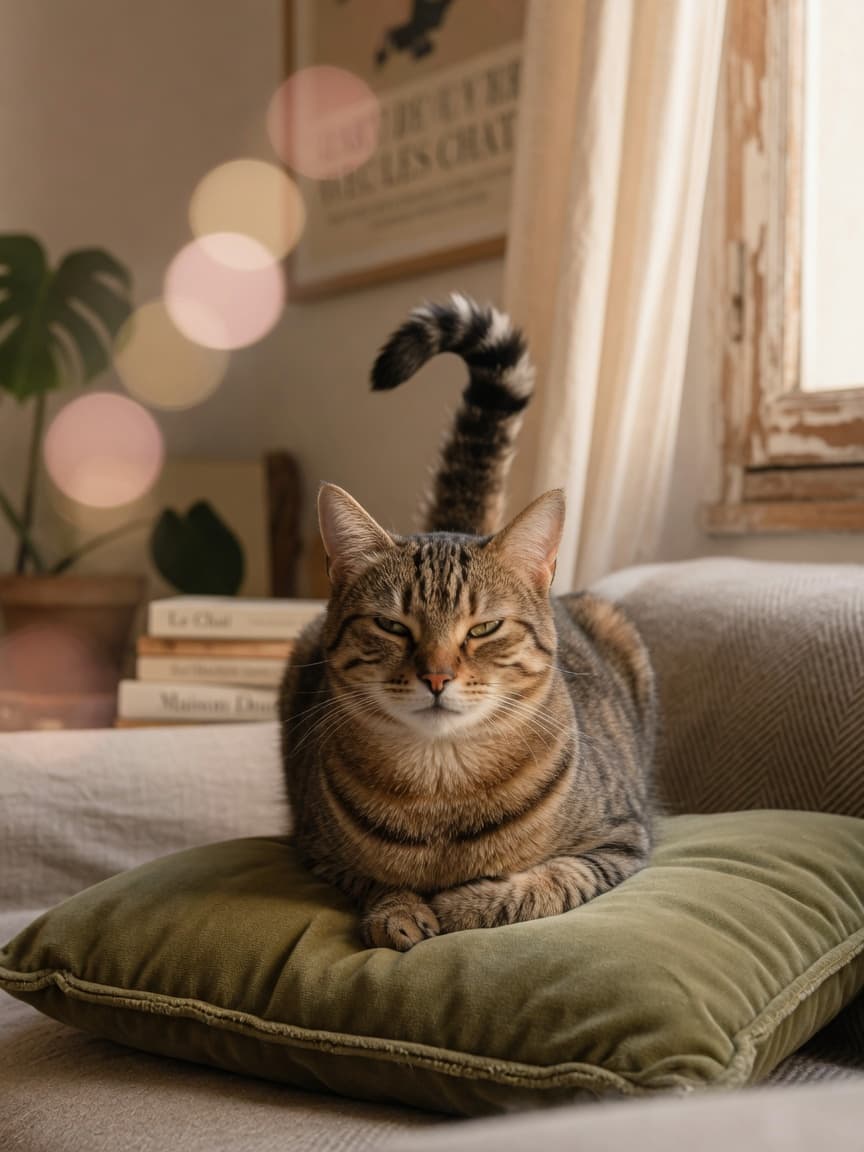
A vertical tail, often with a slight curl at the tip, is a greeting signal — confident, friendly, and content. Cats reserve this posture for individuals they trust and feel safe around. When your cat approaches you with their tail pointing straight up, they are genuinely pleased to see you.
Tail Puffed Up
Piloerection — fur standing on end — makes the tail look dramatically larger. This is a fear or threat response. The cat is attempting to appear bigger than they are. Combined with an arched back, this signals significant distress.
Low Tail or Tucked
A tail held low or tucked close to the body signals anxiety, submission, or illness. If your cat suddenly begins carrying their tail low without an obvious stressor, a veterinary check is warranted.
Lashing or Thrashing
A rapidly flicking or thrashing tail is not playfulness — it is irritation or overstimulation. This is frequently the precursor to a scratch or bite during petting. When the tail starts lashing, stop what you are doing.
Ear Position: Precise Indicators of Mood
Cats have extraordinary muscular control over their ears, and can move each independently. This makes ear position one of the most reliable signals in feline body language.
- Forward-facing, slightly angled out: relaxed and engaged
- Pricked forward, fully erect: alert, curious, tracking something
- Rotated to the side, flat against the skull (aeroplane ears): fear, anxiety, or aggression building
- Fully flattened back: defensive aggression or extreme fear — do not approach
Flattened ears are one of the clearest warning signals a cat can give. A cat with ears pinned flat is communicating that they feel cornered or threatened and may act defensively.
The Slow Blink: Feline Trust in Action
Perhaps the most famous piece of cat body language is the slow blink — a long, deliberate closing and opening of the eyes directed at a trusted individual. It is sometimes called a cat kiss, and research from the University of Sussex confirmed in 2020 that cats are more likely to approach humans who return the slow blink than those who maintain a neutral expression.
To use it yourself: make soft eye contact, then slowly close your eyes and open them again. Many cats will reciprocate. It is a simple but meaningful act of communication that can build trust, particularly with shy or rescue cats.
Conversely, a wide-eyed, unblinking stare from a cat is the opposite of affection — it signals threat or extreme arousal. Never stare directly back.
Body Posture and What It Reveals
The Loaf
A cat sitting with all four paws tucked under their body in a compact shape is comfortable and content, though not quite relaxed enough to lie flat. They feel safe but remain gently alert.
Exposed Belly
An exposed belly in a cat is a sign of trust — they are showing their most vulnerable area. However, unlike dogs, this is not necessarily an invitation to touch. Many cats will immediately grab and bite a hand that reaches for their belly. Read the full context before responding to this posture.
The Halloween Cat
Arched back, piloerection from head to tail, sideways stance — this is a fear and threat display designed to maximise perceived size. Give the cat space and remove the perceived threat if possible.
Vocalisation and Body Language Together
Body language rarely exists in isolation from sound. A chirping cat watching birds through a window, tail flicking, is exhibiting predatory arousal. A cat who growls with flattened ears is escalating a warning. A cat who meows softly while approaching with a raised tail is soliciting interaction.
Interestingly, adult cats rarely meow at other cats — research suggests this vocalisation has evolved largely as communication directed at humans. Your cat has essentially developed a language specifically to talk to you.
Practical Summary
- A high, upright tail is a friendly greeting from a confident, content cat
- Flattened ears and a thrashing tail are warnings — stop and give space immediately
- The slow blink is a trust signal; practise returning it to build your relationship
- An exposed belly signals trust but is not necessarily an invitation to touch
- Piloerection — puffed fur — signals fear or threat, not playfulness
- Read tail, ears, eyes and posture together for an accurate picture
- Persistent changes in body language or unusual postures warrant a consultation with your vet to rule out pain or illness