
Hyperthyroidism in Cats: Medication, Radioiodine & Diet
By Sarah Bennett, Certified Animal Nutritionist
Hyperthyroidism is the most common endocrine (hormonal) disorder in older cats and one of the most frequently diagnosed conditions in feline medicine overall. The encouraging news is that it is also one of the most treatable — four different therapeutic options exist, ranging from daily medication to a single curative injection. Understanding the disease, recognizing its sometimes subtle signs, and knowing the pros and cons of each treatment approach will help you make the best decisions for your older cat.
What Is Hyperthyroidism?
The thyroid gland, located in the neck, produces thyroid hormones (T3 and T4) that regulate metabolism throughout the body. In hyperthyroidism, one or both thyroid lobes develop a functional adenoma (a benign tumor) that produces excess thyroid hormone autonomously — meaning it ignores the normal feedback signals that keep hormone levels in check. Thyroid carcinoma (cancer) causes fewer than 2–3% of cases; the vast majority are benign adenomatous hyperplasia or adenoma.
Hyperthyroidism affects primarily middle-aged to older cats — the average age at diagnosis is around 13 years. It is rare under 8 years of age. The underlying cause is not fully understood, but dietary factors (particularly iodine content), environmental chemicals (flame retardants, BPA in canned food linings), and genetic predisposition are suspected contributors. Siamese and Himalayan breeds appear to have lower risk compared to the general feline population.
Signs and Symptoms
Excess thyroid hormone accelerates virtually every body system, producing a characteristic constellation of signs:
- Weight loss despite increased or ravenous appetite: This paradox is one of the most telling signs. A cat eating voraciously but losing muscle and body condition is a classic hyperthyroid presentation. Owners often initially think their cat is "finally eating well."
- Hyperactivity and restlessness: Affected cats may seem unusually active, agitated, or vocal — sometimes described as reverting to kitten-like behavior. However, some cats, particularly those with concurrent disease, present with lethargy instead (so-called "apathetic hyperthyroidism").
- Vomiting and diarrhea: Increased GI motility leads to frequent regurgitation of food, vomiting, and loose stools.
- Increased thirst and urination: Elevated metabolic rate and direct renal effects cause PU/PD.
- Poor coat condition: Unkempt, matted, or greasy coat is common. Cats may groom excessively or, conversely, neglect grooming.
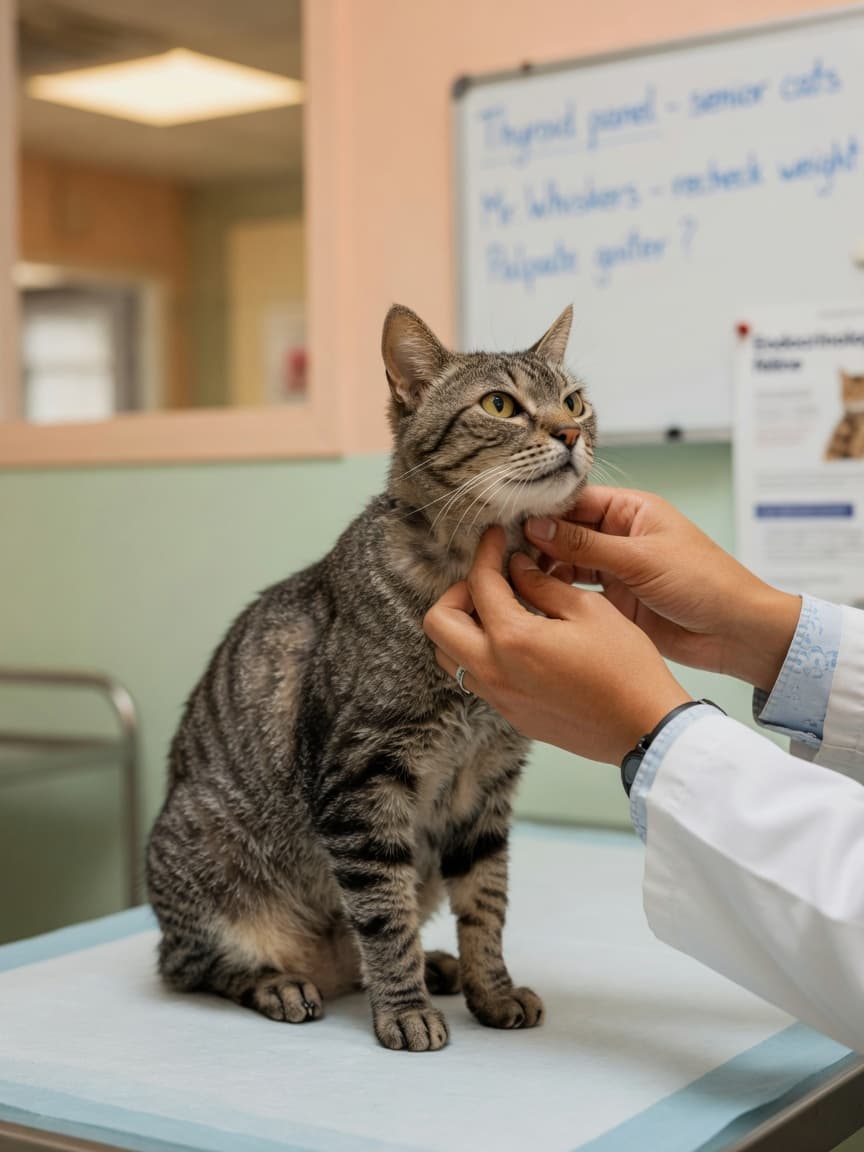
- Palpable thyroid nodule: A skilled clinician can often feel an enlarged thyroid lobe in the neck of affected cats — a useful examination finding.
- Elevated heart rate and hypertension: Thyroid hormone stimulates the heart directly, causing tachycardia, hypertension, and in some cases secondary hypertrophic cardiomyopathy. Cardiac complications can be severe, including congestive heart failure.
- Muscle weakness: Particularly in the hindlimbs; neck ventroflexion (inability to hold the head up) is a dramatic but less common sign related to hypokalemia or thiamine deficiency in severe cases.
Diagnosis
Diagnosis is usually straightforward: a serum total T4 (thyroxine) level is the primary screening test, and the vast majority of hyperthyroid cats have clearly elevated T4. In a small percentage of early or mild cases, T4 may fall within the upper normal range (so-called "occult" hyperthyroidism). In these cases, repeat testing, free T4 by equilibrium dialysis (fT4ED), or a TRH stimulation test may be needed to confirm the diagnosis. Technetium scintigraphy (nuclear imaging) is the most sensitive diagnostic tool and is used to identify ectopic thyroid tissue or assess suitability for radioiodine treatment.
Treatment Option 1: Methimazole (Medical Management)
Methimazole (brand name Felimazole in Europe, Tapazole in the US) is the most commonly used medical treatment. It blocks thyroid hormone synthesis but does not destroy the gland or cure the disease — medication must continue for life to maintain control.
Methimazole is available as oral tablets (given once or twice daily) or as a transdermal gel applied to the inner ear flap (pinna). The transdermal route is convenient for difficult-to-pill cats, but absorption is somewhat less predictable than the oral form, and the ear skin requires rotation to prevent irritation.
Side effects occur in approximately 15–20% of cats and include vomiting, anorexia, lethargy (usually transient in the first few weeks), and, more seriously, facial scratching and excoriations (thought to be an immune-mediated reaction), and blood dyscrasias (bone marrow suppression causing low white cell or platelet counts). Liver toxicity occurs rarely. Regular monitoring — T4 and CBC at 2–3 weeks after starting, then every 3–6 months once stable — is essential.
Treatment Option 2: Radioiodine Therapy (The Gold Standard)
Radioactive iodine (I-131) treatment is widely considered the gold standard for treating feline hyperthyroidism. A single subcutaneous injection of radioactive iodine is taken up selectively by the overactive thyroid tissue (which is metabolically avid for iodine), destroying it with minimal damage to surrounding structures. Normal thyroid tissue, which is largely suppressed by the autonomous nodule, is relatively spared and recovers function over weeks to months.
Cure rates exceed 95% with a single treatment. There are no significant side effects other than a small risk of transient hypothyroidism if too much normal tissue is destroyed — which resolves without intervention in most cats. The procedure is non-invasive (just an injection) and requires only a few days of hospitalization in a licensed radiation facility (for radiation safety reasons, not for the cat's medical needs). The limitations are availability — not all areas have licensed I-131 facilities — and cost, which is higher upfront than medication but often cost-effective over a lifetime of managed medication and monitoring.
Treatment Option 3: Surgical Thyroidectomy
Surgical removal of the affected thyroid lobe(s) is curative and achieves excellent results in experienced hands. The primary complication risk is damage to the adjacent parathyroid glands, which regulate calcium, potentially causing life-threatening hypocalcemia postoperatively. For this reason, surgery is generally reserved for cats that are not candidates for radioiodine and have not responded adequately to or tolerated methimazole. Stabilization on methimazole before surgery is standard practice to reduce anesthetic risk in cats with cardiac complications.
Treatment Option 4: Hill's Prescription Diet y/d
Hill's y/d is a prescription diet with extremely restricted iodine content. Since the thyroid requires iodine to synthesize hormone, feeding y/d as the sole diet reduces thyroid hormone production. It effectively controls hyperthyroidism in many cats without medication.
The significant limitation is that the diet must be fed exclusively — no other food, treats, or flavored medications can be given. In multi-cat households or in cats who refuse the diet, this is impractical. It also does not cure the disease; thyroid hormone levels rise again if the diet is discontinued. Some concerns about long-term nutritional adequacy and iodine restriction in cats with other conditions have also been raised.
The Kidney Disease Overlap: A Critical Nuance
Hyperthyroidism artificially elevates glomerular filtration rate (GFR) — essentially the kidneys work harder under the metabolic drive of excess thyroid hormone. This can mask underlying chronic kidney disease. When thyroid levels are normalized with treatment, GFR drops to baseline and CKD that was previously hidden may become apparent. This is not caused by the treatment but unmasked by it, and it occurs in a meaningful proportion of cats (estimated 30–40%). The practical implication: kidney values must be reassessed 2–4 weeks after starting any hyperthyroid treatment. Some cats with very poor underlying renal reserve require careful management decisions, sometimes accepting a higher target T4 to preserve renal perfusion.
Key Takeaways
- Hyperthyroidism is the most common endocrine disease in older cats; affects primarily cats over 10 years.
- Classic signs: weight loss despite ravenous appetite, hyperactivity, vomiting, elevated heart rate.
- Diagnosis: serum total T4 is the primary test; most cases are straightforward to confirm.
- Radioiodine (I-131) is the gold standard — single treatment, 95%+ cure rate, minimal side effects.
- Methimazole controls but does not cure hyperthyroidism; lifelong treatment and monitoring required.
- Always recheck kidney values 2–4 weeks after starting treatment — CKD may be unmasked.
References
- Peterson ME. "Hyperthyroidism in cats: what's causing this epidemic of thyroid disease and can we prevent it?" Journal of Feline Medicine and Surgery. 2012;14(11):804-818. PMID: 23087043
- Vaske HH, et al. "Diagnosis and management of concurrent diabetes mellitus and hyperthyroidism in a cat." Journal of the American Veterinary Medical Association. 2014;244(11):1275-1279. PMID: 24823965