
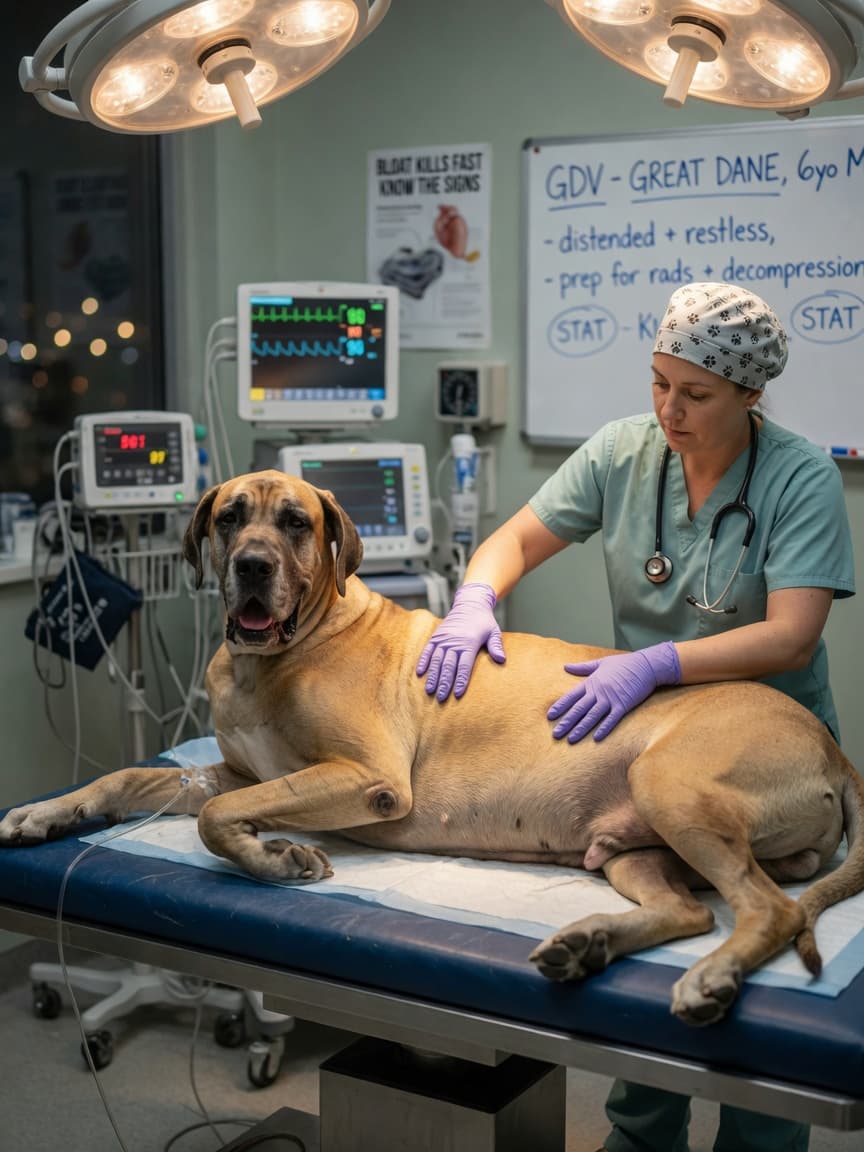
THIS IS A VETERINARY EMERGENCY — ACT IMMEDIATELY
If your dog is retching without bringing anything up, has a visibly swollen abdomen, and appears distressed or restless, do not wait. Do not try home remedies. Do not monitor overnight to see if things improve. Call your nearest emergency veterinary practice right now and go directly there. Gastric dilatation-volvulus — commonly called GDV or bloat — kills dogs within hours if not treated surgically. Time is the most critical factor in survival.
What Is GDV?
GDV occurs when the stomach fills rapidly with gas and then rotates on itself, twisting at both ends. This rotation — called a volvulus — traps the gas inside with no way to escape. As the stomach swells, it compresses major blood vessels, cutting off circulation to the stomach wall and other organs. Gastric tissue begins to die within one to two hours of the volvulus occurring. As the condition progresses, toxins enter the bloodstream, blood pressure drops, and the heart may develop fatal arrhythmias.
Without emergency surgery, GDV is almost always fatal. Even with prompt treatment, survival rates depend significantly on how quickly the dog reaches a surgical team.
Which Dogs Are at Risk?
GDV is most common in large, deep-chested breeds. The deep chest creates a physical environment in which the stomach is able to rotate. Breeds at elevated risk include:
- Great Dane — one of the highest-risk breeds
- German Shepherd
- Standard Poodle
- Weimaraner
- Irish Setter
- Dobermann
- Rottweiler
- Bloodhound
- Basset Hound — a less obvious risk given the build, but deep-chested relative to body size
Within these breeds, risk is further increased in older dogs, dogs with a first-degree relative that has experienced GDV, dogs that eat one large meal per day rather than smaller portions, and dogs that exercise vigorously immediately after eating. Male dogs appear to be at slightly higher risk than females.
Signs of GDV: What to Look For
The signs of GDV can develop very quickly — a dog that appeared healthy an hour ago may be in critical condition. Watch for:
- Unproductive retching — the dog is clearly trying to vomit but nothing or very little comes up
- A visibly swollen, distended abdomen, particularly on the left side behind the ribcage
- Extreme restlessness — unable to settle, pacing, changing position repeatedly
- Excessive drooling or foamy saliva
- Pale or white gums — a sign of poor circulation and shock
- Rapid, shallow breathing
- Weakness, collapse, or inability to stand
You do not need to observe all of these signs before acting. If your dog is retching unproductively and is in any distress, treat it as a GDV emergency until a vet confirms otherwise.
What NOT to Do
In the time between recognising possible GDV and reaching the vet, it is important to avoid actions that worsen the situation:
- Do not give your dog food or water — this increases the volume in an already compromised stomach
- Do not attempt to relieve the gas yourself by any home method — this is ineffective and wastes critical time
- Do not give any medications unless specifically instructed by a vet over the phone
- Do not wait to see if the dog improves on its own — GDV does not resolve without treatment
Call ahead to the veterinary practice as you travel so they can prepare for your arrival. This can save vital minutes once you get there.
Emergency Treatment for GDV
When a dog with GDV arrives at a veterinary practice, the immediate priorities are stabilising the circulation and relieving pressure from the stomach. This typically involves intravenous fluids to treat shock and a procedure to decompress the stomach — either by passing a tube down the oesophagus or by inserting a needle through the abdominal wall to release trapped gas.
Once the dog is stable enough for anaesthesia, emergency surgery is performed. During surgery the veterinary team will:
- Return the stomach to its correct position
- Assess the stomach wall, spleen, and other affected tissues for areas of necrosis (tissue death)
- Remove any tissue that cannot recover
- Perform a gastropexy — surgical attachment of the stomach to the abdominal wall to prevent the rotation from occurring again
The surgery is complex and lengthy. Recovery requires intensive monitoring, often in a veterinary hospital for several days. The prognosis depends heavily on how long the volvulus was present before surgery and whether significant tissue death had already occurred.
Gastropexy: Preventing Recurrence — and Preventing GDV in the First Place
A gastropexy is a surgical procedure in which the stomach is permanently attached to the inner abdominal wall. Once performed, it is extremely unlikely that the stomach can rotate again even if it becomes distended with gas. This surgery is performed as part of emergency GDV treatment, but it can also be carried out prophylactically — that is, before GDV ever occurs — in high-risk dogs.
Prophylactic gastropexy is a well-established option for at-risk breeds and is increasingly available via minimally invasive laparoscopic (keyhole) surgery. Many owners of Great Danes, Standard Poodles, and other high-risk breeds now choose to have this surgery performed when their dog is already undergoing another procedure, such as a spay or neuter, to minimise anaesthetic events.
If you own a large deep-chested breed, discuss prophylactic gastropexy with your veterinary surgeon. The procedure is significantly less complex and costly when performed as an elective surgery rather than in an emergency setting, and it provides a high degree of protection against a condition that is otherwise potentially fatal.
Reducing the Risk
While prophylactic gastropexy is the most reliable preventive measure for high-risk dogs, several management practices are thought to reduce the likelihood of GDV developing:
- Feed two or three smaller meals per day rather than one large daily meal
- Avoid vigorous exercise for at least one hour before and one to two hours after eating
- Do not allow the dog to drink large volumes of water immediately before or after meals
The use of raised food bowls has historically been recommended as a preventive measure, but current evidence does not support this — some studies suggest raised bowls may actually increase risk in certain breeds. Standard-height bowls are the safer choice unless your vet advises otherwise for an individual dog with specific physical difficulties.
Knowing the signs of GDV and acting without delay remains the single most important thing any owner of a high-risk dog can do.