
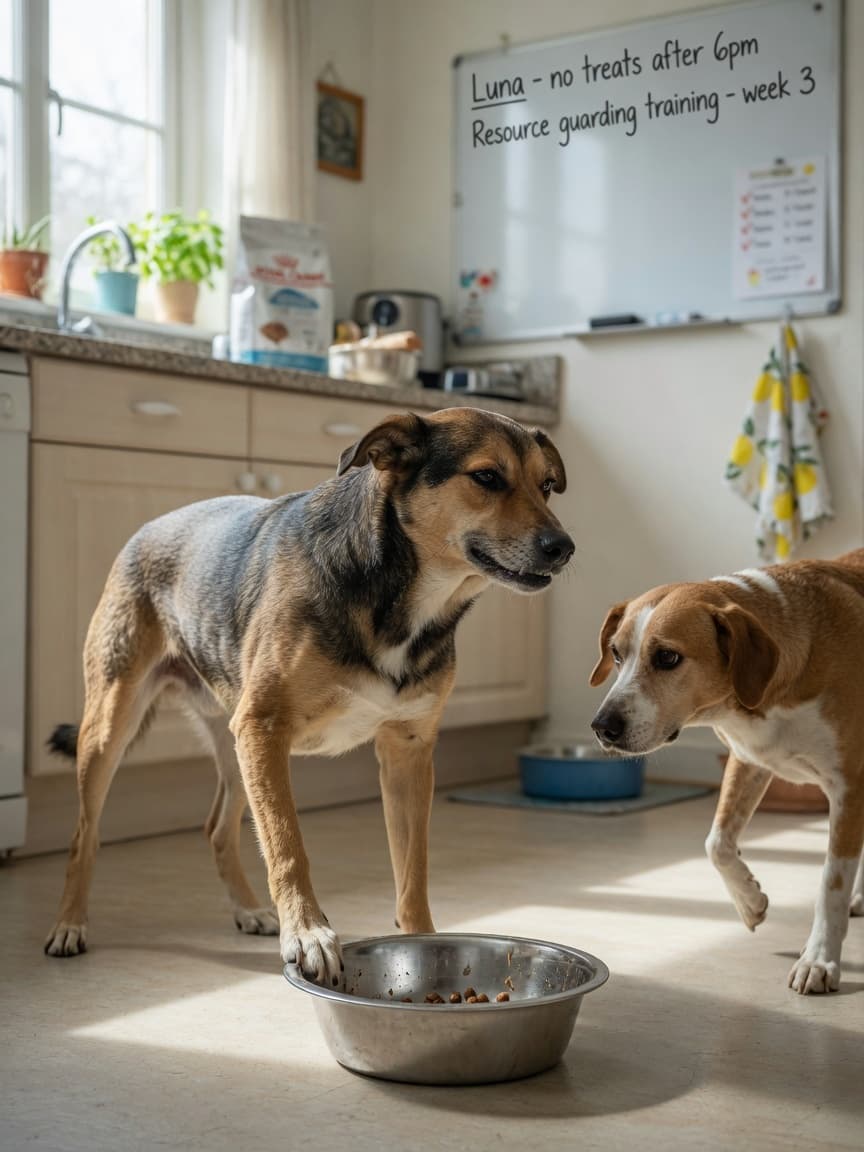
What Is Resource Guarding?
Resource guarding is the behaviour a dog displays when they want to keep something they value — food, a toy, a resting spot, or even a person — away from someone or something they perceive as a threat to that resource. It is a completely normal piece of canine behaviour, rooted in survival instinct. In a natural context, guarding food or a comfortable resting place makes biological sense. The problem arises when it occurs in a domestic setting, where it can escalate to a point that puts people or other animals at risk.
Resource guarding affects dogs of all breeds and backgrounds. It can appear in puppies, rescue dogs, and dogs who have lived happily in a family for years. It is not a sign of dominance, spite, or a "bad" dog — it is communication, and it needs to be responded to as such.
What Dogs Guard
The most commonly guarded resources include food in the bowl or food that has been dropped on the floor, high-value chews and bones, favourite toys, resting spots such as sofas or beds, and sometimes specific people. Dogs may guard from other dogs, from strangers, or from family members they know well. The range of what any individual dog guards, and how intensely, varies considerably.
The Escalation Ladder
Resource guarding typically follows a progression if the early signals are missed or punished. The sequence usually runs: body stiffening and freezing over the item, a hard direct stare, a low growl, a lip curl or snarl, a snap in the air, and finally a bite. Most dogs are giving extensive warning before they reach a bite — the danger comes when those warnings are suppressed rather than respected.
Never Punish Growling
This is perhaps the most important point in this entire guide: do not punish your dog for growling. A growl is communication. It is your dog telling you they are uncomfortable. Punishing a growl does not make the dog less likely to bite — it makes them more likely to bite without warning, because you have removed the signal they were using to express their discomfort. A dog that has been punished for growling skips the warning and goes straight to the snap or bite.
If your dog growls, move away calmly and create space. Take the growl seriously as information about how your dog is feeling, and use that information to inform your training approach rather than to escalate the situation.
Management: Reducing the Risk While You Work
Management means arranging your dog's environment so that guarding incidents are less likely to occur while you work on the underlying behaviour. This is not a permanent solution, but it keeps everyone safe during the training period.
- Feed your dog separately from other pets to eliminate competition at meal times
- Remove high-value items such as bones or chews when children are present
- Avoid putting your hand into your dog's food bowl while they are eating — this is a common trigger that serves no useful purpose
- Use baby gates to give your dog a space to enjoy valuable items without interruption
- Ensure children understand they must never approach a dog who is eating or chewing
Counter-Conditioning: Changing the Emotional Response
Counter-conditioning works by changing how your dog feels about your approach when they have a valued item. The goal is for your dog to associate your approach not with a threat to their resource, but with the arrival of something even better.
Begin at a distance where your dog notices you but does not stiffen or show any tension. At that distance, toss a very high value treat — a piece of chicken or cheese, something significantly better than whatever your dog is guarding — in their direction without approaching any closer. Repeat this until your dog looks up at you when you appear, anticipating the treat rather than stiffening. Very gradually, over many sessions, decrease the distance at which you deliver the treat.
The trade-up technique works similarly. Approach, offer something more valuable in exchange for what your dog has, and once your dog takes the better item, return the original item as well. This teaches your dog that your approach leads to good things and that resources are not permanently lost when you are nearby.
Teaching Drop It and Leave It Proactively
Teaching "drop it" and "leave it" before resource guarding becomes an issue is far easier than trying to implement them in the middle of a guarding incident. Train these behaviours in low-stakes situations using positive reinforcement — exchange a toy for a treat, then give the toy back. Build a strong positive history with these cues so that when you need them in a real situation, they are well established. A clicker is very helpful for capturing the exact moment of release and building the behaviour clearly.
Children and Resource Guarding Safety
Children are at particular risk around resource-guarding dogs because they move unpredictably, may not read body language, and do not understand why they cannot approach a dog who is eating. Supervise all interactions between children and dogs around food, chews, and toys without exception. Teach children from an early age to leave the dog alone when they are eating or have a chew, and to ask an adult before approaching. These rules apply regardless of whether your dog has shown guarding behaviour before.
When to Seek Professional Help
Mild resource guarding, addressed promptly with counter-conditioning and good management, often improves significantly with owner-led training. However, if your dog has already snapped or bitten, if the guarding is escalating, or if there are children in the household, contact a behaviourist accredited by the APBC (Association of Pet Behaviour Counsellors) before beginning any training programme. A qualified professional can assess the severity, identify all triggers, and build a tailored plan that is safe for your specific situation. Do not attempt to physically retrieve a guarded item from a dog who has previously bitten — this is how serious injuries occur.