
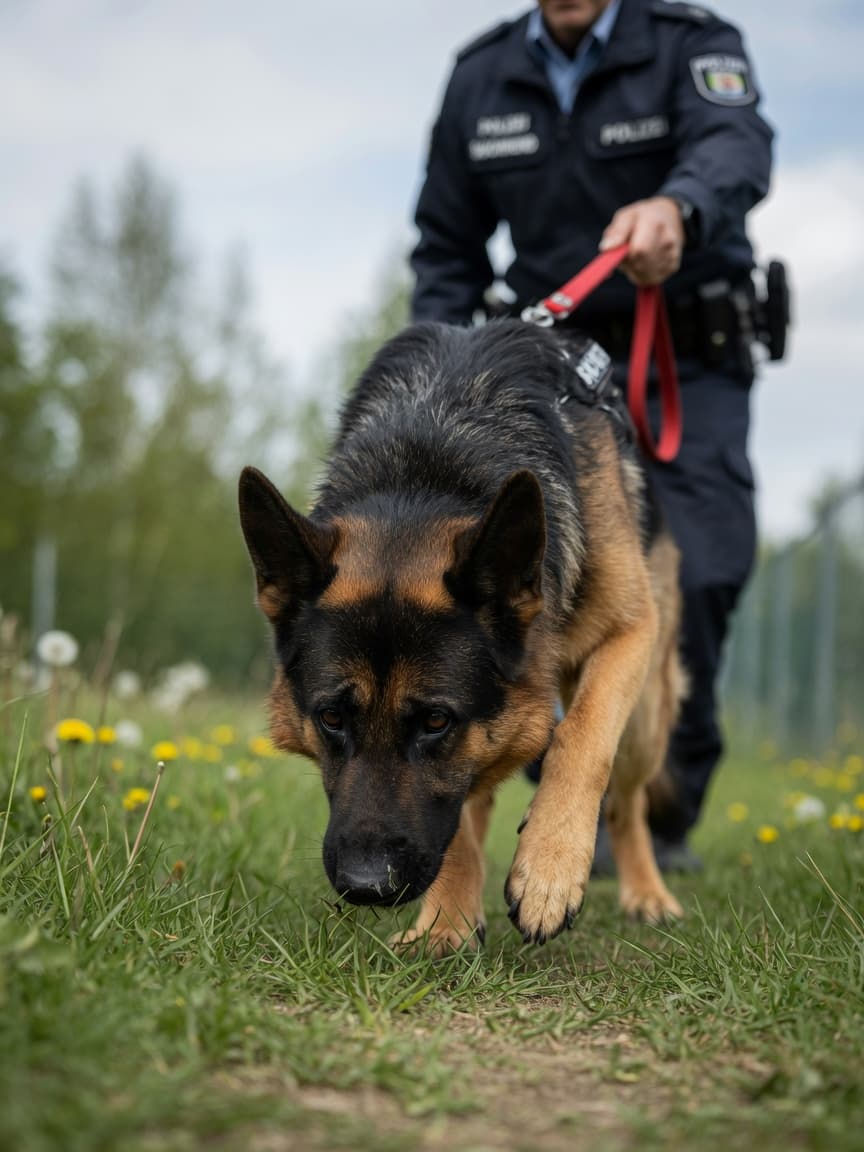
The Science of a Dog's Nose
To understand why dogs are so extraordinarily effective at detecting scent, it helps to start with the anatomy. A human nose contains approximately six million olfactory receptor cells. A dog's nose contains around 300 million. This difference in receptor density alone would give a dog a significant advantage, but the disparity goes further than cell count.
In humans, the olfactory area — the region of the nasal passage dedicated to detecting scent — accounts for roughly five per cent of the nasal cavity. In dogs, it accounts for approximately 12 per cent, and the surface area dedicated to scent analysis is far greater due to the complex folded structure of the tissue. The dog's brain also devotes a proportionally much larger region to processing olfactory information compared to the human brain.
The result is a sensory system estimated to be between 1,000 and 100,000 times more sensitive than a human's, depending on the substance being detected. For most practical purposes, a figure of around 10,000 times more sensitive is used as a working estimate. Dogs can detect odour concentrations measured in parts per trillion — equivalent to identifying a single drop of liquid diluted in an Olympic swimming pool.
Dogs also possess a secondary olfactory organ, the Jacobson's organ or vomeronasal organ, located in the roof of the mouth. This organ detects chemical signals that may not register as conventional scent, adding another layer to the dog's sensory capability.
Narcotics and Explosives Detection
The most familiar application of a dog's olfactory ability is in the detection of illicit drugs and explosive materials. Sniffer dogs are used at airports, seaports, border crossings, and public events across the UK and worldwide. Dogs trained for this purpose are taught to recognise the specific odour profiles of target substances and to indicate their location to their handler — either actively, by scratching or barking, or passively, by sitting or freezing at the source.
The range of drugs that detection dogs can be trained to find includes cannabis, cocaine, heroin, MDMA, and synthetic substances. Explosive detection dogs can identify the component chemicals found in commercial and improvised explosive devices. Different dogs are usually trained for either narcotics or explosives rather than both, as the training and indication behaviours can conflict.
Medical Detection: Cancer, COVID-19 and Beyond
Perhaps the most remarkable application of canine scent detection is in medicine. Research has demonstrated that dogs can be trained to detect a range of serious illnesses by identifying the distinctive volatile organic compounds produced by diseased cells.
Cancer Detection
Multiple studies have shown that dogs can reliably detect several forms of cancer, including bladder cancer, lung cancer, prostate cancer, and colorectal cancer. The research conducted by Medical Detection Dogs, a UK-based charity, has been particularly influential in this area. In one landmark study, dogs were able to detect bladder cancer from urine samples with a sensitivity comparable to or exceeding conventional diagnostic tests.
Lung cancer has been detected from breath samples, and prostate cancer from urine, with accuracy rates in excess of 90 per cent in some trials. The mechanism is thought to relate to specific volatile organic compounds that are released in greater quantities by malignant tissue and which produce a detectable odour even at very low concentrations.
COVID-19 Detection
During the COVID-19 pandemic, research teams in the UK and across Europe trained dogs to detect SARS-CoV-2 infection from sweat samples. Results published from trials at the London School of Hygiene and Tropical Medicine suggested that trained dogs could detect COVID-19 with high sensitivity and specificity, raising the possibility of using dogs as a rapid, non-invasive screening tool in high-throughput settings such as airports and venues.
Epilepsy and Seizure Alert
Some dogs appear to be able to detect an impending epileptic seizure before it occurs, possibly by identifying subtle changes in the scent produced by the person as neurological activity changes in the lead-up to a seizure. Medical Detection Dogs and other organisations train dogs specifically for this role, providing their owners with advance warning that allows them to move to a safe position or take preventative medication. The lead time can be as much as 20 to 45 minutes before a seizure, which is significant for the person's safety and independence.
Hypoglycaemia Detection
Dogs trained to detect hypoglycaemia — dangerously low blood sugar — in people with Type 1 diabetes can alert their owner before the person becomes aware of the drop themselves. This is thought to work through the detection of isoprene and other volatile compounds whose concentration in breath changes during hypoglycaemic episodes. For people who experience hypoglycaemia unawareness, a condition where the normal warning symptoms do not occur, a trained medical alert dog can be life-saving.
Bedbug and Environmental Detection
Beyond medicine and security, dogs are trained to detect bedbugs — an increasingly significant problem in hotels, care homes, and residential properties. Bedbug detection dogs can locate live insects and viable eggs within walls, furniture, and bedding with high accuracy, enabling targeted treatment rather than blanket pesticide application. Dogs are also used in conservation contexts to detect invasive species, illegal wildlife products, and even the scat of endangered animals for ecological research.
Training Methodology
Sniffer dogs are trained using a method based on classical and operant conditioning. The process begins by pairing the target odour with a reward — typically a toy or food — so that the dog learns to associate the scent with something highly desirable. Over time, the dog is trained to search for the odour across increasingly complex environments and to indicate its location in a consistent way.
Medical Detection Dogs UK trains dogs using a rigorous laboratory protocol, presenting samples from both positive cases and control subjects and only rewarding correct identifications. Training is ongoing throughout the dog's working life, and regular testing ensures that detection accuracy is maintained. The dogs used tend to be high-drive breeds such as Springer Spaniels, Labradors, and Cocker Spaniels, though the specific breed matters less than the individual dog's temperament and motivation to work.