
Why Early Socialisation with Children Matters
A puppy's socialisation window — the period during which new experiences are most readily accepted and normalised — closes significantly around twelve to sixteen weeks of age. Experiences within this window shape a dog's emotional responses for life. A puppy who has positive, carefully managed experiences with children during this period is far more likely to be comfortable around them as an adult dog. A puppy who has never encountered children, or who has had frightening experiences with them, may develop fear or reactivity that is genuinely difficult to address later.
This does not mean throwing your puppy into a room full of small children and hoping for the best. It means creating enough structured, positive experiences with children of different ages, sizes, and noise levels that your puppy learns children are safe, predictable, and associated with good things.
Understanding What Children Are Like From a Puppy's Perspective
Children are, from a canine perspective, quite strange. They move unpredictably. They make loud, high-pitched sounds. They crouch down to eye level, which can be threatening to some dogs. They run away — triggering chase instincts — and they run towards, which can be overwhelming. They reach over the top of a dog's head rather than under the chin. They hug, which most dogs find deeply uncomfortable. They sometimes fall on dogs, trip over them, or grab parts of their body without warning.
None of this is the child's fault. It is simply how children move through the world. Understanding this perspective helps adults design interactions that work for both parties, rather than hoping the puppy will simply tolerate whatever happens.
Setting Up the First Interactions
The first time your puppy meets a child, choose your circumstances carefully. A calm child who has been briefly coached on how to behave is far more useful than an enthusiastic one who cannot yet regulate their own excitement. A tired puppy or a puppy who has just eaten is not a good candidate. Find a moment when your puppy is alert, has recently toileted, and is in a relaxed but not sleepy state.
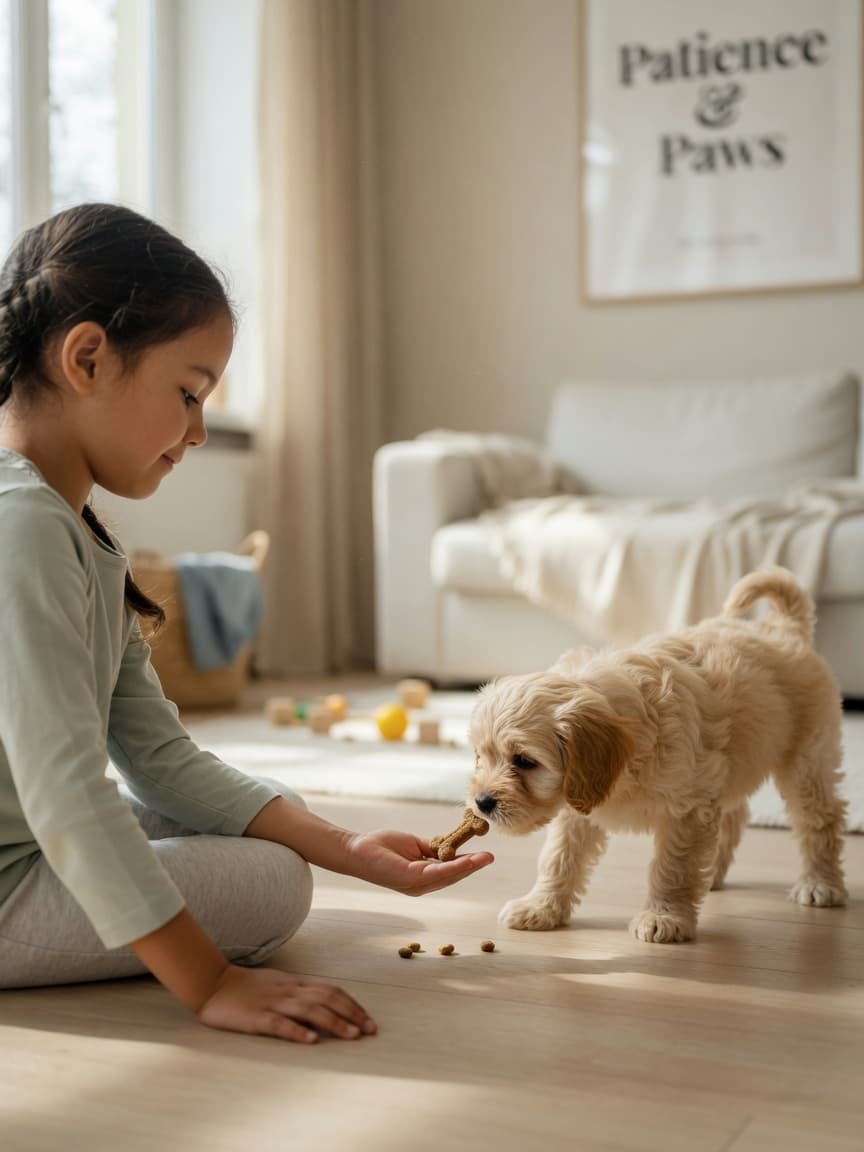
Ask the child to sit on the floor rather than standing over the puppy. Let the puppy approach the child, not the other way around. Have the child hold a treat in a flat palm at floor level. Do not force the puppy towards the child if they show any reluctance — allow them to sniff from a distance and decide when they are comfortable coming closer. A puppy who approaches voluntarily and takes a treat from a child is building a positive association. A puppy who is pushed towards a child and accepts a treat while showing mild stress is having a neutral-to-negative experience regardless of the treat.
Teaching Children How to Interact Safely
Children need explicit instruction, not just the assumption that they will instinctively know how to behave around a dog. The following points should be taught clearly and consistently:
- Always ask an adult before touching a dog you do not know
- Approach dogs from the side, not from directly in front or from behind
- Stroke the dog on the chest or side, not over the top of the head
- Do not hug dogs or put your face close to theirs
- Do not take food, toys, or chews from a dog
- Walk, do not run, around dogs
- Leave dogs alone when they are eating, sleeping, or in their crate
- If a dog walks away or moves behind an adult, let them go — this is the dog saying they need space
For younger children under about six years old, all interactions with puppies should be directly supervised by an adult who is paying attention, not simply present in the room. The speed of a puppy bite and a child's instinctive reaction to pain — screaming, pulling away — can escalate a minor incident into something more serious within seconds.
Recognising Stress Signals in Your Puppy
Puppies do not bite without warning. They communicate discomfort through a cascade of signals that precede any snap or bite. Learning to recognise these signals — and acting on them before the puppy has to escalate — is one of the most important skills a puppy owner can develop:
- Lip licking or yawning when not tired or hungry
- Turning the head or body away from a person
- Blinking rapidly or showing the whites of the eyes
- A low body posture, tucked tail, or flattened ears
- Moving behind an adult or trying to leave the space
- Freezing — a sudden stillness that often precedes escalation
When you see any of these signals during an interaction between your puppy and a child, calmly end the interaction. Do not punish the puppy for communicating. Take them to a quiet space and let them settle. A puppy who has their early stress signals consistently ignored learns that subtle communication does not work — and may move more quickly to biting in future interactions as a result.
Creating Safe Spaces for Your Puppy
Your puppy must always have access to a space where children are not permitted to follow. This is not optional. A crate, a bed behind a baby gate, a corner of a room — the specific location matters less than the rule being absolute. When the puppy is in their safe space, children do not enter it, touch them through it, or call to them. This space is where the puppy can fully decompress.
Teaching children from the very first day that the puppy's space is inviolable gives your dog an enormous amount of psychological security. A dog who knows they can always escape does not need to use aggression to create distance. That alone reduces bite risk substantially.
Building a Lasting Relationship
The goal of early socialisation is not just tolerance — it is genuine comfort. A puppy who grows up with children who respect boundaries, offer treats, engage in appropriate play, and allow the puppy to disengage at will is likely to become a dog who actively seeks out children's company. That relationship — a dog and a child who genuinely trust each other — is one of the most rewarding things in family life with a dog. It is built on small, consistent, respectful interactions from the very beginning.