
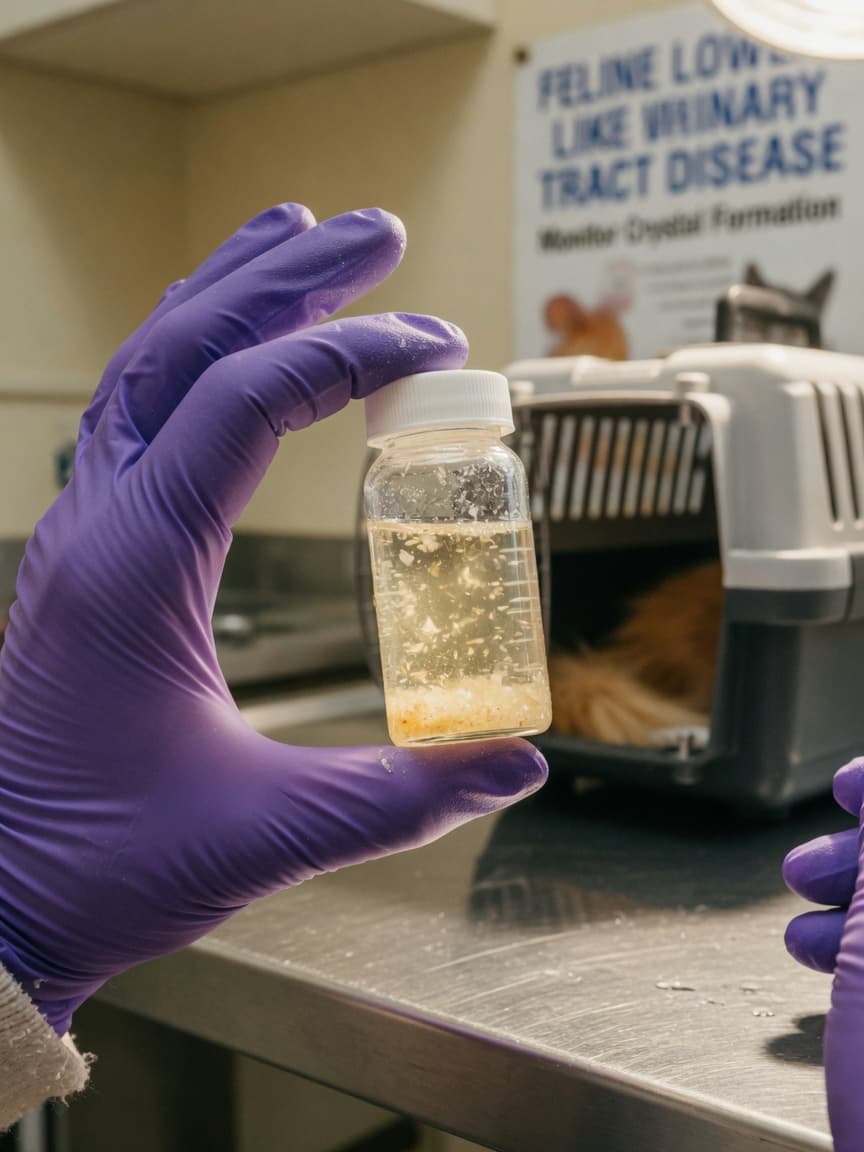
What Are Urinary Crystals in Cats?
Urinary crystals form when minerals in your cat's urine become concentrated and begin to clump together. While small amounts of certain crystals can be found in healthy cats, a significant accumulation can irritate the bladder lining, block the urethra, or develop into stones — a condition known as urolithiasis. Two types are responsible for the vast majority of feline cases: struvite and calcium oxalate. Each behaves very differently, and this distinction has a major impact on how your vet will treat your cat.
Struvite Crystals: The Dissolvable Type
Struvite is a mineral compound made up of magnesium, ammonium, and phosphate. It tends to form when urine is alkaline — that is, when the pH is higher than normal. Struvite crystals are the most commonly diagnosed type in cats, and their management has an important advantage over other crystal types: they can often be dissolved using a prescription urinary diet.
Your vet may recommend a specific therapeutic food formulated to acidify the urine and reduce the minerals that feed struvite formation. With strict dietary compliance and increased water intake, many cats see a significant reduction in crystals within weeks. Regular urinalysis is used to monitor progress. If struvite crystals have already formed into stones large enough to cause obstruction, surgery may still be required — but in many cases, medical management alone is sufficient.
Calcium Oxalate Crystals: A Different Challenge
Calcium oxalate crystals form in acidic urine and are more commonly seen in older, male, and neutered cats. Unlike struvite, calcium oxalate crystals and stones cannot be dissolved through diet alone. Once they progress to the point of causing a blockage or significant clinical signs, surgical removal or a procedure called voiding urohydropropulsion (flushing stones out under sedation) becomes necessary. This is one reason why early detection and prevention matter so much with this crystal type.
Prevention focuses on keeping urine dilute and maintaining a slightly alkaline pH — the opposite approach to struvite management. Because the two crystal types require opposite dietary interventions, it is critical that your vet confirms which type is present before recommending a food. Using the wrong prescription diet can actually worsen the problem.
The Role of Urine pH
Urine pH is one of the most important factors in crystal formation. Struvite thrives in alkaline urine (pH above 7), while calcium oxalate forms more readily in acidic urine (pH below 6.5). A simple urinalysis, which your vet can perform in-clinic, will measure pH along with checking for blood, protein, bacteria, and crystals under a microscope. This is typically the first step in investigating any suspected urinary problem.
FLUTD: The Umbrella Term
You may hear your vet use the term FLUTD — feline lower urinary tract disease. This is not a single diagnosis but rather a collection of signs that affect the bladder and urethra, including straining to urinate, blood in the urine, frequent trips to the litter tray with little output, and crying out in pain. Crystals are one possible cause of FLUTD, but others include bacterial infection, urinary stones, anatomical abnormalities, and — very commonly — feline idiopathic cystitis (FIC).
Feline Idiopathic Cystitis and the Stress Link
FIC accounts for a large proportion of FLUTD cases, particularly in cats under ten years of age. The word idiopathic means the cause is unknown, but stress is widely believed to play a significant role. Changes in routine, new pets, moving house, or even a change in litter brand can trigger an episode. The bladder wall becomes inflamed without any infection or crystals being present. FIC typically resolves within a week to ten days, but environmental enrichment and stress reduction are important parts of long-term management.
How Are Urinary Crystals Diagnosed?
Diagnosis begins with a full urinalysis, ideally from a sample collected by cystocentesis — a sterile needle passed directly into the bladder — to avoid contamination. The sample is examined for pH, specific gravity, red and white blood cells, bacteria, and crystal type. X-rays can detect radio-opaque stones such as calcium oxalate, while ultrasound is better for identifying soft-tissue changes and smaller accumulations. Your vet may use both imaging methods together to get a complete picture.
Prescription Urinary Diets
Therapeutic diets are a cornerstone of urinary crystal management. These foods are carefully formulated to adjust urine pH, reduce mineral concentrations, and promote dilute urine. It is important to understand that these diets are not the same as over-the-counter urinary health foods found in pet shops. They are prescription-only for a reason: feeding the wrong formulation, or switching between them without veterinary guidance, can do more harm than good. Most vets recommend feeding prescription urinary food exclusively, with no additional treats or supplements unless specifically approved.
Why Water Intake Matters
Dilute urine is one of the best defences against crystal formation of any type. The more dilute the urine, the less concentrated the minerals and the harder it is for crystals to form. Wet food — whether pate, chunks, or broth-based — contributes significantly more moisture than dry kibble. Many cats with recurrent urinary issues benefit greatly from switching to a wet diet or adding water to their meals. Fresh water should always be available, and water fountains can encourage reluctant drinkers.
When to See a Vet
- Your cat is straining to urinate and producing little or no urine — this is an emergency, particularly in male cats
- There is visible blood in the urine
- Your cat is crying out, hiding, or showing signs of pain
- Symptoms have persisted for more than 24 hours
- Your cat has stopped eating or is lethargic alongside urinary signs
A complete urinary blockage is a life-threatening emergency. Male cats are at far greater risk due to their longer, narrower urethra. If your male cat has been in and out of the litter tray repeatedly without passing urine, seek emergency veterinary care immediately.
Long-Term Management
Once the crystal type is identified and treated, long-term management is about consistency. Stick to the recommended diet, encourage water intake, schedule regular urinalysis checks every three to six months, and work to reduce environmental stress where possible. Many cats with a history of urinary crystals live full and comfortable lives with the right ongoing care.