
What Is Hypertrophic Cardiomyopathy in Cats?
Hypertrophic cardiomyopathy, known as HCM, is the most common form of heart disease in cats. Unlike the situation in dogs — where the heart muscle weakens and enlarges — in HCM the walls of the heart's left ventricle become abnormally thickened. This thickening reduces the amount of blood the ventricle can hold and makes it stiff, so the heart cannot fill or function as efficiently as it should. Over time, this leads to a range of serious complications, including heart failure and life-threatening blood clots.
HCM can affect cats of any age and breed, though certain breeds carry a significantly higher genetic risk. It is estimated that HCM affects around 15 per cent of the general cat population, making it an important condition for all cat owners to understand.
Breeds at Highest Genetic Risk
Maine Coons and Ragdolls are the two breeds most strongly associated with a hereditary form of HCM. In both breeds, a mutation in a gene called MYBPC3 has been identified. This gene encodes a protein that plays a structural role in the heart muscle, and when the mutation is present, the muscle thickens abnormally.
Genetic tests are available for both breeds, allowing breeders and owners to find out whether their cat carries one or two copies of the mutation. Cats with two copies of the mutation (homozygous) tend to develop more severe disease earlier in life. However, it is critical to understand that a negative genetic test does not guarantee a cat will never develop HCM — other mutations and non-genetic factors can also cause the condition. Genetic screening should therefore always be used alongside regular cardiac monitoring, not as a replacement for it.
Other breeds with elevated rates of HCM include British Shorthairs, Sphynx cats, and Persian cats, though the specific mutations in these breeds have not all been fully characterised.
Why HCM Is So Difficult to Detect Early
One of the most challenging aspects of HCM is that it is often completely silent in its early stages. Cats are experts at hiding illness, and a cat with significant cardiac disease may appear entirely normal to their owner. To make matters more difficult, not all cats with HCM develop the characteristic heart murmur that a vet might hear through a stethoscope. A study published in veterinary cardiology literature found that a meaningful proportion of cats with echocardiographically confirmed HCM had no audible murmur at all.
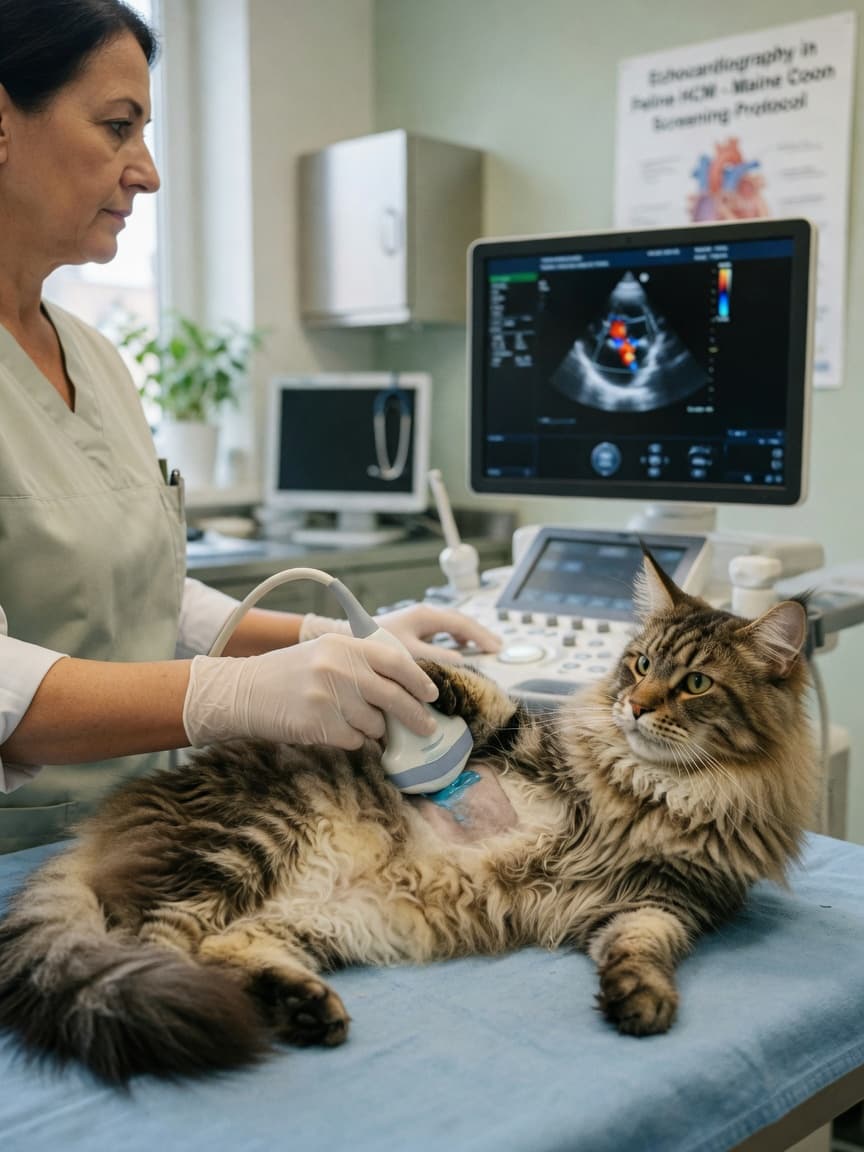
This means that listening to the heart alone is not sufficient to rule out HCM. The only reliable way to diagnose and assess the severity of HCM is through echocardiography — a cardiac ultrasound performed by a veterinary cardiologist or a vet with specialist training. This imaging allows the actual thickness of the heart wall to be measured and the function of the heart to be assessed.
Symptoms of HCM
Many cats with early HCM show no symptoms at all. As the disease progresses, signs may include:
- Increased breathing rate or effort, especially at rest
- Open-mouth breathing, which in cats is always a sign of serious respiratory distress
- Lethargy and reduced activity levels
- Reduced appetite
- Sudden hindlimb weakness or paralysis (discussed in more detail below)
- Collapse or sudden death
A cat breathing rapidly while resting — more than 30 to 40 breaths per minute — warrants an urgent veterinary assessment. Open-mouth breathing in a cat is always an emergency and requires immediate veterinary attention.
Aortic Thromboembolism: The Saddle Thrombus
One of the most devastating complications of HCM is aortic thromboembolism, often called a saddle thrombus. When the heart is not functioning normally, blood can pool within the chambers and form clots. These clots can travel through the bloodstream and become lodged at the point where the aorta divides — the saddle point — cutting off blood supply to the hindlimbs.
A cat experiencing a saddle thrombus will typically show sudden, dramatic hindlimb paralysis or extreme weakness, often crying out in pain. The affected limbs will feel cold to the touch and the paw pads may turn pale or bluish. This is a veterinary emergency and requires immediate treatment.
Treatment for a saddle thrombus focuses on pain relief, supportive care, and restoring circulation. In some cats, limb function returns over days to weeks, though recovery is variable. Sadly, the prognosis for cats with a saddle thrombus is guarded — many cats either do not survive the initial episode or experience a recurrence. To reduce the risk of clot formation, cats with HCM that are considered at higher risk of thromboembolism are often prescribed clopidogrel, an antiplatelet medication that makes the blood less likely to form dangerous clots.
Treatment for HCM
There is currently no treatment that reverses the thickening of the heart muscle in HCM. Management focuses on controlling symptoms, slowing progression where possible, and preventing complications. Treatment choices depend on the severity of the disease and whether complications such as fluid accumulation or arrhythmias are present.
- Atenolol: A beta-blocker that slows the heart rate and can help reduce the degree of obstruction in some forms of HCM. It may also reduce the risk of certain arrhythmias.
- Clopidogrel: An antiplatelet drug given to reduce the risk of blood clot formation. It is widely recommended for cats at elevated risk of thromboembolism.
- Diuretics (typically furosemide): Used when fluid accumulates around or within the lungs. Fluid may need to be physically drained from the chest cavity — a procedure called thoracocentesis — in urgent situations.
- ACE inhibitors: Sometimes used in combination with other medications, though evidence for their benefit in cats is more limited than in dogs.
Screening Recommendations for At-Risk Breeds
For Maine Coons, Ragdolls, and other predisposed breeds, annual echocardiographic screening is strongly recommended even in the absence of any symptoms. Catching HCM early allows treatment to begin promptly and gives the best chance of managing the condition effectively. Most veterinary cardiologists suggest that screening begins from around one to two years of age in predisposed breeds and continues annually throughout life. Breeding cats should always be screened before being used for reproduction.
If you own a Maine Coon or Ragdoll, speak with your vet about arranging cardiac screening. Many veterinary practices can refer you directly to a cardiologist, and specialist heart clinics are increasingly available at competitive prices.