
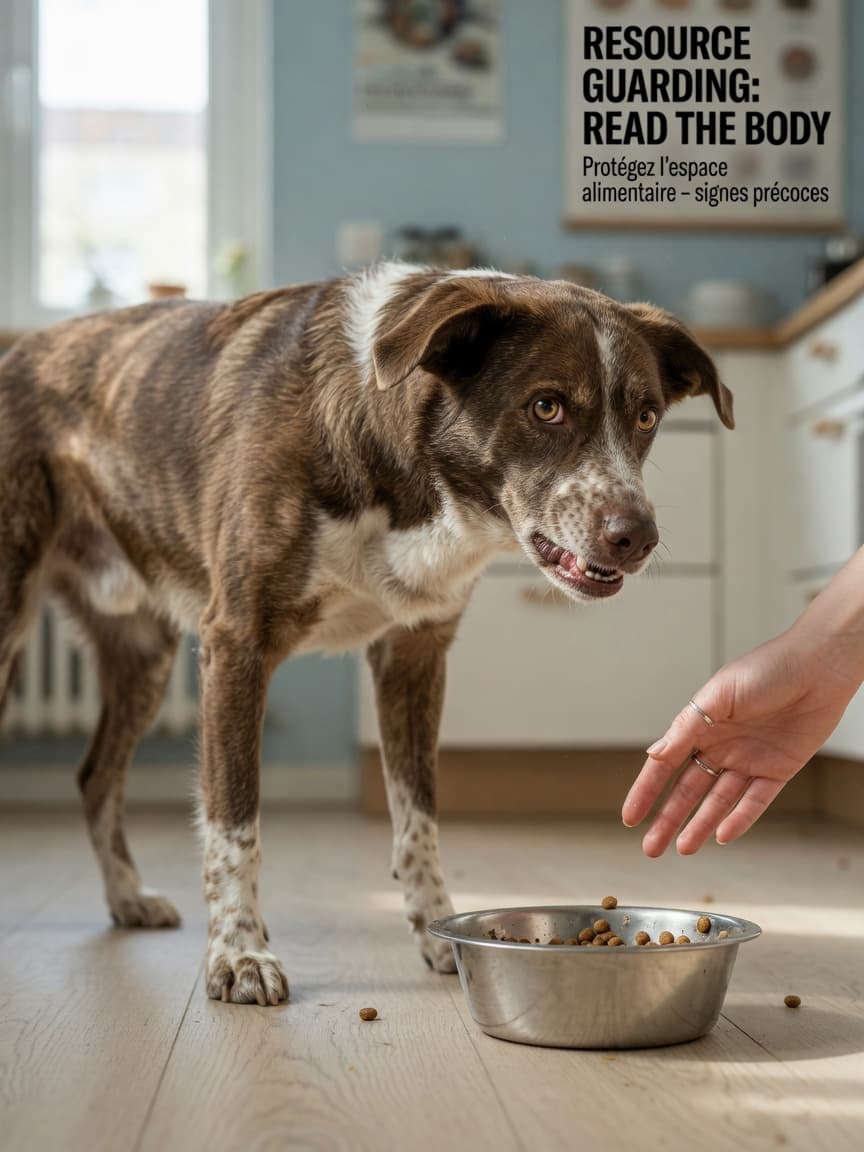
Your Dog Growls Over Its Bowl — Now What
Resource guarding is one of the most frequently mishandled behaviour problems in companion dogs. It is also, in its milder forms, one of the most normal. Dogs are descendants of animals in whom defending access to food, space, and mates had direct survival value. The behaviour becomes a problem when it escalates to biting, occurs in unpredictable contexts, or poses a danger to children and other pets sharing the household.
What Resource Guarding Actually Is
Resource guarding refers to behaviour that an animal uses to retain access to a valued item when a perceived competitor approaches. In dogs, this encompasses a spectrum of signals from subtle body stiffening and a hard stare, through growling, snarling, and snapping, to an uninhibited bite. The items guarded extend well beyond food bowls.
Commonly Guarded Resources
- Food — including the bowl, food dropped on the floor, and food in other people's hands
- High-value chews, bones, and toys
- Resting locations — sofas, beds, or specific spots
- The owner themselves — guarding a person from other pets or family members
- Stolen items — dogs that guard tissues, socks, or other pilfered objects
- Space — doorways, thresholds, and car boots
The breadth of guarding across contexts, the identity of individuals who trigger it (some dogs guard only from other dogs, others from children, others from everyone), and the severity of the response all influence how the behaviour is assessed and managed.
Prevention: Building a Safe Foundation From Puppyhood
The most effective intervention is prevention. Puppies exposed to careful, positive handling around resources during their developmental period are significantly less likely to develop problematic guarding behaviour as adults.
What Effective Prevention Looks Like
- Regularly approach a puppy while it is eating and drop an extra high-value piece of food into the bowl — this teaches that human approach predicts good things rather than loss
- Practise swapping — offer a high-value treat in exchange for whatever the puppy has, then return the item. "Drop it" should always be followed by "get it back" in early training, or you teach the dog that giving up an item means losing it permanently
- Occasionally pick up the food bowl mid-meal, add something better, and return it
- Handle the puppy around resting spots and high-value items, pairing the approach with rewards
Critically, prevention does not mean routinely taking things from the dog. The goal is to create a dog that has no reason to guard because human approach reliably predicts additional good things.
Management Strategies for Existing Guarding
When guarding behaviour is already established, management reduces risk while modification work is under way.
Environmental Management
- Feed dogs separately if multi-dog guarding is occurring, in different rooms with doors closed
- Pick up food bowls once the dog has finished eating rather than leaving them available as a fixed resource to guard
- Limit access to high-value chews and bones when young children or other pets are present
- Gate off the dog's preferred resting spots if space guarding is problematic, and provide an alternative comfortable space the dog can access freely
- Teach children that the dog's space, food bowl, and chews are out of bounds — this is not optional and is particularly important given that children are the demographic most frequently bitten in the home
What Not to Do
Punishing a dog for growling over a resource is among the most counterproductive responses possible. The growl is a communication signal — a warning that the dog is uncomfortable. Suppressing it through punishment does not resolve the underlying motivation to guard; it removes the warning, producing a dog that bites without escalating signals. Flooding approaches — repeatedly approaching a guarding dog to force it to accept intrusion — are similarly inadvisable and increase the risk of bites significantly.
Behaviour Modification: Changing the Emotional Response
The objective of modification is to change how the dog feels about approach to its resources — from threat to predictor of good things. This is achieved through systematic counter-conditioning.
The Approach-Reward Protocol
Working at a distance that produces no guarding response (the dog continues eating or chewing without stiffening), approach, toss a high-value treat near the dog, and retreat. Over many repetitions, the dog begins to look up in anticipation of the treat when it sees you approach rather than stiffening. Only once this response is consistent should the approach distance be gradually decreased.
This protocol requires patience, consistency across all household members, and careful attention to the dog's body language throughout. A session that triggers growling has moved too fast — step back and slow down.
Teaching Reliable Cue Responses
A well-trained "leave it" and "drop it" cue, both built through reward-based methods and practised extensively with low-value items before being applied near guarded resources, provides important management tools. These cues must be genuinely trained, not simply commanded under pressure.
When to Seek Professional Help
Guarding that has escalated to biting, that occurs in multiple contexts, that is directed at children, or that has appeared suddenly in an adult dog with no prior history should be assessed by a veterinary behaviourist or certified clinical animal behaviourist. Sudden onset guarding in an adult dog — particularly if accompanied by other behavioural changes — warrants a veterinary examination to rule out pain or systemic illness as a contributing factor.
Multi-dog households where guarding is causing significant conflict between animals, or cases where an owner does not feel safe implementing a modification programme, also require professional guidance. This is not a failure — resource guarding with bite history is a safety matter and deserves specialist-level expertise.
Summary and Action Steps
- Understand that resource guarding is normal canine behaviour — your response to it determines whether it escalates or diminishes
- Never punish growling around resources: address the underlying motivation instead
- Use environmental management to keep all household members safe while modification work is ongoing
- Begin counter-conditioning below threshold — at a distance where no guarding occurs — and progress slowly
- Teach all children that a dog's food, chews, and resting spots are off limits without exception
- See a vet if guarding has appeared suddenly in an adult dog, or if biting has occurred
- Seek a certified behaviourist for multi-context guarding, bite history, or guarding directed at children