
Hamsters in Europe: Choosing the Right Species
Several hamster species are kept as pets across Europe, each with distinct temperaments, care requirements, and health vulnerabilities. Understanding which species you have — or are considering — is the first step to providing appropriate care.
The Syrian hamster (Mesocricetus auratus), also known as the golden hamster, is the largest commonly kept species and is strictly solitary. Syrian hamsters must be housed alone from approximately six to eight weeks of age; housing two together will almost certainly result in serious injury or death from fighting. They are generally more tolerant of handling than dwarf varieties and are often recommended for first-time owners.
Dwarf hamster species available in Europe include the Roborovski hamster (Phodopus roborovskii) — the smallest and fastest — and Campbell's dwarf hamster (Phodopus campbelli). Russian white winter hamsters (Phodopus sungorus) are also popular. Some dwarf species can be kept in pairs or small groups if introduced correctly and from a young age, though fighting remains a risk that owners must monitor closely. Roborovskis in particular are extremely quick and not ideally suited to frequent handling.
Housing: The 2,500 cm² Standard
One of the most significant advances in hamster welfare policy in Europe has come from Germany, whose minimum cage guideline of 2,500 cm² of unobstructed floor space has set a benchmark increasingly recognised across the EU. This means the cage floor must measure at least 50 cm by 50 cm — considerably larger than the small plastic cages still commonly sold in pet shops across Europe.
The reasoning behind this guideline is grounded in hamster biology. In the wild, hamsters travel several kilometres per night in search of food. A small, cramped enclosure causes chronic stress — a condition directly linked to stereotypic behaviours such as repetitive bar chewing and pacing, and to compromised immune function and shortened lifespan.
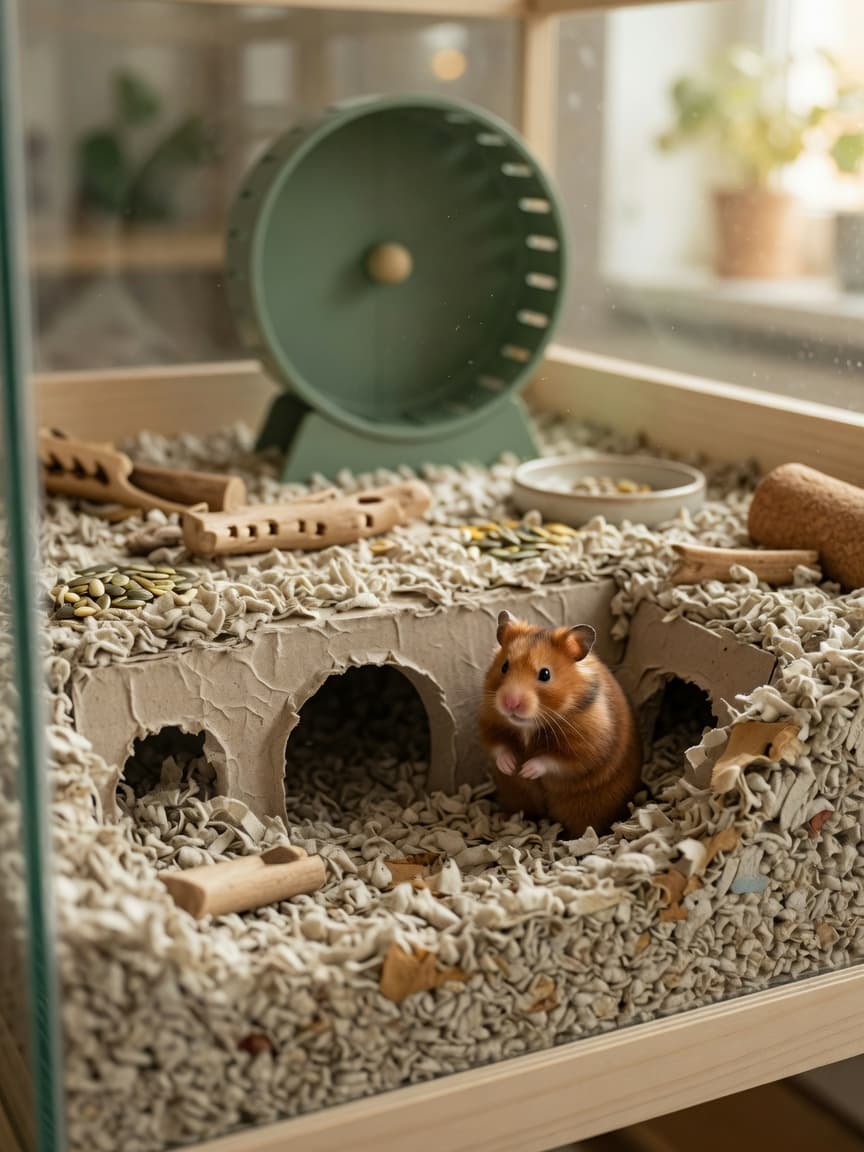
In addition to floor space, hamsters require a deep substrate layer for burrowing — a minimum of 30 to 40 centimetres is recommended, though more is better. Hamsters are instinctive burrowers, and denying them the opportunity to dig and construct tunnel systems is a significant welfare concern. Good substrate options include paper-based bedding or kiln-dried dust-extracted wood shavings. Avoid cedar or pine shavings, which release aromatic compounds harmful to the respiratory system.
A wheel is essential and must be the correct size — 25 to 28 centimetres in diameter for Syrian hamsters, 18 to 20 centimetres for dwarf species. A wheel that is too small causes the hamster to run with an arched back, which can lead to spinal injury over time. Solid-surface wheels are preferable to barred ones to prevent foot injuries.
Zooplus offers a good range of appropriately sized hamster cages, deep bedding substrates, and large solid wheels, and ships across Europe. Always verify cage dimensions before purchasing, as many products marketed for hamsters fall below the recommended minimums.
Diabetes Susceptibility in Dwarf Hamsters
Campbell's dwarf hamsters in particular have a known genetic susceptibility to diabetes mellitus. The condition is believed to be hereditary and has become more prevalent in captive Campbell's lines through decades of selective breeding without adequate health screening. Russian white winter hamsters can also develop diabetes, though less commonly.
Signs of diabetes in dwarf hamsters include excessive thirst and urination, weight loss despite a good appetite, lethargy, and a distinctive sweet or fruity smell to the urine. If you notice these signs, a vet can confirm the diagnosis with a urine or blood glucose test.
Management involves dietary adjustment — removing sugary treats, fruits, and high-carbohydrate foods entirely, and feeding a hamster-appropriate diet based on seeds, grains, and protein sources. There is no cure, but many diabetic dwarf hamsters live comfortably for extended periods with appropriate dietary management. Syrian hamsters are generally far less prone to diabetes.
Wet Tail: Proliferative Ileitis
Wet tail — properly known as proliferative ileitis — is a bacterial intestinal infection most commonly seen in Syrian hamsters, particularly young animals between three and eight weeks of age. It is caused by Lawsonia intracellularis and results in severe, watery diarrhoea that wets the fur around the tail and hindquarters — hence the common name.
Wet tail is a serious and rapidly progressing condition. An affected hamster can die within 24 to 48 hours of symptoms appearing. It is often triggered by stress — weaning, transport, overcrowding, and environmental changes are all recognised precipitating factors. Newly purchased hamsters from pet shops are particularly vulnerable, as the stress of transport and rehoming can trigger an outbreak.
If you observe any sign of wet tail, contact a vet immediately. Treatment involves antibiotics, fluid support, and gut-supportive care. The prognosis is guarded but improves significantly with prompt treatment. Handle an affected hamster minimally, as the infection can be transmitted to other hamsters.
Safe Handling and Stress Prevention
Stress is a significant health risk for hamsters. A chronically stressed hamster has a weakened immune system and is more susceptible to illness, wet tail, and stereotypic behaviour. Stress prevention begins with the environment — a sufficiently large, enriched enclosure with deep substrate and appropriate hiding places — but handling practices are equally important.
Hamsters are crepuscular, meaning they are most active at dawn and dusk. Handling them during the day, when they would naturally be sleeping, is stressful and may provoke biting from an otherwise docile animal. Allow new hamsters at least one to two weeks to settle in before beginning handling, and introduce handling sessions gradually — starting with letting the hamster explore your hands in the cage before picking it up.
Never approach a sleeping hamster suddenly or wake it abruptly. Cup your hands under the animal rather than grasping from above, which mimics the approach of a predator. Children should always be supervised when handling hamsters, and handling should take place over a low surface or with the owner seated to minimise injury from falls.
Diet and Enrichment
A balanced hamster diet consists of a good-quality hamster seed mix or pellet as a base, supplemented with small amounts of fresh vegetables (avoiding citrus, onion, and garlic), occasional protein such as mealworms or a small piece of boiled egg, and constant access to fresh water. Fruits should be offered only sparingly due to their high sugar content — particularly relevant for dwarf hamsters with diabetes risk.
Enrichment is as important as physical space. Foraging opportunities — hiding food in the substrate, providing cardboard tubes, wooden chews, and varied nesting materials — help keep hamsters mentally stimulated and reduce stereotypic behaviour. Zooplus stocks a comprehensive range of hamster-safe enrichment toys, nesting materials, and bedding products for all species.