
Understanding EU Pet Import Rules
Moving a pet into the European Union — whether you are a UK resident taking your dog on holiday, an EU citizen returning with a pet from abroad, or someone rehoming a rescue animal from another country — is subject to a detailed set of regulations designed to protect animal health and prevent the spread of disease. These rules vary depending on where the animal is coming from, what species it is, and whether the movement is for personal travel or commercial purposes.
Understanding which rules apply to your situation before you arrange travel or adoption is essential. Mistakes can result in animals being refused entry, placed in quarantine, or destroyed in the most serious cases involving rabies risk.
The EU Pet Passport for EU Residents
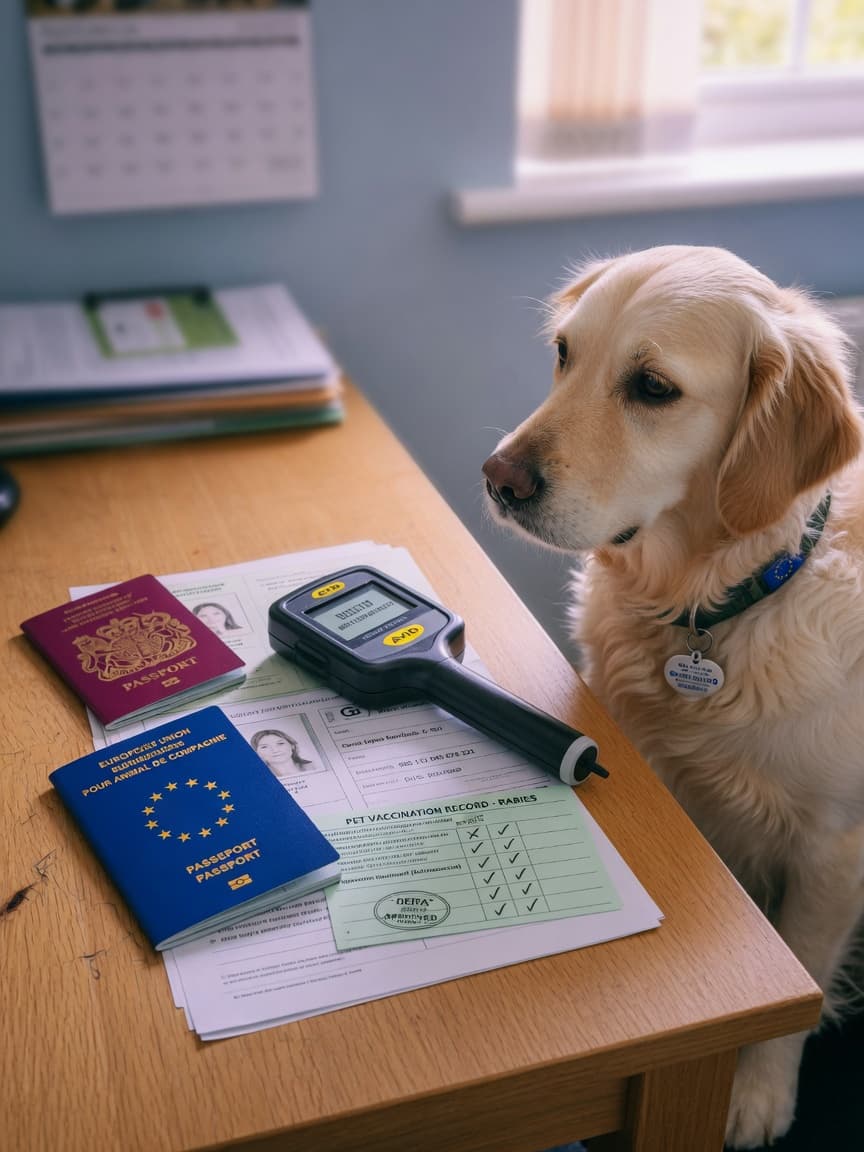
The EU Pet Passport remains in use for residents of EU member states. It is a standardised document that records a pet's microchip number, rabies vaccination history, and other health treatments. It allows pet owners living within the EU to travel between member states and to return home from EU countries without needing to obtain new health certificates for every journey.
The EU Pet Passport is not available to UK residents as a result of Brexit. UK-based pets travelling to the EU require an Animal Health Certificate for each trip instead. The passport continues to function normally for EU citizens and their pets, including travel to some non-EU countries that accept it under bilateral agreements.
Core Requirements to Enter the EU from a Non-EU Country
For any pet entering the EU from outside — whether as part of personal travel or being imported for rehoming — there are minimum requirements that apply regardless of origin country.
- The animal must be microchipped to the ISO 11784/11785 standard (a 15-digit chip) before or at the same time as the first rabies vaccination.
- The animal must have a valid rabies vaccination. If it is the animal's first rabies vaccination, there must be a 21-day wait before entry is permitted.
- A health certificate or equivalent document must be issued by an official or authorised veterinarian in the country of origin.
- Entry must be made through an approved Border Inspection Post.
The Rabies Titre Test: When It Is Required
One of the most significant distinctions in EU pet import rules is whether a rabies antibody titre test is required. This blood test verifies that a pet has developed sufficient immunity following rabies vaccination. It is a stringent requirement that adds both time and cost to the import process.
The titre test is required when a pet is entering the EU from a country that is not on the EU's list of approved third countries — the so-called "unlisted" countries. Many countries in Africa, Asia, and Latin America fall into this category. For pets coming from unlisted countries, the titre test must be carried out by an approved laboratory at least 30 days after the rabies vaccination and at least three months before entry into the EU. This three-month waiting period applies from the date of the blood sample being taken, not from the date of the vaccination.
The United Kingdom is currently on the EU's list of approved Part 1 third countries. This means that pets travelling from the UK to the EU do not require a rabies titre test. The standard rabies vaccination and health certificate process is sufficient. This listed status is important to understand, particularly for UK owners, as it significantly simplifies the travel process compared to pets arriving from non-listed countries.
Rehoming Dogs and Cats From Abroad
The practice of adopting rescue dogs from countries in southern and eastern Europe — including Romania, Spain, Portugal, Bulgaria, and Cyprus — has grown substantially in the UK over recent years. While many of these rescues are conducted legitimately and responsibly, the process is subject to strict regulations, and there have been significant welfare concerns around illegal imports.
Any dog or cat being imported into the UK from another country must meet the same health requirements: microchip, valid rabies vaccination, and appropriate health documentation. Puppies under 15 weeks of age cannot legally enter the UK because they are too young to have been vaccinated against rabies at the required age and then waited the necessary period. Puppies and kittens below this threshold should not be accepted by UK adopters regardless of what documentation is presented.
The Animal and Plant Health Agency (APHA) has issued repeated warnings about the use of falsified documentation in rescue dog imports. Fraudulent papers have been used to bring in underage puppies and animals that have not received the vaccinations claimed. If you are adopting a rescue animal from abroad, use a reputable rescue organisation, verify the documentation carefully, and consider having the animal checked by a UK vet promptly after arrival. A vet can scan the microchip to verify it matches the documentation and assess whether the animal's physical development is consistent with the age stated.
Tapeworm Treatment for Dogs
Dogs entering Finland, Ireland, Malta, and Norway (which is outside the EU but applies the same rules) must receive a tapeworm treatment administered by a vet between one and five days before arrival. This treatment must be recorded in the official travel documentation. The requirement exists because these countries are free of the Echinococcus multilocularis tapeworm and have rules designed to keep it that way. The requirement applies to all dogs entering these countries, including those coming from EU member states.
Other EU countries do not generally impose this requirement as a condition of entry, though regular parasite treatment is always good veterinary practice regardless of destination.
Commercial Imports and Stricter Rules
Moving more than five pets at once — or more than five pets within a five-day period — is classified as a commercial import in UK and EU law, regardless of whether any money changes hands. Commercial imports are subject to substantially stricter regulations, including requirements for commercial health certificates, notification of the border inspection post in advance, and in some cases prior authorisation. If you are involved in rescue work that brings multiple animals into the country at once, ensure you are operating under the correct commercial framework and have sought appropriate regulatory guidance from APHA.
CITES and Protected Species
Some animals are subject to international trade controls under the Convention on International Trade in Endangered Species (CITES). This includes certain parrot species, some reptiles, and other animals that may be kept as pets. If you are importing any animal that may fall under CITES appendices, you must obtain the appropriate permits from both the exporting and importing countries before the animal travels. Failure to do so can result in seizure of the animal and criminal prosecution.
Northern Ireland: A Special Case
Northern Ireland occupies a distinct regulatory position. Its rules on pet imports and movement are more closely aligned with EU standards than those applied to Great Britain. Pet owners moving animals between Great Britain and Northern Ireland, or bringing animals into Northern Ireland from outside the UK, should check the current requirements separately. These rules have evolved since Brexit and continue to be subject to regulatory development.
Key Regulatory Bodies
In the UK, the Animal and Plant Health Agency (APHA) is the authority responsible for regulating pet imports and exports. APHA maintains guidance on health certificate requirements, approved laboratories for titre testing, and border inspection post locations. In the EU, TRACES NT is the online system used to track and document animal movements across borders. Pet owners and importers may need to interact with TRACES NT when their pets' movements are being registered at EU entry points.