
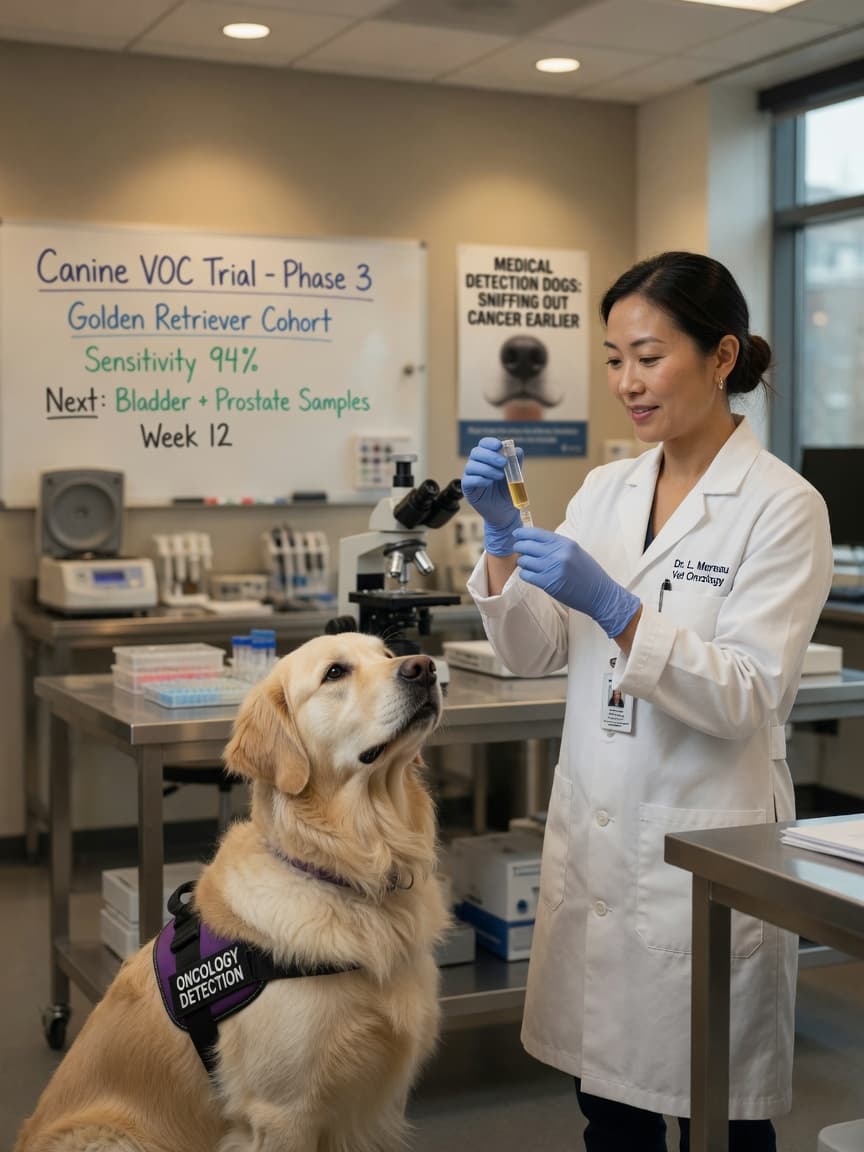
Can Dogs Smell Cancer? The Science Is More Impressive Than You Think
Key fact: Dogs possess up to 300 million olfactory receptors — compared to just 6 million in humans — and the part of their brain dedicated to analysing smells is proportionally 40 times larger than ours. This extraordinary sense of smell is now being harnessed by medical researchers to detect cancer with accuracy that rivals — and sometimes exceeds — conventional laboratory screening tools.
By Sarah Bennett, Certified Animal Nutritionist
Few claims about the canine–human bond are as astonishing as this one: your dog may be able to smell cancer growing inside your body before any clinical symptom appears. What once sounded like anecdotal folklore has, over the past two decades, accumulated a remarkably solid scientific base. Peer-reviewed studies, controlled clinical trials, and dedicated training programmes run by world-class research institutions have all converged on the same conclusion — dogs can detect certain cancers with extraordinary reliability, and scientists are only beginning to understand the full implications.
The Biology Behind the Nose
To understand how dogs can detect cancer, you first need to appreciate just how different a dog's nose is from a human's. When we breathe in, air travels directly to the lungs. When a dog inhales, a portion of that air is diverted to a specialised olfactory recess where scent molecules are trapped and analysed. Dogs can also wiggle each nostril independently, allowing them to triangulate the direction of a smell in three dimensions. Their wet nose further helps to dissolve and capture chemical particles from the air.
Cancerous cells produce metabolic waste products — volatile organic compounds (VOCs) — that differ chemically from those produced by healthy tissue. These compounds circulate through the bloodstream and eventually escape the body through breath, urine, and skin secretions. To human senses, these changes are imperceptible. To a dog trained to identify specific chemical signatures, they are as distinctive as a fingerprint, as National Geographic has documented in depth.
What the Research Actually Shows
The first rigorously designed peer-reviewed study was published in the British Medical Journal in 2004 by Willis et al. (PMID 14584005). Six dogs — a mix of breeds — were trained to detect bladder cancer from urine samples. The dogs identified cancer samples correctly 41% of the time, well above the 14% expected by chance. More strikingly, in several cases where dogs persistently flagged a sample marked as "healthy," subsequent medical investigations revealed that those patients did, in fact, have early-stage kidney or bladder cancer that had not yet been diagnosed. The dogs were right; the original clinical records were wrong.
Since that landmark study, the field has advanced considerably. A 2019 study by Guest et al. (PMID 30996880) trained dogs specifically to detect prostate cancer via urine odour, achieving sensitivity of 71% and specificity approaching 72% — figures that place canine detection on a par with some PSA (prostate-specific antigen) blood tests. The Medical Detection Dogs charity in the UK has run some of the most rigorous trials, working in partnership with NHS hospitals to evaluate dogs against clinical gold standards. Their prostate cancer research, published with the University of Portsmouth, demonstrated sensitivity over 80% in some cohorts.
The BBC has reported on multiple studies showing that trained dogs can detect lung, colorectal, ovarian, and breast cancers — in some cases from blood samples taken weeks before imaging detected any tumour. Ovarian cancer detection is particularly exciting to researchers because this disease has notoriously low survival rates largely due to late diagnosis.
Which Cancers Can Dogs Detect?
Research to date has investigated canine detection across a growing number of cancer types:
- Bladder cancer: The best-studied form, with multiple replication studies since 2004.
- Prostate cancer: Demonstrated in controlled trials with urine samples, high accuracy.
- Lung cancer: Dogs trained on breath samples have shown accuracy above 90% in some studies.
- Breast cancer: Detection from skin odour and blood serum samples.
- Colorectal cancer: A 2011 Japanese study reported 91% sensitivity on breath samples.
- Ovarian cancer: Showing particular promise given the lack of effective early screening tools.
The National Cancer Institute emphasises that early detection is the single most important factor in improving cancer survival rates. If canine detection can reliably flag disease in early stages, the implications for public health screening are profound.
How Dogs Are Trained to Detect Cancer
Training a medical detection dog is a lengthy and meticulous process. It typically begins when the dog is young — ideally between eight weeks and two years old — and relies on operant conditioning using positive reinforcement. The dog learns to associate the scent of cancer-positive samples with a reward (usually a toy or food). The scent is gradually made more dilute and introduced alongside increasing numbers of "distractor" healthy samples. A working medical detection dog may spend 12 to 18 months in training before reaching clinical reliability.
Not all breeds are equally suited. Spaniels (especially Labradors and Cocker Spaniels), German Shepherds, and Belgian Malinois tend to show the highest aptitude, though individual temperament and drive matter more than breed alone. Medical detection charities screen hundreds of dogs before selecting candidates for cancer detection programmes.
From Dogs to Electronic Noses
One of the most productive offshoots of canine cancer detection research is the development of electronic noses — chemical sensors designed to mimic what dogs do biologically. By training dogs first and analysing the specific VOC profiles they respond to, researchers can programme sensor arrays to detect the same chemical fingerprints. This approach sidesteps the logistical challenges of deploying trained animals in clinical settings at scale. Several devices are now in clinical evaluation phases in the UK, US, and Germany.
That said, the electronic nose has yet to match the dog in sensitivity. Dogs remain the gold-standard biological detector, and many researchers believe that fully characterising the VOC signatures dogs are responding to will take several more years of study.
Spontaneous Detection: When Pets Warn Owners
Beyond controlled research settings, there is a growing body of case reports in which pet dogs spontaneously and repeatedly sniffed, licked, or drew attention to a lesion on their owner's body that subsequently turned out to be a malignant tumour. While individual case reports cannot establish causation, their sheer number — and their consistency — has been noted by researchers. In several documented instances, a dog's persistent behaviour led an owner to seek medical attention for what they had dismissed as a harmless mole or skin patch, and melanoma was diagnosed.
This does not mean you should rely on your dog as a cancer screening tool. If you have concerns about any symptom, consult a qualified medical professional. But it does underscore the remarkable perceptual sensitivity dogs bring to their daily interactions with humans.
Key Takeaways
- Dogs have up to 300 million olfactory receptors, making them biologically capable of detecting cancer-related VOCs in breath, urine, and blood.
- Peer-reviewed studies confirm dogs can detect bladder, prostate, lung, and colorectal cancers with clinically relevant accuracy.
- The landmark Willis et al. (2004) study found dogs outperformed chance significantly, and subsequent dogs actually detected cancers missed by initial clinical records.
- Medical Detection Dogs and other organisations run rigorous, NHS-partnered trials showing sensitivity above 80% for some cancers.
- Research on trained dogs is directly informing the development of electronic nose technology for scalable cancer screening.
Looking for quality pet nutrition? Zooplus offers Europe's widest range of science-backed pet food and supplements, with free delivery on orders over €29. Shop now →
References
- Willis CM, Church SM, Guest CM, et al. Olfactory detection of human bladder cancer by dogs: proof of principle study. BMJ. 2004;329(7468):712. PMID 14584005
- Guest C, Pinder M, Doggett M, et al. Development of screening method for prostate cancer by trained scent detection dogs. PLOS ONE. 2019. PMID 30996880