
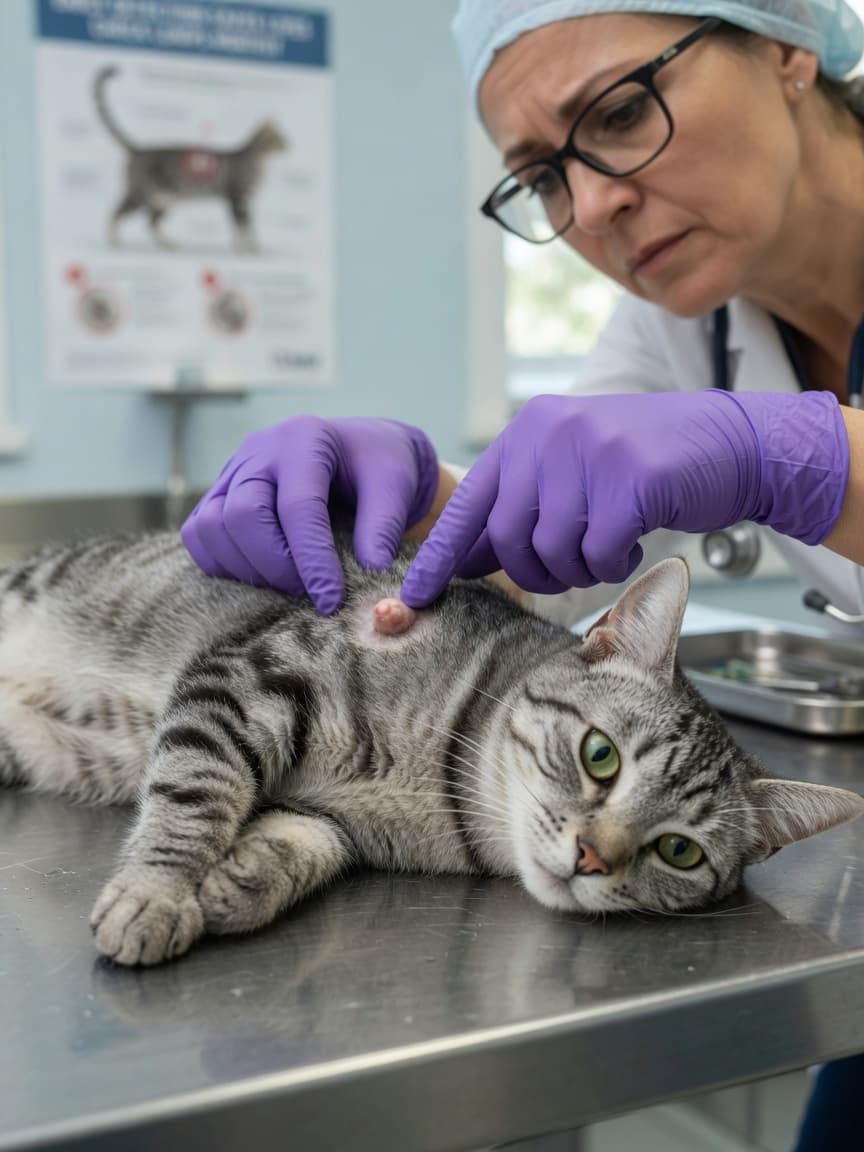
Lumps in Cats Are Not Like Lumps in Dogs
One of the most important things to understand about skin lumps in cats is that they are less commonly benign than in dogs. Dogs develop fatty lipomas, harmless warts, and histiocytomas with considerable frequency; in cats, these innocuous lumps are far less common. When a cat develops a skin growth, the probability that it is something significant is meaningfully higher than it would be in a dog. This does not mean every lump is cancer — but it does mean that a "wait and see" approach is rarely appropriate in cats. Any new or changing lump should be examined by a vet sooner rather than later.
Types of Lumps and Bumps Commonly Found in Cats
Abscesses
Abscesses are the most common cause of sudden swellings in cats, and they are almost exclusively caused by bite wounds — typically from fights with other cats. Cat teeth are long and thin, and when they puncture the skin, the small wound often seals over quickly at the surface while bacteria are deposited deep in the tissue. A painful, hot, fluctuant (fluid-filled) swelling develops over several days, and the cat may become lethargic and feverish. Abscesses typically need to be lanced, flushed, and drained under veterinary care, and a course of antibiotics is usually prescribed. Outdoor cats, entire males in particular, are most at risk. Neutering and keeping cats indoors at night significantly reduces bite wound frequency.
Sebaceous Cysts
Sebaceous cysts form when a sebaceous (skin oil) gland becomes blocked, producing a smooth, well-defined lump beneath the skin surface. In cats, these cysts are smaller and less common than in dogs. They are generally not painful and may remain stable for months or years. Occasionally, a cyst ruptures and releases a waxy or cheesy grey-white material — this can look alarming and the resulting inflammation may be mistaken for something more sinister. Ruptured cysts should be examined by a vet to rule out infection and to ensure the correct diagnosis. Small, stable, unruptured cysts can often simply be monitored.
Lipomas
Fatty lipomas are far less common in cats than in dogs, and when a soft, fatty-feeling lump is found on a cat, it should not be assumed to be benign on that basis alone. In cats, the distinction between a true lipoma and other soft-tissue growths is harder to make clinically, and fine needle aspirate cytology is particularly important. Infiltrative lipomas — which lack clear borders and invade surrounding tissue — are more surgically challenging to remove and require histopathology for accurate diagnosis.
Warts and Papillomas
Unlike dogs, cats are not commonly affected by papillomaviruses, and viral papillomas (warts) are uncommon in immunocompetent cats. When they do occur, they may be associated with immunosuppression — for example, in cats receiving long-term corticosteroids or those that are FIV-positive. Any rough or irregular growth on a cat's skin should not automatically be labelled a wart; it requires veterinary investigation to exclude more serious diagnoses.
Lymphoma
Lymphoma is one of the most common cancers in cats and can manifest as lumps or swellings in a variety of locations — most often as enlargement of one or more lymph nodes, but also as masses in the intestinal tract, chest, skin, or other organs. Cutaneous lymphoma, while less common than alimentary (intestinal) lymphoma, can appear as skin thickening, scaling, ulcerated plaques, or nodules. It may initially resemble inflammatory skin disease and can be difficult to diagnose without a biopsy. Any suspicious skin lesion that is not responding to treatment for presumed infection or inflammation should be biopsied.
Injection Site Sarcoma (Feline Injection Site Sarcoma — FISS)
Feline injection site sarcoma is a particularly aggressive form of cancer that can develop at sites where injections — most commonly vaccines — have previously been administered. FISS is a serious concern in the UK and across Europe, and is a subject of active veterinary research and guideline development. These tumours typically appear as a firm, rapidly growing mass beneath the skin at a previous injection site, sometimes months to years after the injection was given.
The Advisory Board on Cat Diseases (ABCD) — Europe's leading feline vaccination advisory body — has published specific guidelines on injection site selection designed to reduce the consequences of FISS. Their recommendations advise giving vaccinations in sites that can be surgically excised widely if a sarcoma does develop — specifically the distal limbs (lower leg) rather than between the shoulder blades, where wide excision is anatomically very difficult. The ABCD also recommends using subcutaneous injections in the lateral chest wall, and some European vets routinely use the tail as an injection site.
If you notice a firm lump at any previous injection or vaccination site that persists for more than four weeks, is larger than two centimetres, or is growing one month after the injection, you should seek urgent veterinary advice. The "2-2-2 rule" — vet assessment if a lump is present at an injection site more than two months after injection, is larger than two centimetres, or is growing after two weeks — is a useful guideline from the Vaccine-Associated Feline Sarcoma Task Force. Early, aggressive surgery is the cornerstone of treatment, and delays worsen prognosis significantly.
Distinguishing Abscesses from Other Lumps
Because abscesses are so common in cats, they are frequently the first explanation considered for any new swelling. However, it is essential not to assume a lump is an abscess without veterinary confirmation. Some sarcomas and other tumours are also warm and painful, particularly if they have become inflamed or ulcerated. If a presumed abscess does not respond to appropriate antibiotic treatment within the expected timeframe, or if the lump recurs after drainage, further investigation — including biopsy — is necessary.
Diagnostic Procedures
Fine needle aspirate (FNA) cytology is the first-line test for most lumps in cats. A small needle is inserted into the lump to collect cells for examination under a microscope. This is generally quick and well tolerated without sedation, though some cats require a light sedative. FNA is very useful for diagnosing abscesses, lipomas, and some tumours, but it has limitations — in particular, it may not provide enough information about tumour grade or architecture.
Biopsy and histopathology — the removal of a small piece of tissue for pathological examination — provides more detailed information and is often required for a definitive diagnosis. For any lump at a previous injection site, incisional biopsy before surgical removal is strongly recommended to allow proper surgical planning, as FISS requires very wide margins to reduce the risk of recurrence.
When to See a Vet: Cat Lumps Need Prompt Attention
Given that cats are less likely than dogs to have benign lumps, the threshold for seeking veterinary advice should be lower. Seek prompt assessment if:
- Any new lump appears — regardless of size or appearance
- A lump is warm, painful, or accompanied by systemic signs such as fever or reduced appetite — possible abscess, but must be confirmed
- A firm lump appears at a previous vaccination or injection site — possible FISS, seek assessment within days if it is growing
- A lump grows rapidly, ulcerates, or bleeds
- The cat is losing weight, becoming lethargic, or drinking more than usual alongside a new lump
- Any lymph node is visibly or palpably enlarged
- A presumed abscess does not resolve with treatment, or recurs
Cats are adept at hiding signs of illness, and the earlier a lump is investigated, the more treatment options are available. For aggressive tumours such as FISS, the difference between early and delayed presentation can be the difference between curative surgery and palliative care. When in doubt, book the appointment — with cats, it is always better to investigate early and be reassured than to wait and miss a critical window for treatment.