
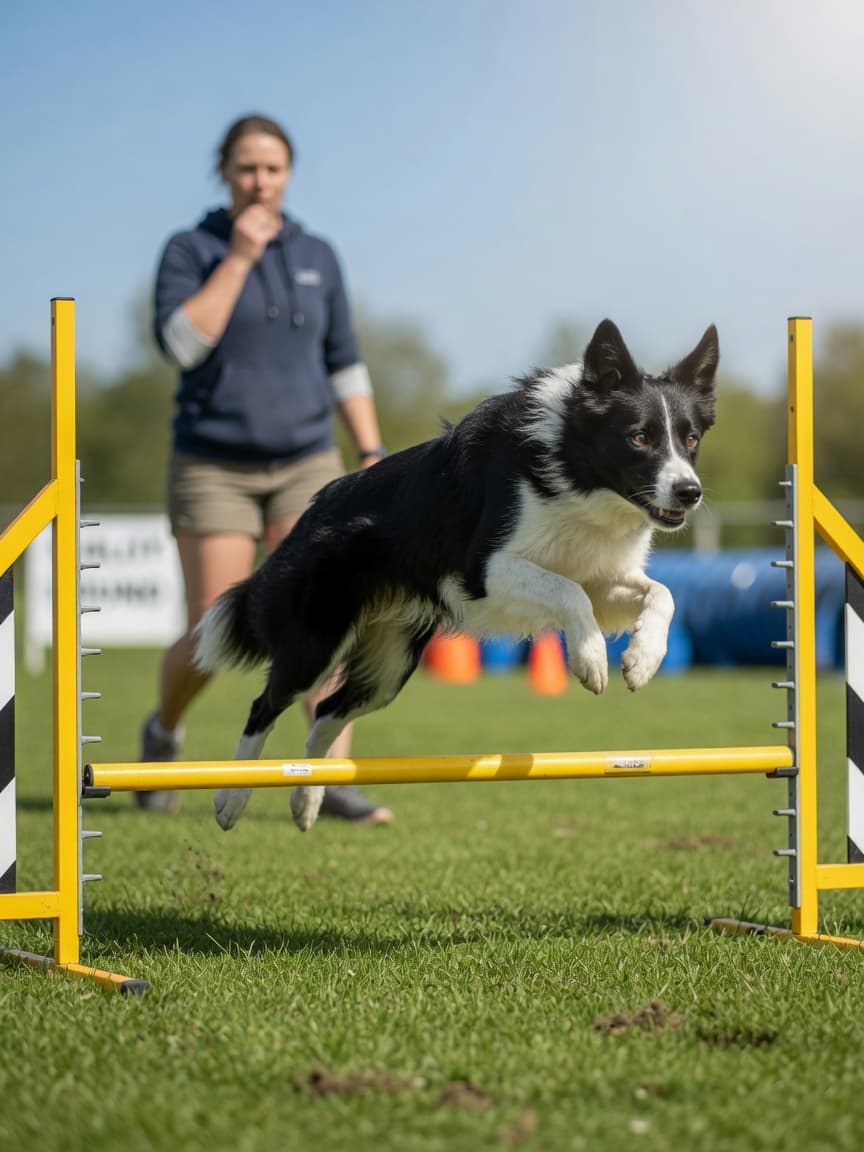
What Is Dog Agility?
Dog agility is a timed obstacle course sport in which a handler directs their dog through a sequence of obstacles as quickly and accurately as possible. The dog and handler work as a team — the dog off-lead, responding entirely to the handler's body language, movement, and vocal cues. It is one of the fastest-growing canine sports in the UK and across Europe, and for good reason: it is exhilarating to watch, deeply rewarding to train, and brilliant for the bond between dog and owner.
A standard agility course includes a range of obstacles: hurdle jumps, collapsed and rigid tunnels, weave poles, the A-frame, the dog walk, the see-saw (also known as the teeter-totter), and the tyre jump. Each obstacle tests a different combination of athleticism, confidence, and handler communication.
Dogs are judged on both speed and accuracy. Faults are awarded for knocked poles, missed contact zones on the A-frame, dog walk, and see-saw, as well as refusals — where the dog approaches an obstacle and turns away without completing it. The winning dog is the one that completes the course in the fastest time with the fewest faults.
How to Get Started
The best first step is to join a local agility club. In the UK, you can search for affiliated clubs through the Kennel Club (KC Agility), which maintains a directory of registered training groups across England, Scotland, Wales, and Northern Ireland. Elsewhere in Europe, contact your national kennel club — most are affiliated with the Fédération Cynologique Internationale (FCI) and can point you toward local clubs running FCI-rules training.
Before your dog ever tackles an obstacle, foundation training is essential. Good agility clubs spend considerable time on the basics: focus work, reliable recall, toy play, and basic obedience. A dog that cannot pay attention to its handler in a distracting environment is not ready for obstacle work, no matter how athletic it is.
Most clubs accept dogs from 12 to 18 months of age. This is not arbitrary — dogs younger than this should not be asked to jump at full competition heights, because their growth plates have not yet closed. Premature high-impact work puts serious stress on developing joints and can cause lasting orthopaedic damage. Some clubs allow puppies to come along for socialisation and flatwork before they are old enough for obstacles, which is a lovely way to start building drive and confidence early.
Suitable Breeds for Agility
The Border Collie dominates competitive agility worldwide, and it is easy to see why: exceptional intelligence, boundless drive, and extraordinary physical ability make it the breed most handlers aspire to run. The Shetland Sheepdog (Sheltie) is another standout — agile, quick, and enthusiastic, it excels particularly in small dog classes. The Belgian Malinois, an FCI-recognised working breed, has become increasingly popular in sport agility circles across Europe. The Australian Shepherd, also FCI recognised, brings excellent drive and a natural affinity for handler communication.
In the small dog categories, the Jack Russell Terrier and the Papillon are perennial favourites — zippy, tenacious, and capable of extraordinary weave pole speed.
That said, agility is not just for working breeds or pedigree dogs. Competition in the UK and under FCI rules is divided into height categories — Large, Medium, Small, and Extra Small (XS) — so dogs of all sizes can compete on courses with appropriately scaled obstacles. Mixed breeds are fully welcome in both KC Agility and FCI competitions. If your dog is fit, healthy, and keen to work with you, agility is worth exploring regardless of breed or background.
Health Considerations
Agility places real physical demands on a dog. Hip and elbow health are particularly important, as jumping and contact obstacles put repeated stress on these joints. Dogs with orthopaedic conditions should not begin agility training without explicit veterinary clearance — and in some cases, agility may not be appropriate at all.
As noted above, puppies must not jump at full competition heights until their growth plates have closed. This typically occurs between 12 and 18 months, depending on breed size — larger breeds mature more slowly, so the rule of thumb is to err on the side of caution. Many trainers use low, adjustable jump heights throughout the puppy and adolescent period, gradually increasing only when the dog is physically ready.
For dogs competing regularly, an annual veterinary check is strongly recommended. Your vet can assess joint health, body condition, and any early signs of wear that might need to be managed before they become serious problems.
Training Progression
Good agility training follows a logical progression, and rushing it is the most common mistake beginners make. The stages look roughly like this:
- Foundation work: hand targeting, restrained recalls, toy play, and attention exercises. These build the raw engagement and drive that agility requires.
- Flatwork: teaching the dog to read handler body language and movement — turning, acceleration, deceleration — without any obstacles present. Flatwork is the foundation of handling and is often underestimated.
- Individual obstacle training: introducing one obstacle at a time, always with positive reinforcement. Each obstacle is shaped and proofed until the dog is confident and accurate before moving on.
- Sequencing: linking two or three obstacles together, then gradually extending sequences as fluency grows.
- Full courses: working on handling challenges such as front crosses, blind crosses, and rear crosses — the techniques handlers use to guide dogs efficiently around a full course.
Throughout all stages, positive reinforcement is the method of choice. Agility dogs need to love their job; pressure or punishment erodes confidence and kills drive. Food, toys, play, and genuine enthusiasm from the handler are the currency of good agility training.
Competition Structure in the UK and Europe
In the UK, the Kennel Club Agility grading system runs from Grade 1 (beginner) to Grade 7 (elite). Dogs progress through the grades by winning or placing at licensed agility shows, which take place throughout the UK from spring to autumn. The system is well-structured and gives handlers a clear sense of progression and achievement.
Across Europe, the FCI governs agility at an international level. The FCI Agility World Championship is held annually and features team and individual competitions, drawing handlers from dozens of countries. Many European nations also run their own national agility circuits under FCI rules, and titles such as the CACS (Certificat d'Aptitude au Championnat de l'Agility des Sociétés) can be earned through national kennel clubs, contributing toward national agility championships. The CANIS circuit is another prominent competition framework operating across multiple European countries.
Equipment for Home Practice
Between club sessions, home practice can accelerate progress considerably. Basic starter sets — including low adjustable jumps, a tunnel, and weave poles — are available from suppliers such as Zooplus, which stock agility training equipment at accessible price points. Competition-standard weave poles number twelve; for home practice, you can begin with fewer and add more as your dog's skill develops.
Always practise on a safe surface. Grass is ideal. Avoid slippery floors, hard concrete, or uneven ground, all of which increase the risk of injury. Keep home sessions short, high-value, and fun — the goal is to build enthusiasm, not fatigue.
The Benefits of Agility Training
Beyond the sport itself, agility offers a remarkable range of benefits for both dog and owner. The communication required to guide a dog around a course at speed deepens the dog-owner bond in a way that few other activities can match. It provides genuine physical exercise for both handler and dog, and the mental effort of navigating a course tires a dog out far more effectively than a simple walk ever could. It is also a wonderfully social activity — agility clubs tend to be friendly, passionate communities where handlers of all levels support one another.
Whether you are chasing a Grade 7 title or simply looking for a fun new challenge to share with your dog, agility is worth every moment of the training journey.