
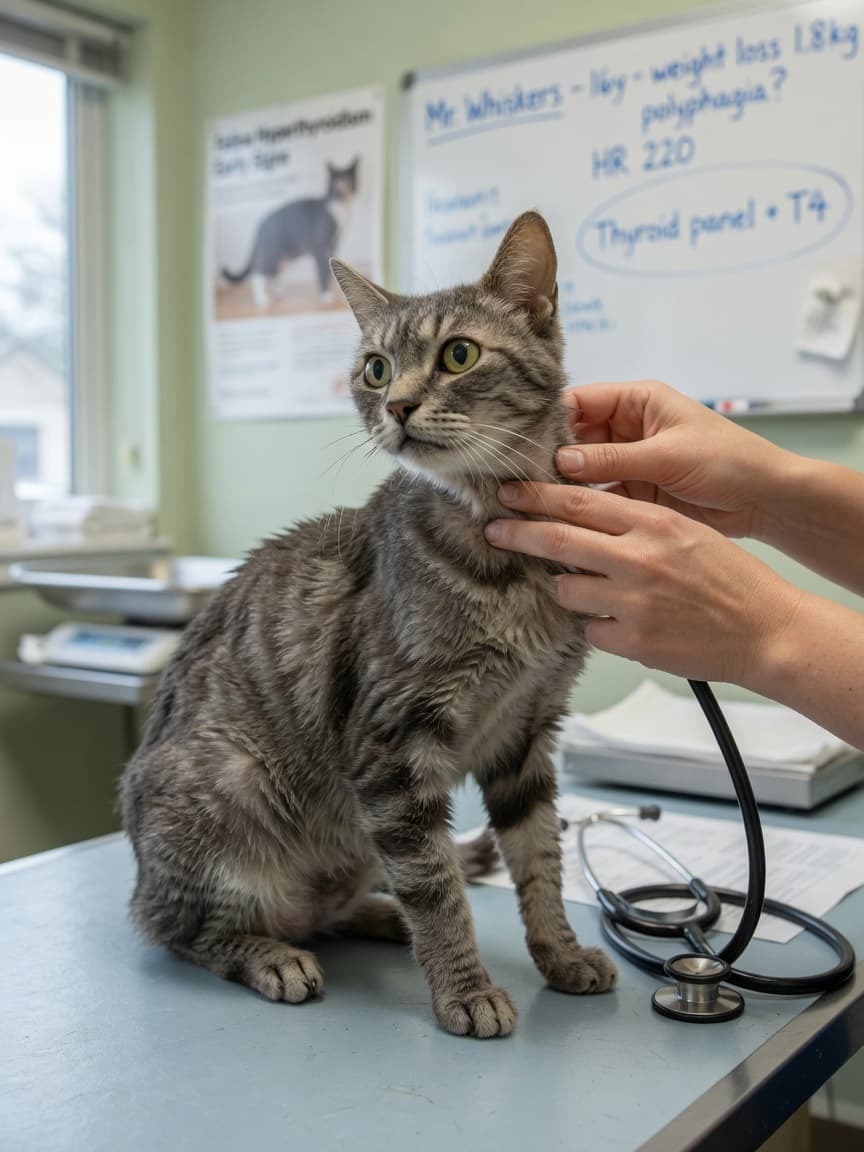
The Most Common Hormonal Disease in Older Cats
If your cat is over ten years old and has been losing weight despite eating well, acting more restless than usual, or vomiting regularly, hyperthyroidism should be near the top of the list of possibilities. It is the single most common endocrine (hormonal) disorder seen in older cats, with estimates suggesting that around one in ten cats over ten years of age is affected. The good news is that it is both diagnosable with a straightforward blood test and treatable through several different approaches.
What Is Hyperthyroidism?
The thyroid gland sits in the neck and produces hormones — primarily thyroxine (T4) — that regulate the body's metabolic rate. In cats with hyperthyroidism, one or both thyroid lobes develop a benign overgrowth called an adenoma (or, less commonly, a condition called adenomatous hyperplasia) that produces thyroid hormone in excess. The result is a metabolism running at far too high a speed, affecting virtually every organ system in the body.
The cause of this overgrowth is not fully understood, though dietary factors, environmental chemicals, and genetic predisposition have all been suggested as contributing factors. Importantly, the growth is almost always benign — thyroid carcinoma accounts for fewer than two per cent of feline hyperthyroidism cases.
Recognising the Symptoms
The hallmark sign that brings most owners to the vet is weight loss in a cat that is eating voraciously. The cat seems hungry all the time, yet the scales tell a different story every few weeks. This paradox — increased appetite with progressive weight loss — is highly characteristic of hyperthyroidism.
Beyond weight and appetite changes, owners frequently describe their cat as having become uncharacteristically restless, vocal, or difficult to settle. Some cats develop a noticeably unkempt or matted coat because they are no longer grooming effectively. Vomiting and diarrhoea are common, sometimes with large, poorly formed stools. Heart rate increases, and a vet examining a hyperthyroid cat will often detect a heart murmur or abnormal rhythm caused by the effects of excess thyroid hormone on the cardiac muscle.
Hypertension (high blood pressure) is another serious consequence and can lead to retinal detachment and sudden blindness if left untreated. Any older cat showing acute vision changes should be assessed promptly.
Diagnosis: The T4 Blood Test
Diagnosis is usually straightforward. A blood test measuring total thyroxine (T4) will be elevated in the vast majority of hyperthyroid cats. Your vet will also run a general blood panel to check for concurrent conditions — kidney disease, liver changes, and anaemia can all accompany hyperthyroidism or be unmasked once treatment begins. In a small number of cats with strong clinical signs but a borderline T4, a repeat test or a free T4 measurement may be needed to confirm the diagnosis.
Treatment Option One: Medication (Methimazole or Carbimazole)
The most widely used treatment in the UK and Europe is daily oral medication. Carbimazole is commonly prescribed in Europe, while methimazole is preferred in North America. These drugs work by blocking the production of thyroid hormone by the overactive tissue. They do not destroy the abnormal tissue — they simply suppress its output — so medication must be continued for life to keep the condition controlled.
The advantages of medication are that it is widely available, relatively affordable, and reversible if problems arise. The disadvantages include the need for daily dosing (some cats are very resistant to tablets), the requirement for regular blood tests to monitor thyroid levels and check for side effects such as low white cell count or liver changes, and the fact that it treats the symptoms rather than the underlying cause. A transdermal gel formulation that is applied to the inner ear flap is available for cats who cannot be medicated orally and can significantly improve compliance.
Treatment Option Two: Radioactive Iodine (I-131)
Radioactive iodine therapy is widely regarded as the gold standard treatment for feline hyperthyroidism. A single injection of radioactive iodine is given, which is taken up preferentially by the overactive thyroid tissue and destroys it, while leaving the surrounding normal tissue largely unharmed. In the majority of cats, a single treatment results in a permanent cure — no further medication is needed and the condition does not recur.
The main limitation is availability. Because treated cats emit low levels of radiation for a period after the injection, they must be housed in a licensed radiation facility for a mandatory isolation period, typically one to four weeks depending on national regulations. Facilities licensed to offer this treatment are relatively limited across the EU, though numbers are growing. The cost is also higher upfront than medication, though over a cat's lifetime it is often more economical than years of medication and monitoring. There are no significant side effects in most cats, though a small proportion develop hypothyroidism if the normal thyroid tissue is affected.
Treatment Option Three: Surgical Thyroidectomy
Surgical removal of the affected thyroid lobe or lobes is an effective and potentially curative option. Where only one lobe is involved, surgery on that lobe alone is usually successful. Where both lobes are affected, bilateral thyroidectomy carries a higher risk of complications.
The main risk of thyroid surgery is inadvertent damage to or removal of the parathyroid glands, which sit adjacent to the thyroid and regulate calcium levels. Hypoparathyroidism — low calcium — following surgery can be a serious and life-threatening complication, manifesting as muscle tremors, facial twitching, and seizures in the days following the operation. For this reason, surgical thyroidectomy requires an experienced surgeon and careful post-operative monitoring. Most cats are also pre-treated with medication for several weeks before surgery to stabilise their thyroid levels and reduce anaesthetic risk.
Treatment Option Four: Hill's Prescription Diet y/d
A prescription diet with restricted iodine content — Hill's Prescription Diet y/d — offers a non-invasive treatment option for cats whose owners cannot administer medication or access other treatments. Because thyroid hormone synthesis requires iodine, restricting dietary iodine dramatically reduces thyroid hormone production and can normalise T4 levels within a few weeks.
The critical caveat is that this diet must be the only food the cat consumes. Even small amounts of iodine from other foods — treats, table scraps, other pets' food — will undermine the treatment. For cats in multi-pet households or for cats with a tendency to roam and scavenge, maintaining the required dietary exclusivity can be very challenging in practice.
Monitoring Kidney Function After Treatment
One important consideration that applies to all treatments is the effect on kidney function. Hyperthyroidism artificially maintains a high blood flow to the kidneys; when thyroid hormone levels normalise, blood flow to the kidneys drops and pre-existing kidney disease that was previously masked may become apparent. Your vet will monitor kidney function closely in the weeks after starting treatment, and in some cases may adjust the target thyroid level or treatment approach accordingly to protect kidney health.
Managing hypertension — usually with amlodipine tablets — is also important in cats with elevated blood pressure at diagnosis, and may need to continue even after thyroid hormone is brought under control.