
A Disease Most Owners Never See Coming
By the time a dog reaches three years of age, there is an 80 percent chance it already has some form of periodontal disease. Yet most owners report their dog's teeth look "fine." That disconnect is precisely what makes this condition so dangerous. Periodontal disease develops silently beneath the gum line, long before any visible signs appear, and by the time bad breath or loose teeth are obvious, significant damage has already been done.
What Is Periodontal Disease
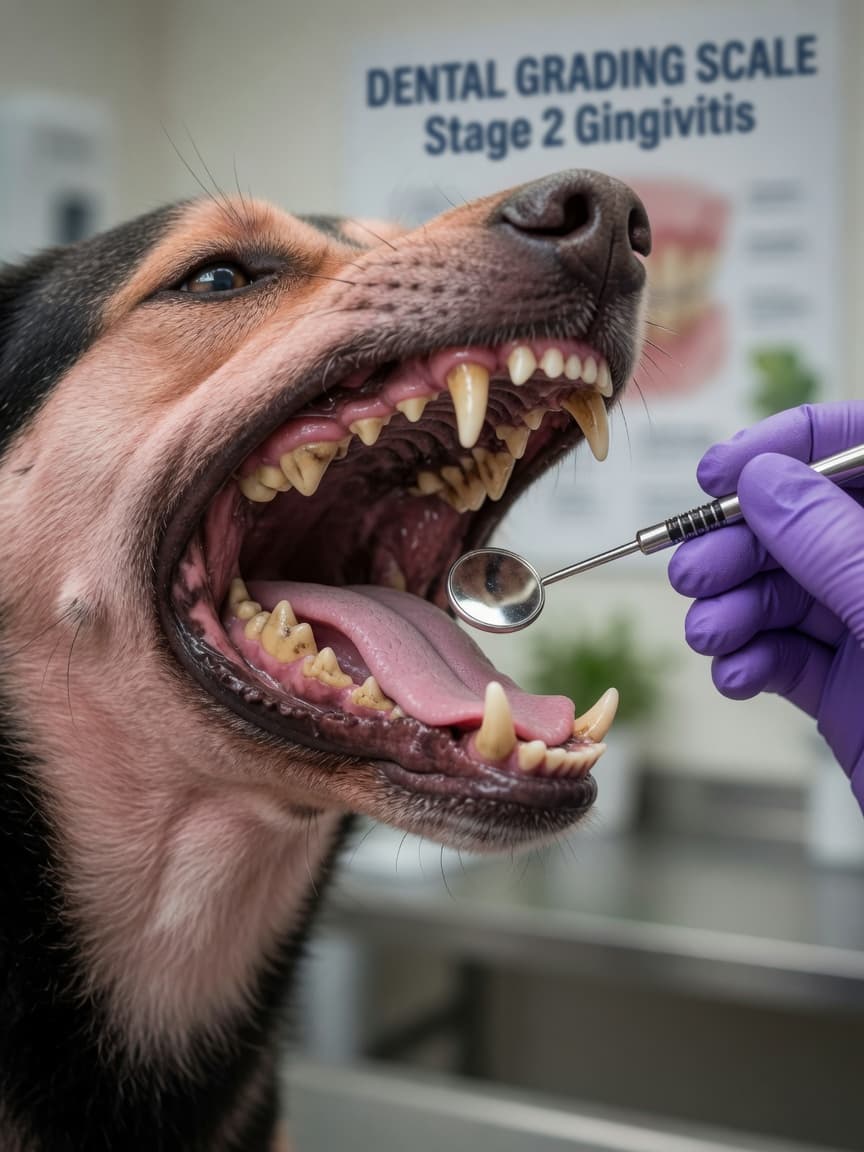
Periodontal disease is an infection of the structures surrounding the teeth, including the gums, periodontal ligament, and the bone that holds teeth in place. It begins with plaque — a soft film of bacteria that forms on tooth surfaces within hours of eating. If plaque is not removed, it mineralises into tartar (calculus) within days. Tartar provides a rough surface where more bacteria accumulate, and those bacteria eventually migrate below the gum line, triggering inflammation and tissue destruction.
The Four Stages
- Stage 1 — Gingivitis: Gum redness and swelling. Fully reversible with professional cleaning.
- Stage 2 — Early periodontitis: Less than 25 percent attachment loss. Some bone changes visible on X-ray.
- Stage 3 — Moderate periodontitis: 25 to 50 percent attachment loss. Pain present, extraction may be needed.
- Stage 4 — Advanced periodontitis: More than 50 percent attachment loss. Tooth loss, jaw involvement, significant pain.
Why It Goes Unnoticed for So Long
Dogs are hardwired to conceal pain. In the wild, showing vulnerability invites predation, so even dogs in considerable discomfort will continue eating and playing. Owners often interpret this as evidence their dog is fine. Additionally, the most destructive changes occur below the gum line and are invisible without dental X-rays — a tool that many practices still do not use routinely. Studies show that up to 60 percent of dental pathology is missed when X-rays are not taken.
Systemic Consequences Beyond the Mouth
The mouth is not a sealed compartment. Bacteria from infected gum tissue enter the bloodstream continuously in dogs with advanced periodontal disease. Research has found associations between chronic oral infection and damage to the kidneys, liver, and heart muscle. One study identified a link between periodontal disease and a two-fold increase in the risk of endocarditis — infection of the heart valves. While cause and effect are still being refined, the biological plausibility is well-established: chronic bacterial load creates chronic systemic inflammation.
Small Breeds and Brachycephalics
Smaller dogs are disproportionately affected. Their teeth are often crowded into jaws too small to accommodate them properly, creating pockets where plaque accumulates rapidly. Brachycephalic breeds — Bulldogs, Pugs, Shih Tzus — face similar challenges due to dental crowding. These breeds typically need their first professional dental assessment earlier, often around 12 to 18 months.
Prevention: What Actually Works
Daily Toothbrushing
Daily brushing with a dog-specific toothpaste remains the single most effective home care measure. Human toothpaste contains fluoride and foaming agents that are unsafe for dogs. The mechanical action of bristles on tooth surfaces — not the paste itself — does the heavy lifting. Even 30 seconds of brushing per day has been shown to reduce plaque accumulation significantly compared to no brushing.
Dental Chews and Diets
Products carrying the Veterinary Oral Health Council (VOHC) seal have passed independent testing for plaque or tartar reduction. These include certain dental chews, water additives, and prescription dental diets. They are useful supplements to brushing but not replacements. Chewing action on appropriately textured products does provide some mechanical cleaning of the tooth surface.
Professional Dental Cleanings
Home care maintains but does not replace professional cleaning. A thorough dental procedure under general anaesthesia allows scaling above and below the gum line, probing of each tooth, and dental radiography. Anaesthesia-free dental cleaning — offered by some grooming facilities — only removes visible tartar from crown surfaces and provides no information about sub-gingival disease. It creates the appearance of a clean mouth without addressing the actual pathology.
What to Ask Your Vet
At your dog's next health check, ask for a specific assessment of gum line health and whether dental X-rays were taken at the last anaesthetic procedure. If your dog has not had a professional dental cleaning, ask for a staging of any disease that is present. The frequency of cleaning needed varies — some dogs with excellent home care can go two to three years between procedures; others with predisposing factors may need annual cleanings. Your vet is best placed to advise based on your individual dog's mouth.
Practical Summary
- Start dental home care early — puppies should be introduced to toothbrushing before six months of age.
- Brush teeth daily using a dog-safe toothpaste and an appropriately sized brush or finger brush.
- Supplement with VOHC-approved chews or dental diets, but do not rely on these alone.
- Book a veterinary dental assessment if your dog has not had one in the past 12 months.
- Always insist on dental X-rays as part of any professional cleaning procedure.
- Consult your vet immediately if you notice bad breath, pawing at the mouth, dropping food, or reluctance to chew.