
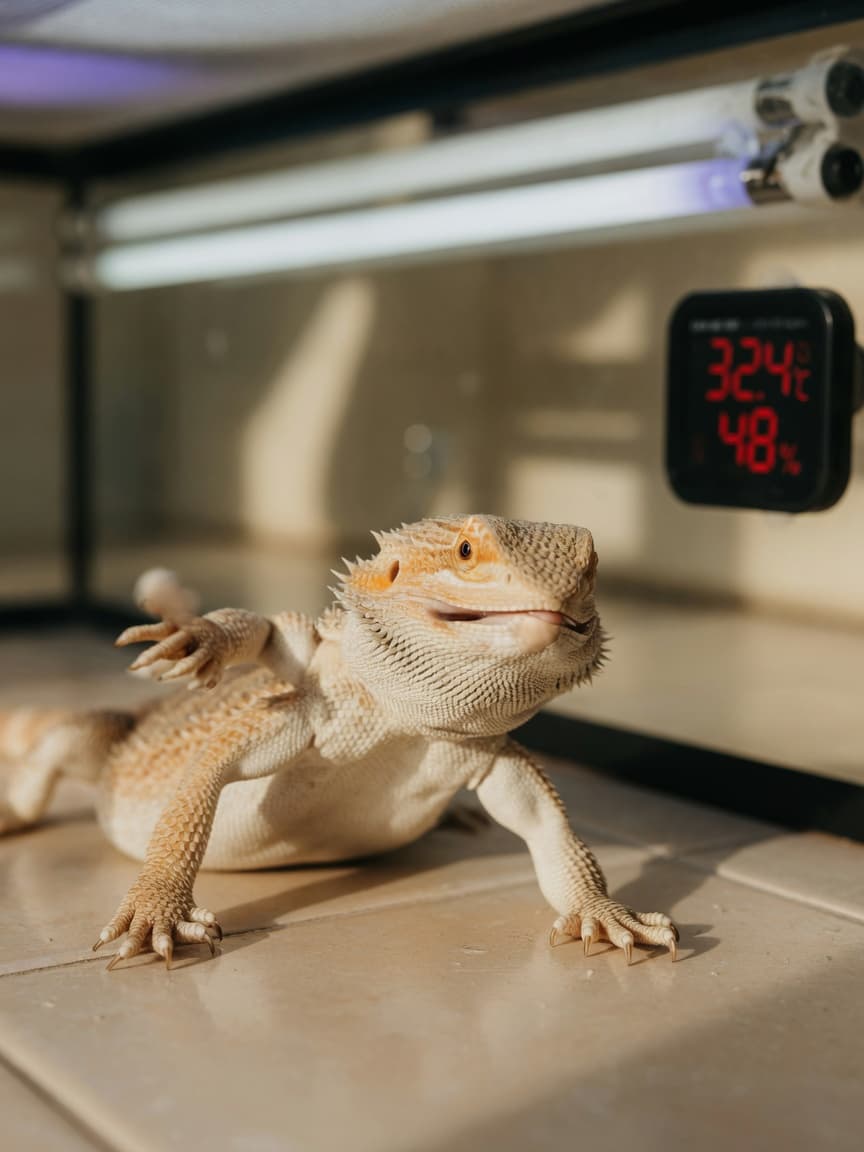
When Your Bearded Dragon Stops Acting Like Itself
Bearded dragons are among the most popular reptile pets in the UK, yet surveys suggest that a significant proportion of owners don't recognise the early warning signs of the three most common health crises these animals face. By the time a beardie looks visibly unwell, the condition is often well advanced. Understanding what to watch for — and why it happens — can genuinely save a life.
Metabolic Bone Disease
Metabolic bone disease, or MBD, is arguably the most widespread health problem seen in captive bearded dragons. It results from a failure to absorb enough calcium, whether due to dietary deficiency, lack of UVB light, or an imbalanced calcium-to-phosphorus ratio in the diet.
Signs to recognise
- Limbs that appear swollen, bent, or tremble at rest
- A jaw that looks soft or the dragon struggles to close properly
- Difficulty walking or an unusual, lurching gait
- Lethargy and reluctance to climb or bask
- Spontaneous fractures in severe cases
Prevention and management
MBD is almost entirely preventable. Bearded dragons require a high-quality UVB tube — not a compact bulb — producing UVB in the 290–315 nm range, replaced every six months even if it still emits visible light. Calcium supplementation should be dusted onto feeder insects at nearly every feeding for juveniles, and every other feeding for adults. Phosphorus-heavy feeders like mealworms should be offered sparingly. If you suspect MBD, consult a reptile-experienced vet without delay; in early stages it is reversible, but advanced cases can cause permanent deformity.
Impaction
Impaction occurs when a mass of indigestible material — typically loose substrate — accumulates in the digestive tract and cannot pass. Sand, gravel, walnut shell, and calcium sand are frequent culprits. A dragon may also ingest substrate accidentally while hunting live prey.
Symptoms of impaction
- Straining to defecate or no faeces produced over several days
- A visibly distended or firm abdomen
- Loss of appetite and lethargy
- Rear limb weakness or partial paralysis in severe cases (due to spinal pressure)
Mild impaction may respond to a warm bath (30°C, shallow enough to stand in) for 15–20 minutes daily, combined with gentle abdominal massage. Never attempt home remedies if the dragon shows signs of paralysis or severe distress — this is a veterinary emergency. Switching to a solid, non-particle substrate such as ceramic tile, reptile carpet, or newspaper eliminates the most common cause entirely.
Respiratory Infections
Respiratory infections in bearded dragons are frequently linked to husbandry failures — specifically, enclosures that are too cold, too damp, or both. Bacterial pathogens are the usual culprits, though viral and fungal causes occur.
A dragon with a respiratory infection may breathe with its mouth open, produce audible wheezing or clicking sounds, and have mucus around the nostrils or mouth. Head tilting, lethargy, and reduced appetite commonly accompany these signs. Unlike some illnesses, respiratory infections rarely resolve without veterinary intervention. Your vet will likely swab for culture, prescribe antibiotics, and may recommend nebulisation therapy. Meanwhile, review your enclosure temperatures: the basking spot should reach 38–42°C, with a cool end of around 26°C and low ambient humidity.
Building a Healthy Enclosure
Many of the health problems above share a common root: incorrect husbandry. An adult bearded dragon needs an enclosure of at least 120 cm in length, a reliable thermostat on all heat sources, a digital thermometer (not a stick-on dial), and a UVB tube spanning at least two-thirds the length of the tank. Feeding a varied diet of appropriately sized live insects alongside leafy greens and vegetables supports long-term health far better than relying on a single feeder species.
When to See a Vet
- Any dragon that has not eaten for more than two weeks without an obvious reason (such as brumation)
- Signs of paralysis, seizures, or muscle tremors
- Laboured breathing or open-mouth breathing at rest
- A swollen, discoloured, or unusually soft abdomen
- Discharge from the eyes, nose, or mouth
A reptile-experienced vet is essential — not all small-animal practices have the knowledge or equipment to treat reptiles adequately. Find one before you need one, not in the middle of a crisis.
Key Takeaways
- MBD is preventable with proper UVB lighting and calcium supplementation; act early if you see limb tremors or soft jaw
- Avoid loose particle substrates and provide warm baths if mild impaction is suspected
- Cold, damp conditions invite respiratory infections; check your temperatures with a reliable thermometer
- Routine observation of your dragon's behaviour and droppings is the cheapest diagnostic tool available
- Always consult a reptile vet for anything beyond minor, easily explained issues