
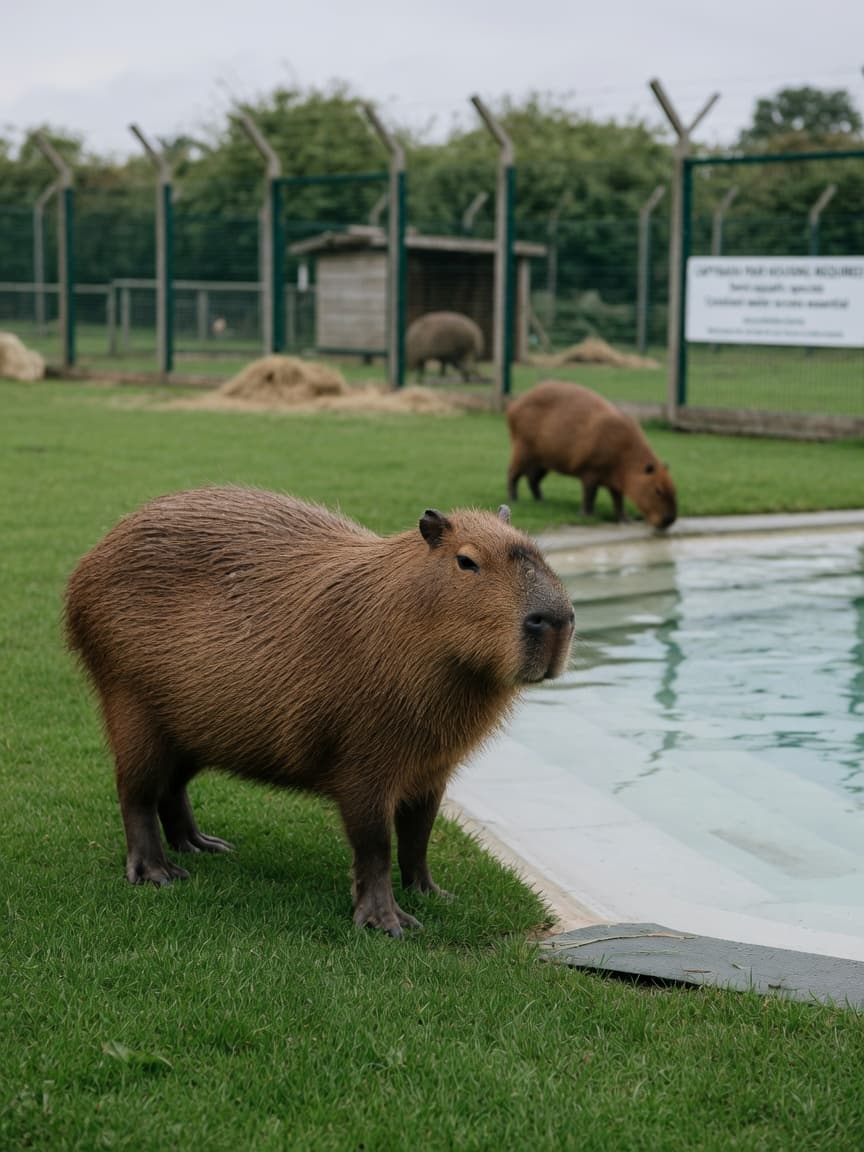
The World's Largest Rodent — and One of Its Most Demanding Pets
Capybaras have experienced a remarkable surge in popular interest. Videos of these large, placid South American rodents interacting amiably with dogs, cats, and birds have accumulated hundreds of millions of views, creating the impression of an extraordinarily gentle, sociable, and easy-going animal. Much of that impression is accurate. Capybaras are genuinely social, generally non-aggressive, and capable of forming bonds with other animals and humans alike. The problem is that their needs are so specific and so demanding that the vast majority of domestic environments cannot meet them.
Understanding what a capybara actually requires — before being charmed by the social media version — is the only responsible starting point for anyone considering ownership.
Legal Considerations
In the United Kingdom, capybaras are not currently listed under the Dangerous Wild Animals Act 1976, which means a national-level licence is not required. However, local authority regulations may apply, and the legal position can vary. In the United States, ownership is legal in some states and prohibited in others, including California and Georgia. Several states require permits. Across continental Europe, regulations vary, with some countries applying CITES-related controls on South American wildlife. As with any exotic animal, verifying the current legal position with your local authority and, where relevant, a wildlife law specialist is essential before proceeding.
Social Needs: The Non-Negotiable Requirement
Capybaras are highly social animals. In the wild, they live in groups of 10 to 20 individuals, sometimes more. A single capybara kept alone will experience chronic social stress — this is not a welfare preference but a biological reality. Solitary capybaras frequently develop anxiety behaviours, become aggressive, or suffer what appears to be depression-like states characterised by inactivity and loss of appetite.
This means that owning a capybara almost always means owning at least two. That immediately doubles every welfare consideration: space, feeding, veterinary costs, and enrichment. Prospective owners who cannot commit to housing a pair should not consider capybaras at all.
Space and Housing
Land Requirements
Capybaras are large animals. Adults typically weigh between 35 and 65 kg and require substantial space to move, graze, and behave naturally. Most exotic animal welfare guidelines suggest a minimum outdoor space of 40 to 60 square metres per animal for adequate welfare — and this should be considered a floor, not a target. The enclosure must be securely fenced, as capybaras can move quickly and will wander if given the opportunity.
Water Access
Capybaras are semi-aquatic. Access to water for swimming and bathing is not a luxury — it is a welfare requirement. In the wild, they spend considerable time in rivers and lakes, using water to thermoregulate, socialise, and escape predators. In captivity, a pool of sufficient size for the animal to fully submerge and move is necessary. Small paddling pools are not adequate for adult capybaras. Water must be kept clean, which requires filtration or regular changes, adding significantly to the practical demands of ownership.
Climate Considerations
Capybaras are native to South America's tropical and subtropical regions. In the UK climate, this creates real challenges. They can tolerate temperate conditions but are susceptible to cold and wet weather, and respiratory infections are a documented risk in capybaras kept in damp, cold environments without adequate shelter. Heated indoor space accessible year-round is necessary.
Diet and Nutrition
Capybaras are herbivores that graze extensively. A diet based primarily on high-quality grass hay and fresh grass, supplemented with leafy vegetables and a small amount of capybara-appropriate pellet food, most closely approximates their natural nutritional intake. They practise coprophagy — consuming their own faecal pellets — which is a normal and necessary part of their digestive process for absorbing essential B vitamins. This surprises many new owners but should not be discouraged.
Vitamin C is a dietary requirement for capybaras, as they cannot synthesise it internally. Deficiency leads to scurvy-like symptoms. Fresh vegetables high in vitamin C should form a regular part of their diet. Consult an exotic animal vet for specific dietary guidance, as requirements can vary with age, reproductive status, and health conditions.
Veterinary Care
Access to a vet with capybara experience is a significant practical barrier. Exotic rodent specialists are not common, and capybaras present unique challenges in clinical settings — they are large, strong, and become severely stressed by handling, which can itself cause serious health complications. Anaesthesia carries elevated risk. Identifying an appropriate exotic vet before acquiring capybaras is not just advisable; it is essential.
Common health problems include dental disease (capybara teeth grow continuously and require appropriate wear), skin conditions, respiratory infections, and gastrointestinal issues. Annual health checks are the minimum recommended, and establishing an early relationship with a knowledgeable vet allows for preventative care planning.
Practical Summary
- Verify local legal requirements before proceeding — regulations vary significantly by region.
- Plan to keep a minimum of two capybaras: solitary ownership is a welfare failure.
- Provide at least 40 square metres of secure outdoor space per animal, with year-round access to a suitable water feature.
- Offer heated indoor shelter for the UK climate and cold seasons.
- Feed a diet based on grass hay and fresh grass, with vitamin C supplementation via vegetables.
- Identify an exotic vet with large rodent or capybara experience before acquiring the animals.
- Budget honestly — food, enclosure construction, water management, and veterinary costs make capybara ownership genuinely expensive.