
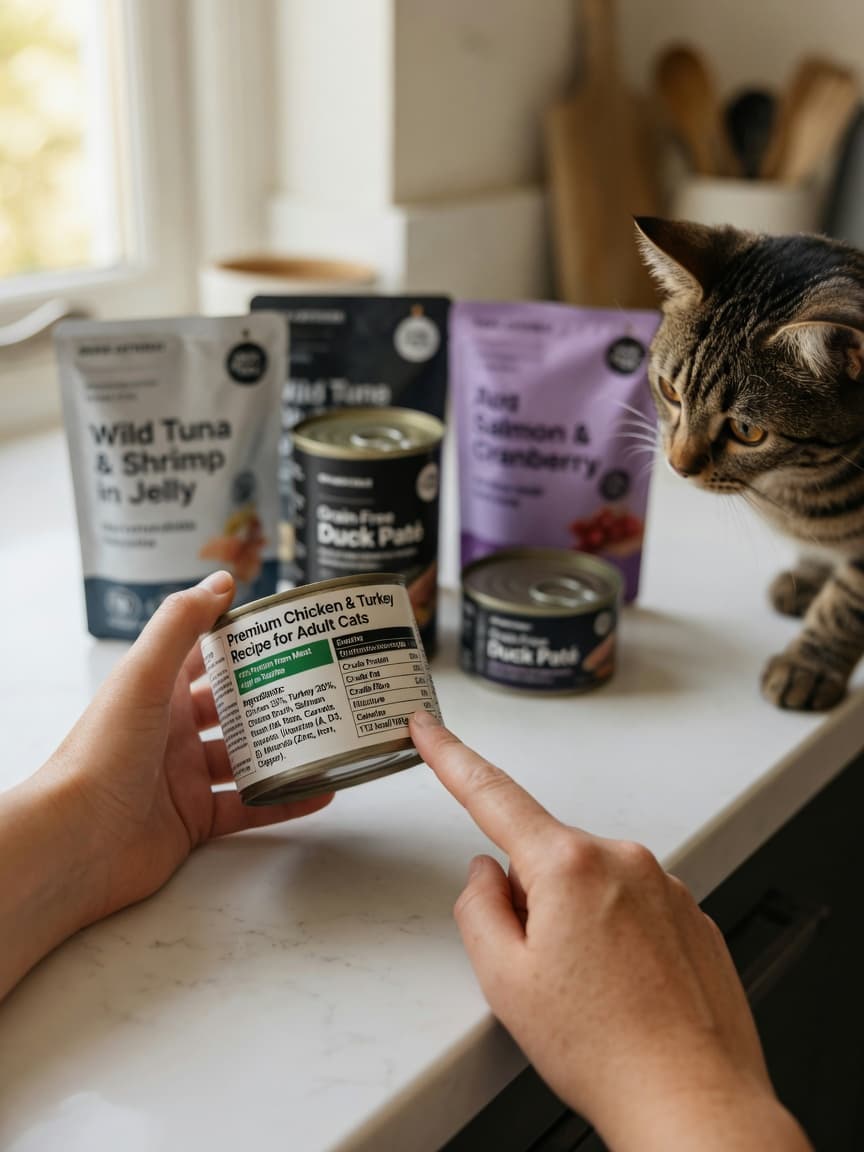
Why Cat Food Labels Matter
The cat food market is vast, and the range of products available — from budget tinned food to premium raw-inspired complete diets — can feel overwhelming. Every product carries a label, and those labels contain a significant amount of information, but understanding what it means requires knowing the rules behind it. In the UK and EU, pet food labelling is governed by specific legislation, and knowing what the law requires (and what it does not) helps you evaluate what you are actually buying.
How Cat Food Is Regulated in the UK and EU
Pet food sold in the UK and EU must comply with regulations that set out requirements for labelling, ingredient declaration, and product safety. In the EU, the primary legislation is Regulation (EC) No 767/2009 on the placing on the market and use of feed. Following Brexit, the UK retained and adapted this regulatory framework, so the rules remain very similar in practice.
The industry body FEDIAF — the European Pet Food Industry Federation — publishes nutritional guidelines that many manufacturers use as the benchmark for formulating complete diets. A product labelled as "complete" must meet the nutritional requirements for a cat at the life stage indicated on the packaging. A product labelled as "complementary" is not nutritionally balanced on its own and is intended to be fed alongside other foods.
This distinction matters enormously. If you are feeding a complementary food as a sole diet, your cat may be receiving inadequate nutrition over time, even if the product appears similar to a complete food on the shelf.
Taurine: A Non-Negotiable Nutrient
Taurine is an amino acid that is essential for cats. Unlike many other mammals, cats cannot synthesise adequate amounts of taurine from other amino acid precursors, which means it must be present in their diet in sufficient quantities. Taurine is critical for heart function, vision, and reproductive health. A deficiency can lead to dilated cardiomyopathy — a serious and potentially fatal heart condition — as well as retinal degeneration and blindness.
EU and UK regulations require that any complete cat food contains a minimum level of taurine. This is one of the most important reasons to ensure you are feeding a complete, regulated product rather than homemade or complementary foods without proper nutritional analysis. When reading a label, you should be able to find taurine listed in the analytical constituents or nutritional additives section. Its presence is not optional — if it is absent from a complete cat food label, that is a serious concern.
Comparing Wet and Dry Food: Why You Must Use Dry Matter Basis
One of the most common mistakes cat owners make when comparing foods is looking at the crude protein percentages on wet and dry food labels as if they are directly comparable. They are not, because the two formats contain vastly different amounts of water.
A typical wet cat food might contain 80% moisture, leaving only 20% of the product as dry matter. A dry food might contain around 10% moisture, leaving 90% as dry matter. If a wet food shows 10% crude protein on the label and a dry food shows 30%, the wet food might actually be providing more protein on a dry matter basis — but you cannot tell without doing the calculation.
To convert to dry matter basis, use this approach: divide the stated nutrient percentage by the percentage of dry matter (which is 100 minus the moisture content), then multiply by 100. For example, a wet food with 10% protein and 80% moisture has a dry matter content of 20%. Dividing 10 by 20 and multiplying by 100 gives a dry matter protein content of 50%. Comparing this with a dry food's dry matter protein gives a meaningful like-for-like comparison.
This calculation applies equally to fat, fibre, and other nutrients. Never compare nutrient levels between wet and dry foods without converting to a common basis first.
Understanding "Fish Flavour" and Artificial Flavouring
Many cat owners are surprised to learn that a product described as "fish flavour" may contain very little actual fish. Under UK and EU labelling rules, the description of a flavour does not necessarily require a minimum quantity of the named ingredient — it can be achieved through the use of artificial flavourings or flavour compounds designed to mimic the taste and aroma of fish.
If you want to ensure that a product contains a meaningful amount of fish, look for fish to be named explicitly in the ingredient list, ideally as one of the first ingredients by weight. A product that lists "fish and fish derivatives" or "flavouring" in the ingredients may be providing far less actual fish than the packaging imagery suggests.
This is part of a broader pattern in pet food marketing where front-of-pack claims and attractive imagery do not always reflect what is actually in the tin or pouch. Reading the ingredient list — not just the product name — is the only reliable way to know what a food contains.
What "Grain Free" Actually Means
Grain-free cat food has become increasingly popular, often marketed with the implication that it is more natural, more nutritious, or more appropriate for cats. It is worth examining this claim carefully.
Grains such as rice, oats, or barley are sometimes included in cat food as a source of carbohydrate and fibre. In moderate quantities and in the context of a complete, balanced diet, they are not harmful to cats. However, some cats do have sensitivities to specific grains, in which case a grain-free diet may be appropriate.
The important point is that "grain free" does not automatically mean lower in carbohydrates or more nutritious. Many grain-free products substitute grains with other carbohydrate sources such as sweet potato, peas, or lentils. The overall macronutrient composition may be broadly similar, and in some cases, the alternative carbohydrate sources may not suit certain cats either. A grain-free label is not, on its own, evidence of a higher quality or more species-appropriate food.
Prescription Diets and How They Differ
Prescription or veterinary diets occupy a separate regulatory category from standard commercial pet foods. In the UK and EU, dietetic pet foods intended for specific health conditions — such as renal disease, urinary health, digestive disorders, or weight management — must meet additional criteria under feed legislation and can only be marketed with specific therapeutic claims if they comply with the relevant compositional rules.
Prescription diets should only be used under veterinary guidance. They are formulated to address specific medical conditions and may have nutrient profiles that are deliberately outside the range considered appropriate for a healthy cat. Using a prescription renal diet in a cat without kidney disease, for example, could result in inadequate nutrient intake over time.
A Label-Reading Checklist
- Check whether the product is labelled "complete" or "complementary"
- Confirm taurine is listed in the nutritional additives or analytical constituents
- Convert protein percentages to dry matter basis before comparing wet and dry foods
- Look at the ingredient list rather than relying on front-of-pack descriptions
- Treat "grain free" as a neutral descriptor — examine the full ingredient list
- Only use prescription diets on veterinary advice
The Bottom Line
Cat food labels contain a great deal of useful information, but extracting it requires understanding the regulatory framework and the conventions of the industry. A complete, FEDIAF-compliant diet that includes taurine, lists ingredients transparently, and is appropriate for your cat's life stage is a sound foundation. If you are uncertain about which product is right for your cat, your vet or a veterinary nutritionist is the best person to ask.