
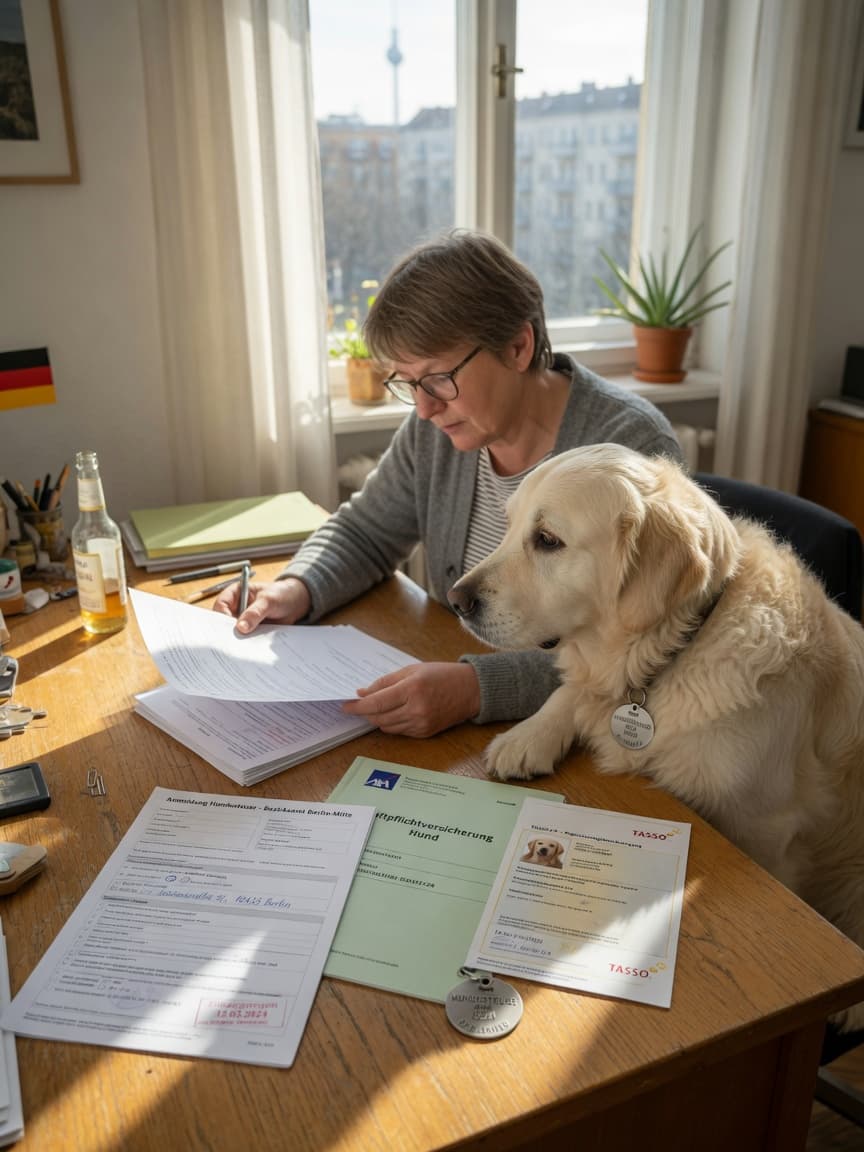
Dog Ownership in Germany: A Complete Legal Guide
Germany has approximately 10.6 million dogs — a number that has grown significantly in recent years. As a federal republic, Germany's dog laws are divided between national regulations, state-level (Bundesland) legislation, and local municipal ordinances. This layered system means that what is required of you as a dog owner in Bavaria may differ considerably from obligations in Berlin or Hamburg. This guide covers all the key areas you need to understand.
Hundehaftpflichtversicherung: Dog Liability Insurance
Dog liability insurance (Hundehaftpflichtversicherung) is one of the most important financial considerations for dog owners in Germany, and in several states it is legally mandatory:
- Berlin: Mandatory for all dog owners under the Berliner Hundegesetz
- Hamburg: Mandatory for all dogs under the Hamburgisches Hundegesetz
- Lower Saxony (Niedersachsen): Mandatory for all dog owners
- Saxony (Sachsen): Mandatory for all dog owners
- Thuringia (Thüringen): Mandatory for all dog owners
In states where it is not legally required, it remains very strongly recommended. German dog liability insurance typically covers personal injury and property damage caused by your dog to third parties — claims that can run into hundreds of thousands of euros in serious cases. Annual premiums for standard cover typically range from €40 to €100 per year for non-listed breeds, rising for breeds subject to BSL restrictions. Insurers such as HanseMerkur, Allianz, and HDI are among the major providers.
Hundesteuer: The German Dog Tax
Germany's Hundesteuer (dog tax) is levied by municipalities and is one of the longest-standing animal taxes in Europe, dating back to the 19th century. It is entirely locally determined, meaning rates vary enormously:
- Most municipalities charge between €60 and €200 per year for a standard dog
- A second dog in the same household typically attracts a higher rate — often 150–200% of the first dog's fee
- Dogs classified as "listed breeds" (Listenhunde) under state BSL legislation are taxed at a significantly higher rate — in some municipalities up to €600–800 per year or more
- Registered guide dogs, hearing dogs, and rescue dogs are commonly exempt
Dogs must be registered with your local Einwohnermeldeamt or Stadtkasse shortly after acquisition. You will receive a Hundesteuermarke — a metal tag which must be worn on the dog's collar at all times. Failure to register is an administrative offence.
Microchipping and the TASSO and FINDEFIX Registers
There is no single federal law mandating microchipping for all dogs in Germany, but several states have introduced their own requirements and it is effectively standard practice. The microchip must comply with ISO 11784/11785 (15-digit transponder). Once microchipped, registration on a national database is strongly recommended — the two main voluntary registers are:
- TASSO: Europe's largest free pet register, operating since 1984, with millions of registered animals. Registration is free at tasso.net
- FINDEFIX: Run by the German Animal Welfare Federation (Deutscher Tierschutzbund), also free and nationally recognised
Both databases are checked by animal shelters and veterinary practices when a lost dog is brought in. Registering on both is advisable. The microchipping procedure itself costs between €30 and €60 at a private clinic.
Breed-Specific Legislation (BSL): Bavaria vs NRW and Beyond
Germany has no federal BSL, meaning each of the 16 states sets its own rules. The result is a patchwork of regulations that can be confusing for owners who move between states:
- Bavaria (Bayern): Operates a two-tier system. Certain breeds (including American Pit Bull Terrier, American Staffordshire Terrier, Staffordshire Bull Terrier, and Bull Terrier) are considered Kampfhunde (fighting dogs) and require special permits, a Wesenstest (behavioural assessment), muzzle and lead requirements, and proof of liability insurance
- North Rhine-Westphalia (NRW): Has moved away from breed-specific bans in favour of a more individual assessment approach following court rulings. Owners of certain breeds must pass a Sachkundenachweis (competency test) demonstrating responsible ownership
- Lower Saxony: Maintains a list of restricted breeds requiring a permit, Wesenstest, and enhanced insurance
- Berlin: Requires a permit for listed breeds, but has removed the outright ban that previously existed for some breeds
Before acquiring a dog of a breed that might be considered a Listenhund, always check the current legislation in your specific Bundesland, as laws change and court decisions continue to reshape the landscape.
Leash Laws and Public Spaces
Leash requirements in Germany are primarily set at state and municipal level. In most cities, dogs must be kept on a lead in pedestrian zones, public parks, playgrounds, and on public transport. German public transport (BVG in Berlin, MVV in Munich, HVV in Hamburg) generally permits dogs to travel if they are on a lead and muzzled, with a reduced-price ticket required for the dog.
Many parks have designated off-lead areas (Hundewiesen or Hundeausläufe) where dogs may run free. Outside these zones, leads are required. In forests and nature reserves, seasonal leash requirements often apply during breeding seasons (typically March to July) to protect wildlife — these are posted at forest entrances.
Gassi-Gehen: The Legal Walking Requirement
Germany's national animal welfare act (Tierschutzgesetz) requires that dogs receive adequate exercise, social contact, and mental stimulation appropriate to their species. Some German states have gone further, with guidance stipulating that dogs must be taken outside for walks at least twice daily. While enforcement of a specific number of walks is difficult in practice, neglect of a dog's exercise needs can constitute an animal welfare offence, with penalties including fines and removal of the animal.
Finding a Vet in Germany
German veterinary professionals are regulated by the Bundestierärztekammer (Federal Chamber of Veterinary Surgeons) and its 17 regional chambers (Landestierärztekammern). You can find a registered vet via the Bundestierärztekammer website (bundestieraerztekammer.de) or through regional directories. Germany has an exceptionally high density of veterinary practices and specialist referral clinics.
Average consultation fees at a private clinic are regulated by the Gebührenordnung für Tierärzte (GOT — the fee schedule for veterinarians). A standard consultation typically costs €15–30 as the base examination fee, with additional charges for treatments and diagnostics. Annual vaccinations usually total €80–150. Specialist referrals and emergency care are considerably more expensive. For pet food, supplements, and veterinary products, Zooplus Germany (zooplus.de) is the country's largest online pet retailer.
Your Checklist as a Dog Owner in Germany
- Register your dog with your local Ordnungsamt and pay the Hundesteuer
- Have your dog microchipped and registered on TASSO and FINDEFIX
- Take out Hundehaftpflichtversicherung (mandatory in several states, essential everywhere)
- Ensure your dog wears its Hundesteuermarke on its collar at all times
- Check your Bundesland's BSL rules if you own a breed that may be listed
- Follow local leash laws and observe seasonal wildlife protection periods in forests
- Provide your dog with at least two outdoor walks per day