
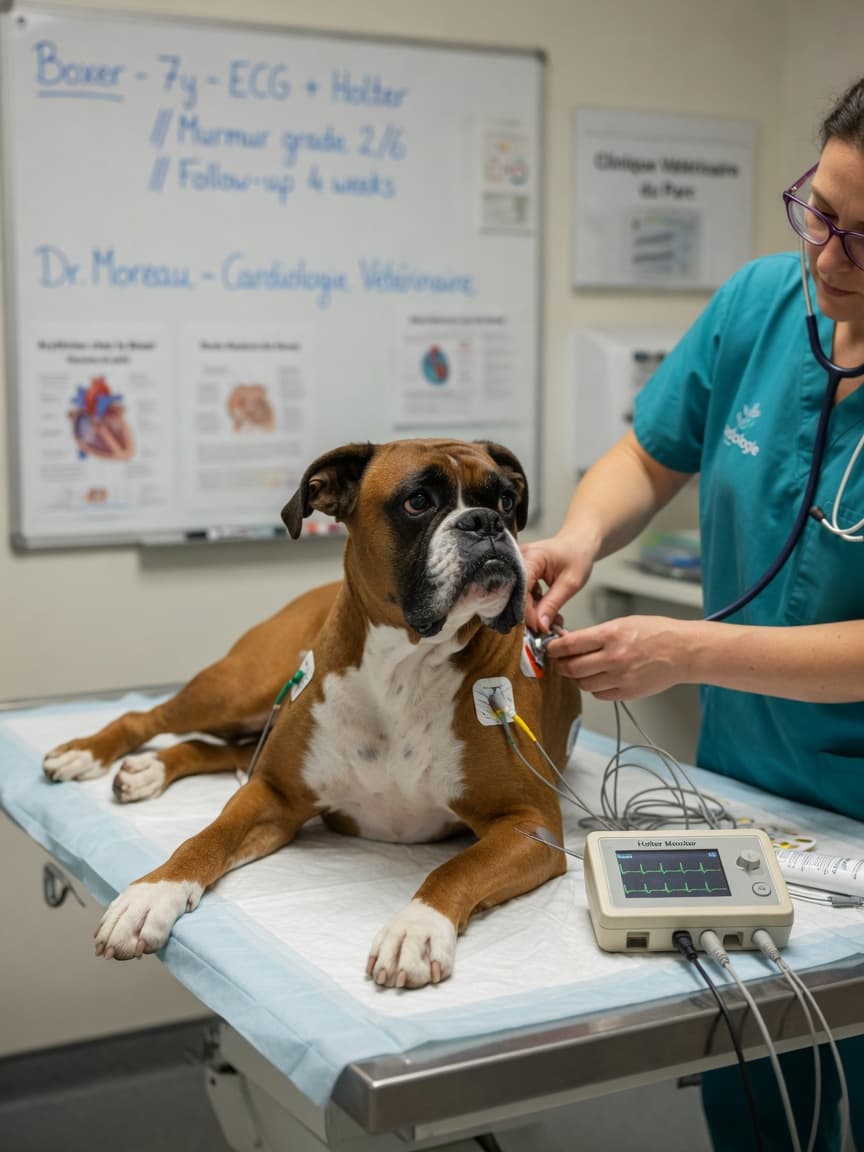
Why Boxers Need a Different Kind of Care
Ask any experienced veterinary cardiologist which breed keeps them busiest, and the Boxer will feature prominently on the list. This athletic, affectionate breed carries a uniquely challenging cluster of inherited health risks — cardiac arrhythmias that can cause sudden death, tumours that disguise themselves as innocent skin lumps, and an anatomy that makes every warm afternoon a potential respiratory crisis. Owning a Boxer well means understanding these risks before they become emergencies.
Boxer Cardiomyopathy: A Silent and Serious Condition
Arrhythmogenic right ventricular cardiomyopathy (ARVC), commonly called Boxer cardiomyopathy, is a genetic condition in which abnormal heart muscle tissue triggers dangerous electrical rhythm disturbances. Unlike some cardiac conditions that develop gradually, ARVC can cause sudden collapse or death with little warning — even in apparently healthy, active dogs.
How it presents
- Fainting or sudden collapse, sometimes during or after exercise
- Episodes of weakness or apparent confusion lasting seconds
- Heart palpitations detectable as an irregular pulse
- In some dogs, no visible signs before sudden cardiac death
Diagnosis and management
A standard stethoscope examination will not reliably detect ARVC, because the problem lies in rhythm rather than sound. A 24-hour Holter monitor — a portable ECG worn by the dog — is the gold-standard screening tool and is recommended for all Boxers from around two years of age, ideally repeated annually. A genetic test is also available and can identify dogs carrying the known ARVC mutation, though a negative result does not guarantee a clear heart. Any Boxer displaying fainting episodes should be seen by a veterinary cardiologist as an urgent priority, not a routine appointment.
Mast Cell Tumours: The Lump That Must Not Be Ignored
Mast cell tumours (MCTs) are the most common skin tumour in dogs overall, but Boxers are among the breeds at greatest risk. What makes MCTs particularly dangerous is their appearance — they can look like an unremarkable fatty lump, a small raised wart, or a soft skin tag. Only microscopic examination of a sample (fine needle aspirate or biopsy) can confirm the diagnosis.
MCTs range enormously in behaviour. Some are low-grade and cured by surgical removal; others are high-grade, aggressive, and capable of spreading to internal organs. The grade is determined by histopathology after excision. Because of this variability, no lump on a Boxer should ever be dismissed without veterinary assessment.
What to monitor
- Any new lump or bump, regardless of size or texture
- Lumps that appear to fluctuate in size — this is a classic MCT sign caused by histamine release
- Redness, swelling, or ulceration around a skin mass
- Vomiting or gastrointestinal upset alongside skin changes (systemic histamine effects)
Brachycephalic Obstructive Airway Syndrome
The Boxer's flattened face is central to the breed's expression and appeal — it is also the source of significant respiratory compromise. Brachycephalic obstructive airway syndrome (BOAS) encompasses a group of related anatomical abnormalities including narrow nostrils (stenotic nares), an overlong soft palate, a narrow trachea, and everted laryngeal saccules. Together, these structures restrict airflow and force the dog to work continuously harder to breathe.
Signs of BOAS
- Loud snoring at rest, not just during sleep
- Noisy, effortful breathing during exercise or excitement
- Rapid overheating in warm weather or with minimal exertion
- Gagging, regurgitation, or vomiting (related structural changes affect the oesophagus)
- Blue-tinged gums (cyanosis) during exercise — a veterinary emergency
Managing BOAS in Boxers
Mild cases can be managed conservatively: avoid exercise in warm weather, use a harness rather than a collar, maintain a lean body weight (excess weight significantly worsens respiratory function), and never leave a Boxer in a hot car. Moderate to severe BOAS frequently warrants surgical correction — widening the nostrils and shortening the soft palate are common procedures with good outcomes when performed before secondary damage occurs. A BOAS functional grading assessment from a specialist can help determine whether surgery is advisable.
Additional Health Considerations
Beyond the three primary concerns, Boxers are also predisposed to hypothyroidism, which can mimic other conditions through symptoms including weight gain, lethargy, and skin changes. Degenerative myelopathy — a progressive spinal cord condition causing rear limb weakness — is also seen in older Boxers. A simple DNA swab test is available for the known genetic mutation. Spondylosis deformans (bony spinal growths) is another age-related finding that warrants monitoring.
A Practical Health Plan for Boxer Owners
- Arrange a Holter monitor assessment from age two and repeat annually or as your vet advises
- Consider the ARVC genetic test for breeding dogs and inform yourself of results before purchase
- Check your Boxer's skin thoroughly at every grooming session — photograph and record any new lumps
- Have all new skin masses assessed by a vet with fine needle aspirate before assuming benignity
- Arrange a BOAS functional grading assessment if breathing sounds laboured at rest
- Keep your Boxer lean — excess body weight worsens both BOAS and cardiac function
- Avoid exercise in temperatures above 20°C, particularly in humid conditions
Boxers are resilient, energetic dogs who thrive with attentive owners. The conditions described here are serious, but they are also well-understood, and early veterinary involvement consistently leads to better outcomes. Always consult your vet if you notice any of the signs outlined above rather than adopting a wait-and-see approach.