
Cancer in Cats: Early Warning Signs & Most Common Types
By Sarah Bennett, Certified Animal Nutritionist
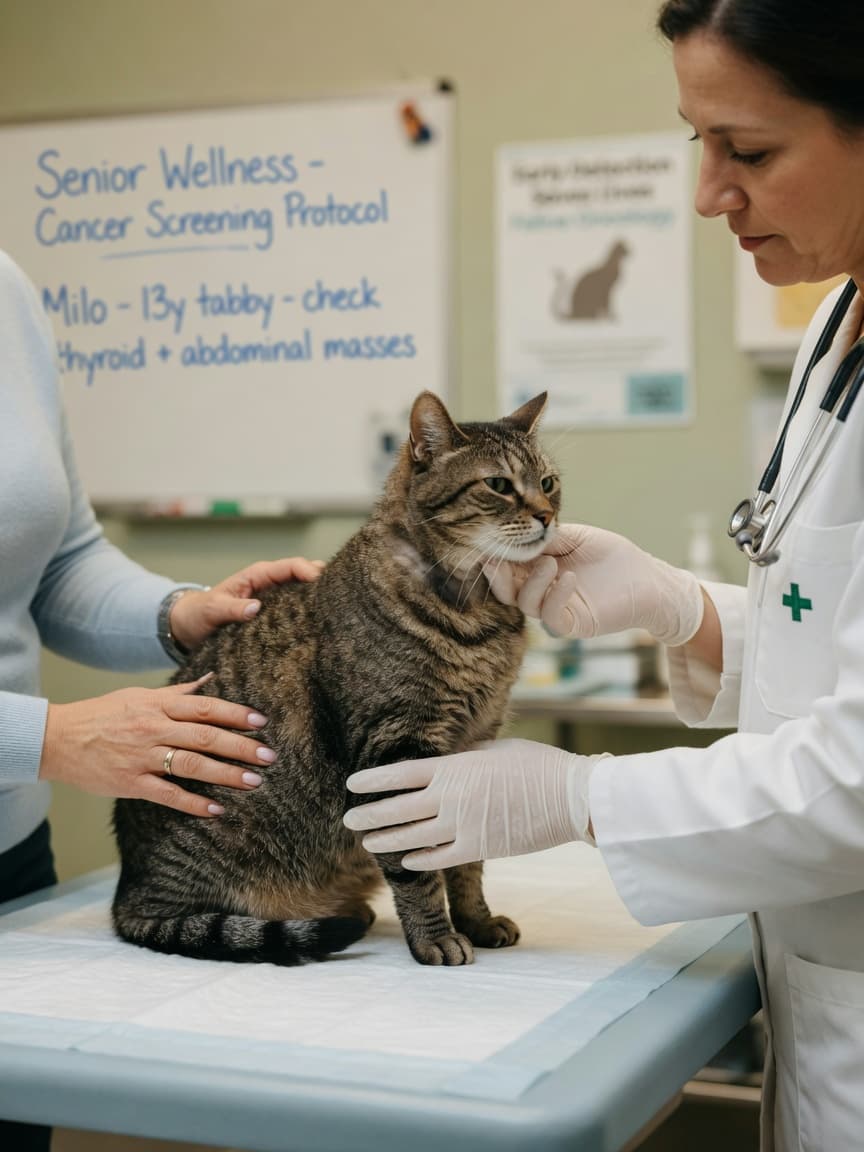
Cancer is the leading cause of disease-related death in cats over 10 years old, yet many owners are caught off guard by a diagnosis because the early signs are easy to dismiss or attribute to normal aging. Unlike dogs, cats are statistically more likely to develop malignant (aggressive) tumors when they do develop cancer, making early recognition and prompt veterinary evaluation genuinely critical. This guide covers the most common cancers in cats, what to watch for, and when you need to act.
Lymphoma: The Most Common Feline Cancer
Lymphoma is by far the most frequently diagnosed cancer in cats, accounting for approximately 30% of all feline tumors. It is a cancer of lymphocytes (white blood cells) and can arise in virtually any location: the intestines (most common), mediastinum (chest cavity), kidneys, liver, nasal cavity, or skin.
Gastrointestinal (alimentary) lymphoma is the most prevalent form in adult and older cats. It presents as chronic weight loss, vomiting, diarrhea, and reduced appetite — signs easily confused with inflammatory bowel disease (IBD), pancreatitis, or other GI conditions. Low-grade (small cell) alimentary lymphoma is the more common and more manageable form; it can often be controlled for 2 or more years with oral chemotherapy (chlorambucil and prednisolone). High-grade lymphoma is more aggressive with a shorter median survival even with treatment.
Mediastinal lymphoma predominantly affects young cats (often under 3 years), frequently associated with feline leukemia virus (FeLV). It causes rapid accumulation of fluid in the chest and presents as severe labored breathing, open-mouth breathing, and exercise intolerance — a true emergency requiring immediate drainage and hospitalization.
FeLV and FIV infections are significant risk factors for lymphoma. Vaccination against FeLV is recommended for at-risk outdoor cats and is an important preventive measure.
Mammary Tumors
Mammary (breast) tumors are the third most common tumor in cats, and they are strikingly more malignant than in dogs. Approximately 85–90% of feline mammary tumors are malignant (compared to 50% in dogs), and the majority are adenocarcinomas with significant metastatic potential — most commonly spreading to regional lymph nodes and the lungs.
Intact (unspayed) female cats carry the greatest risk. spaying-cat-europe-guide" title="Spaying Cat Europe Guide">Spaying before the first heat cycle reduces mammary tumor risk by approximately 91%; spaying before 6 months of age is maximally protective. After 2 years of age, spaying provides no significant mammary protection.
Signs include firm, often irregular or ulcerated lumps along the two rows of mammary glands on the underside of the abdomen and chest. Any new lump in this region should be evaluated promptly — do not wait to see if it grows. Treatment is surgical: aggressive mastectomy (removal of the entire affected mammary chain) followed by staging for metastatic disease. Chemotherapy with doxorubicin may be recommended as adjuvant therapy.
Squamous Cell Carcinoma (SCC)
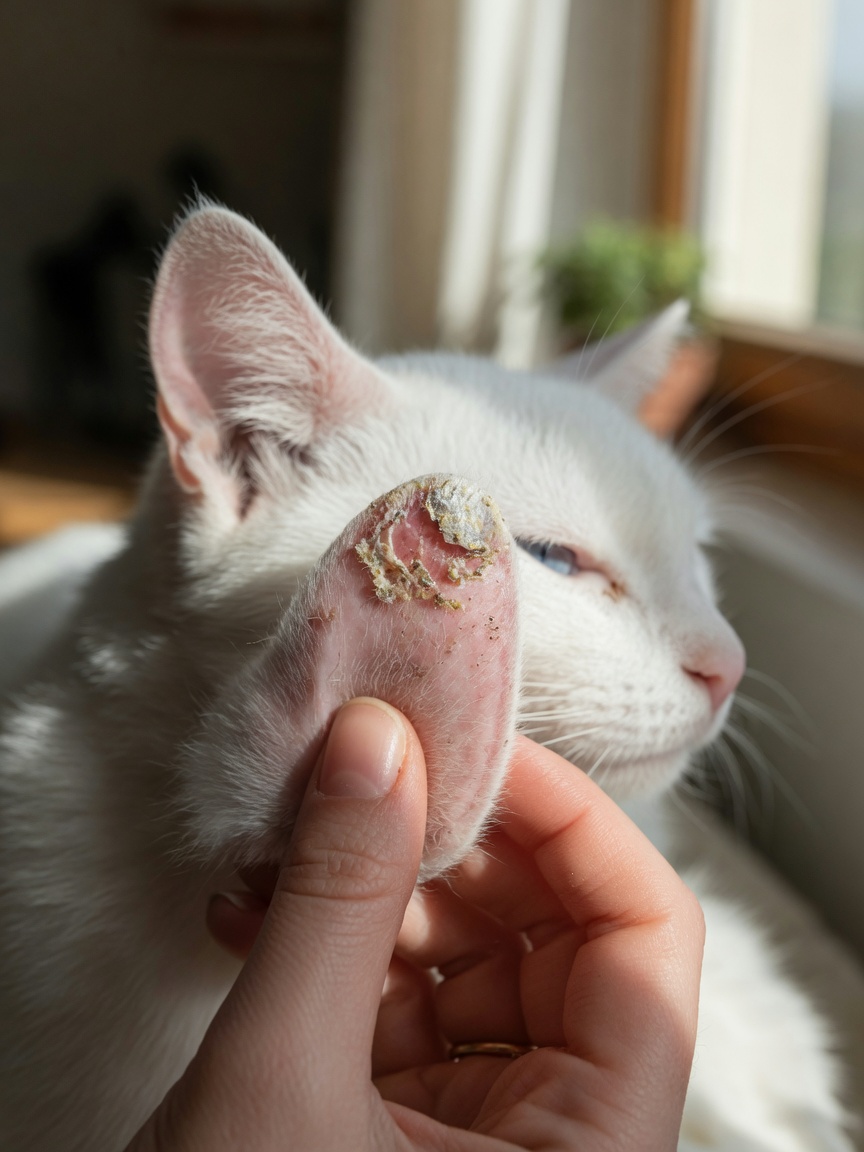
Squamous cell carcinoma is the most common oral tumor in cats and is also frequently seen on the skin, particularly in areas with little pigmentation and sun exposure: the tips of the ears, the nose, and the eyelids. White cats and cats with pale or sparsely-furred ear tips are at highest risk for sun-induced SCC.
Cutaneous SCC often begins as a scaly, crusting, or ulcerated lesion that fails to heal. Owners sometimes mistake early lesions for a scratch or bite wound. Limiting sun exposure (keeping cats indoors, especially midday) and checking lightly-pigmented skin areas regularly can facilitate early detection, when surgical excision is most likely to be curative.
Oral SCC is one of the most devastating cancers in cats. It typically presents as a rapidly growing mass under the tongue or on the gums, causing difficulty eating, drooling, weight loss, and halitosis. Sadly, oral SCC is rarely caught early enough for curative surgery, and median survival even with aggressive treatment is typically 1–3 months. This underscores the importance of regular oral examinations by your veterinarian.
Mast Cell Tumors
Mast cell tumors (MCT) in cats behave differently from those in dogs. Feline MCT most commonly appears on the skin — often on the head and neck — as single or multiple small, raised, firm, frequently itchy nodules. The splenic form (mast cell tumor of the spleen) is also seen and can cause splenomegaly (enlarged spleen), vomiting, and weight loss.
Cutaneous MCT in cats is often benign or low-grade and can be treated successfully with surgical excision. Splenic MCT may respond to splenectomy, sometimes with significantly prolonged survival. Systemic MCT carries a more guarded prognosis. If you notice small firm bumps on your cat's skin that your cat scratches frequently, have them evaluated — do not assume they are harmless cysts.
Other Notable Cancers
Osteosarcoma (bone cancer) is rare in cats compared to dogs, but when it occurs, typically in the limbs, it causes progressive lameness and bone pain. Cats appear to have a less aggressive form than dogs, with lower metastatic rates, making limb amputation more likely to be curative.
Injection-site sarcoma (feline injection-site sarcoma, FISS) is a locally aggressive, malignant tumor that develops at sites of injection — historically associated with rabies and FeLV vaccines. Modern adjuvant-free vaccines and rotating injection sites have reduced incidence, but owners should monitor any lump at a vaccination site that persists beyond 4 weeks, grows larger than 2 cm, or increases in size. This is the veterinary "3-2-1 rule" for post-vaccination lumps.
Early Warning Signs: What Every Cat Owner Should Watch For
The American Veterinary Medical Association identifies the following as warning signs that warrant prompt veterinary evaluation in cats:
- Unexplained weight loss or muscle wasting
- Any new lump or bump, or a known lump that changes in size, shape, or texture
- Sores that do not heal within 2–3 weeks
- Persistent difficulty eating, swallowing, or chewing
- Offensive odor from mouth, ears, or body
- Difficulty breathing, labored breathing, or open-mouth breathing
- Persistent lameness or stiffness
- Abdominal distension (swollen belly)
- Chronic vomiting or diarrhea not explained by dietary change
- Decreased appetite lasting more than 48 hours
When to See a Vet: Do Not Wait
The cultural tendency to "monitor" a concern in a cat rather than seek immediate evaluation has a cost. With cancers like oral SCC and mammary tumors, even a few weeks of delay can make the difference between surgical cure and palliation. The rule of thumb: any lump present for more than 4 weeks, any wound that fails to heal in 3 weeks, or any of the warning signs above merit a veterinary appointment — not monitoring at home. At minimum, your vet can rule out cancer and give you peace of mind.
Key Takeaways
- Cancer is the leading cause of death in cats over 10; 85–90% of mammary tumors are malignant.
- Lymphoma is the most common feline cancer; the intestinal form is often manageable long-term.
- Spaying females before their first heat reduces mammary cancer risk by up to 91%.
- Any lump at a vaccination site persisting beyond 4 weeks needs immediate vet evaluation (3-2-1 rule).
- Oral SCC is devastating and rarely caught early — regular oral exams are essential.
- Do not wait: early diagnosis dramatically improves treatment options and outcomes.
References
- Vail DM, Young KM. "Hematopoietic tumors." In: Withrow SJ, Vail DM, eds. Withrow & MacEwen's Small Animal Clinical Oncology. 4th ed. St. Louis: Saunders Elsevier; 2007. PMID: 17466610
- Overley B, et al. "Association between ovarihysterectomy and feline mammary carcinoma." Journal of Veterinary Internal Medicine. 2005;19(4):560-563. PMID: 16095175