
Why Cats Groom Themselves So Much
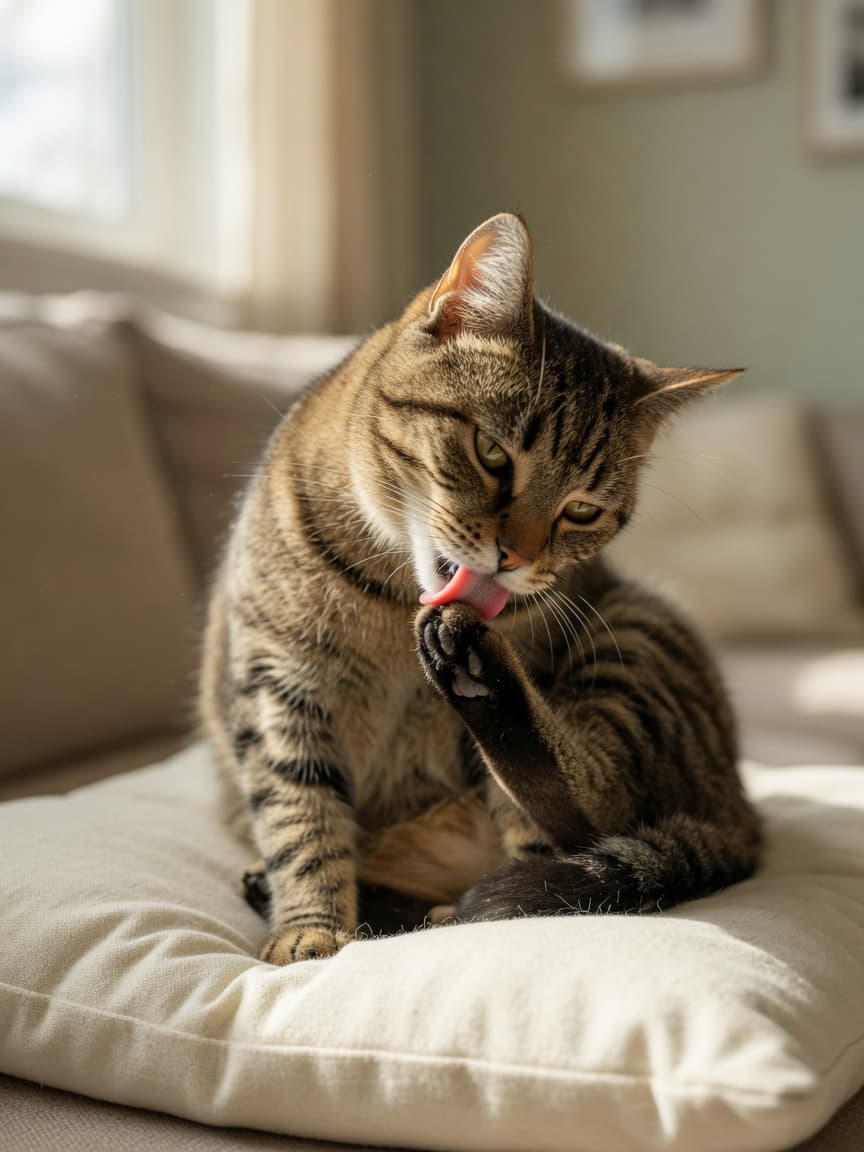
A healthy adult cat dedicates between 30 and 50 per cent of their waking hours to grooming. To a casual observer this might seem excessive — surely a quick lick is enough? In reality, self-grooming in cats is a sophisticated, multi-functional behaviour that serves vital biological and psychological purposes. Understanding what your cat is achieving when they groom themselves helps you distinguish healthy behaviour from signs that something may be wrong.
The Functions of Feline Self-Grooming
Thermoregulation via Saliva Evaporation
Cats do not sweat efficiently through their skin the way humans do. Instead, they rely partly on the evaporation of saliva deposited during grooming to cool themselves. When a cat licks their fur on a warm day, the moisture evaporates and draws heat away from the skin surface — a form of thermoregulation that is particularly important during hot weather. This is one reason why cats groom more frequently when they are warm or stressed, as stress also raises body temperature.
Scent Neutralisation for Hunting
Domestic cats retain the instincts of their wild ancestors, and one of those instincts is scent management. Predators that carry a strong personal scent are detectable by prey. By grooming thoroughly — particularly after eating — cats remove food odours and other scent traces from their coats. Even indoor cats that have never hunted in their lives continue this behaviour because it is hardwired, not learned.
This same instinct is why cats often groom themselves after being handled by humans. They are not expressing displeasure; they are simply re-establishing their own scent signature after it has been overlaid by a foreign one.
Relaxation and Displacement Behaviour
Grooming has a genuine calming effect on cats. The repetitive, rhythmic motion of licking activates the parasympathetic nervous system and promotes relaxation. Cats frequently groom after being startled, after a mildly frustrating experience, or during moments of low-level social tension. In ethology, this is called displacement behaviour — when an animal is caught between two competing motivations, it channels the resulting conflict into an unrelated, self-soothing action.
You may notice your cat suddenly grooming mid-play, or after a failed jump. This is not embarrassment — it is a neurological reset mechanism that allows them to de-escalate their own arousal levels and return to a calm baseline.
Allogrooming: Social Grooming Between Cats
When two cats groom each other, the behaviour is called allogrooming. This occurs between bonded cats and serves both practical and social functions. Practically, cats cannot easily access certain areas of their own bodies — the top of the head, behind the ears, the back of the neck — and a grooming partner fills this gap. Socially, allogrooming is a powerful bonding mechanism. It reinforces affiliative relationships, reduces tension between cats sharing a territory, and communicates mutual trust.
Allogrooming is typically initiated by the more confident cat and is concentrated around the head and neck of the recipient. If your cats engage in allogrooming, it is one of the clearest possible indicators that they have formed a genuine social bond. Do not interrupt it unless one cat is showing signs of discomfort — it is one of the most positive interactions two cats can share.
Interestingly, cats sometimes attempt to allogroom their human owners — particularly around the hairline or hands. This is a significant expression of social bonding and should be received as the compliment it is.
Overgrooming and Psychogenic Alopecia
When grooming exceeds normal levels and begins causing hair loss, broken fur, or skin irritation, the condition is referred to as overgrooming. The term psychogenic alopecia refers specifically to hair loss caused by excessive licking or chewing of the fur in the absence of a dermatological cause. However, arriving at a psychogenic diagnosis requires ruling out a range of physical conditions first.
Rule Out Medical Causes First
Before assuming stress is the driver of overgrooming, your veterinary surgeon will want to investigate physical causes. These include:
- Flea allergy dermatitis — even a single flea bite can trigger intense, localised itching in sensitised cats. Examine the skin carefully, particularly at the base of the tail and along the abdomen, for flea dirt or signs of hypersensitivity.
- Ringworm — a fungal infection that causes circular areas of hair loss, often with scaly or crusty skin at the margins. Highly contagious to other pets and to humans.
- Environmental or food allergies — cats can develop allergies to proteins in their diet or to environmental allergens such as dust mites or pollen, resulting in itching and overgrooming.
- Mites, particularly Demodex or Cheyletiella — microscopic parasites that cause skin irritation and hair loss.
- Pain — a cat that repeatedly licks or grooms a specific area may be responding to localised pain rather than skin irritation. Arthritis, internal discomfort, or bladder pain can all manifest as targeted overgrooming.
Only when medical causes have been excluded through a thorough examination, skin tests, dietary trials, and where necessary biopsy or blood work, is a diagnosis of psychogenic alopecia appropriate.
Stress-Induced Overgrooming
Once physical causes are ruled out, overgrooming is typically driven by chronic stress or anxiety. Common triggers include a new pet or person in the household, changes to routine, conflict between cats, an overstimulating environment with insufficient hiding places, or a single traumatic event that disrupted the cat's sense of safety. Treatment involves identifying and addressing the stressor wherever possible, alongside environmental enrichment, pheromone diffusers, and in some cases anti-anxiety medication prescribed by a vet.
Feline Hyperesthesia Syndrome
A less common but distinctive condition associated with abnormal grooming is feline hyperesthesia syndrome (FHS), sometimes called rolling skin syndrome or twitchy cat disease. Cats with FHS experience episodes of intense sensitivity along the skin of their back — the skin appears to ripple or roll, the cat may suddenly turn to bite or scratch at their tail, engage in frantic grooming, vocalise loudly, or display what looks like a brief hallucinatory state before returning to normal.
FHS is not fully understood. It may involve a neurological component similar to a focal seizure disorder, a dermatological trigger such as underlying allergies or spinal pain, or an obsessive-compulsive element. Episodes can be triggered by touch along the back, by stress, or can appear without any obvious stimulus.
Cats showing signs consistent with FHS should be assessed by a veterinary surgeon who may refer to a neurologist. Depending on the suspected cause, treatment may involve anti-seizure medication, anti-anxiety medication, dietary change, or management of any underlying skin condition.
When to See Your Vet
Contact your veterinary surgeon if you notice any of the following in relation to your cat's grooming behaviour:
- Visible hair loss or thinning, particularly in symmetrical patterns along the belly, inner thighs, or flanks
- Skin redness, scabbing, or open sores caused by licking
- Sudden changes in grooming frequency, whether a marked increase or a notable decrease
- Episodes of skin rippling, frantic behaviour, or apparent hallucination
- A cat that has stopped grooming — this can signal pain, illness, or severe depression
Grooming behaviour is one of the most reliable windows into your cat's physical and emotional health. Learning its normal rhythms allows you to notice changes early, and early intervention almost always leads to better outcomes.