
What Is the Bunny Kick?
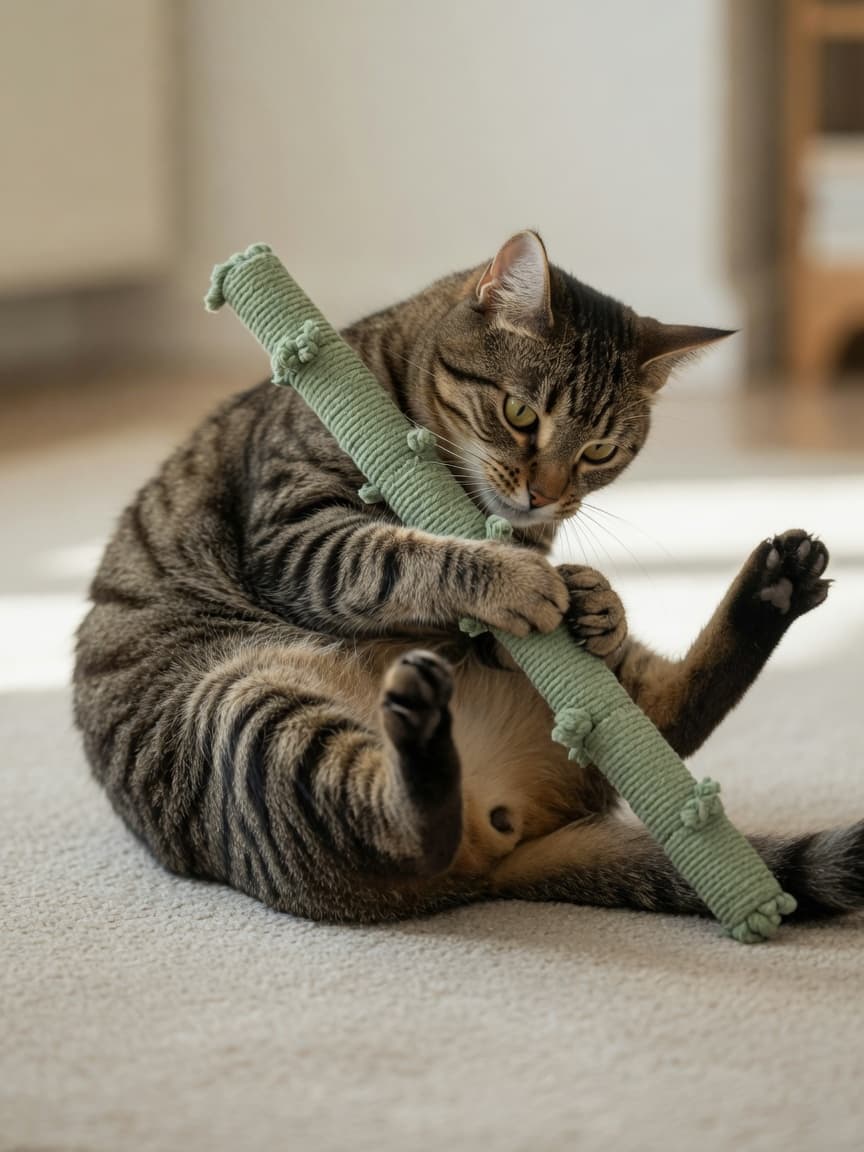
The bunny kick is one of the most distinctive behaviours in a cat's repertoire. When a cat wraps their front paws around an object — whether a toy, a cushion, or unfortunately your hand — and then rapidly pumps their back legs against it, they are performing what animal behaviourists call the killing grip. This is not aggression directed at you personally; it is a deeply hardwired predatory sequence that cats have carried from their wild ancestors.
In the wild, cats use this exact technique to subdue prey. The front paws grip the target firmly to prevent escape, while the powerful back legs deliver rapid, raking kicks designed to disembowel or incapacitate. Even the most pampered indoor cat retains this instinct in full. The bunny kick you see during play is the same motor pattern, redirected onto something far less consequential than actual prey.
Play vs Overstimulation: Knowing the Difference
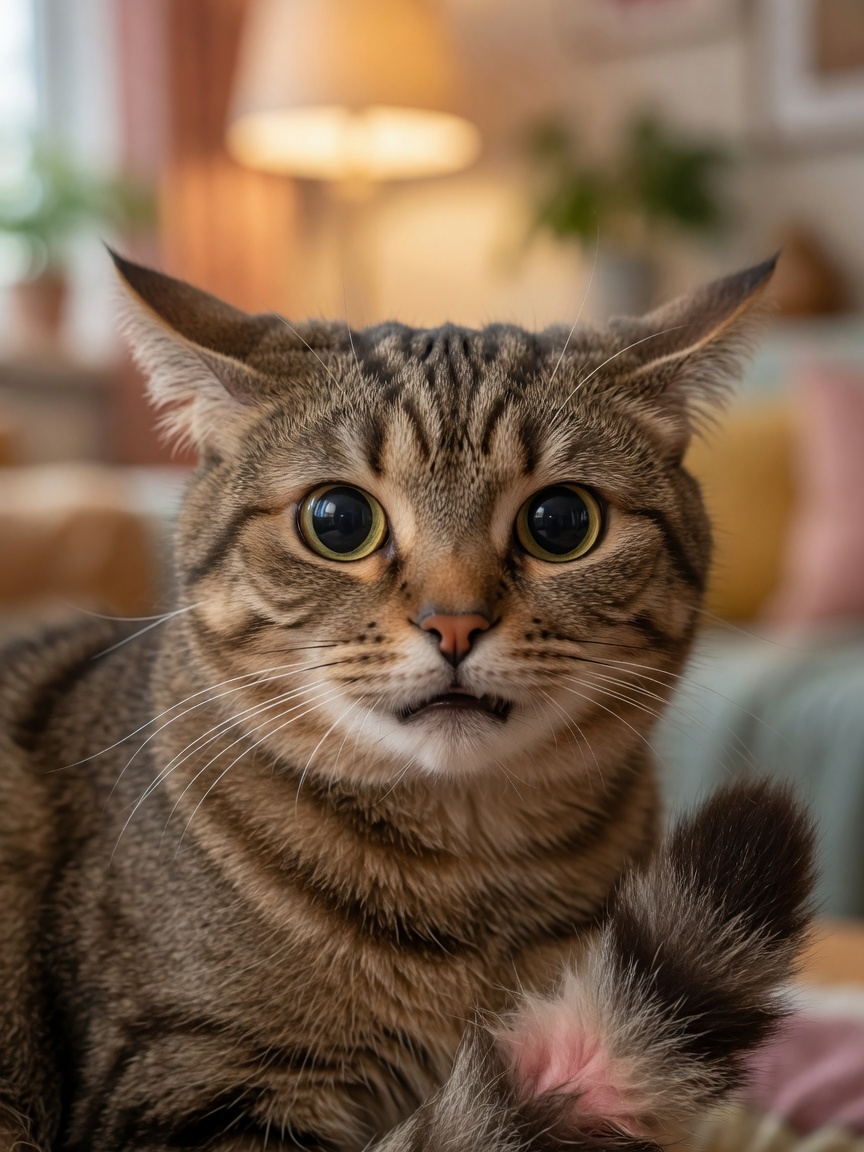
Not every bunny kick signals the same emotional state. Cats engage in this behaviour for two distinct reasons — genuine play and overstimulation — and the difference matters a great deal for your safety and your cat's wellbeing.
Signs of Playful Bunny Kicking
- Relaxed body posture before the kick sequence begins
- Pupils moderately dilated rather than fully blown
- Soft, quiet vocalisation or complete silence
- The cat voluntarily approaches the toy and initiates contact
- Pauses between kick sequences, looking relaxed or even rolling onto their back
- Ears facing forward or slightly to the side
Signs of Overstimulation
- Skin along the back twitching or rippling
- Tail lashing side to side in sharp, rapid sweeps
- Ears flattening or rotating backwards
- Growling, hissing, or low vocalisations mid-session
- Eyes fully dilated even in bright light
- Biting that becomes harder and more deliberate rather than gentle mouthing
Reading Tail Signals: Your Most Important Warning System
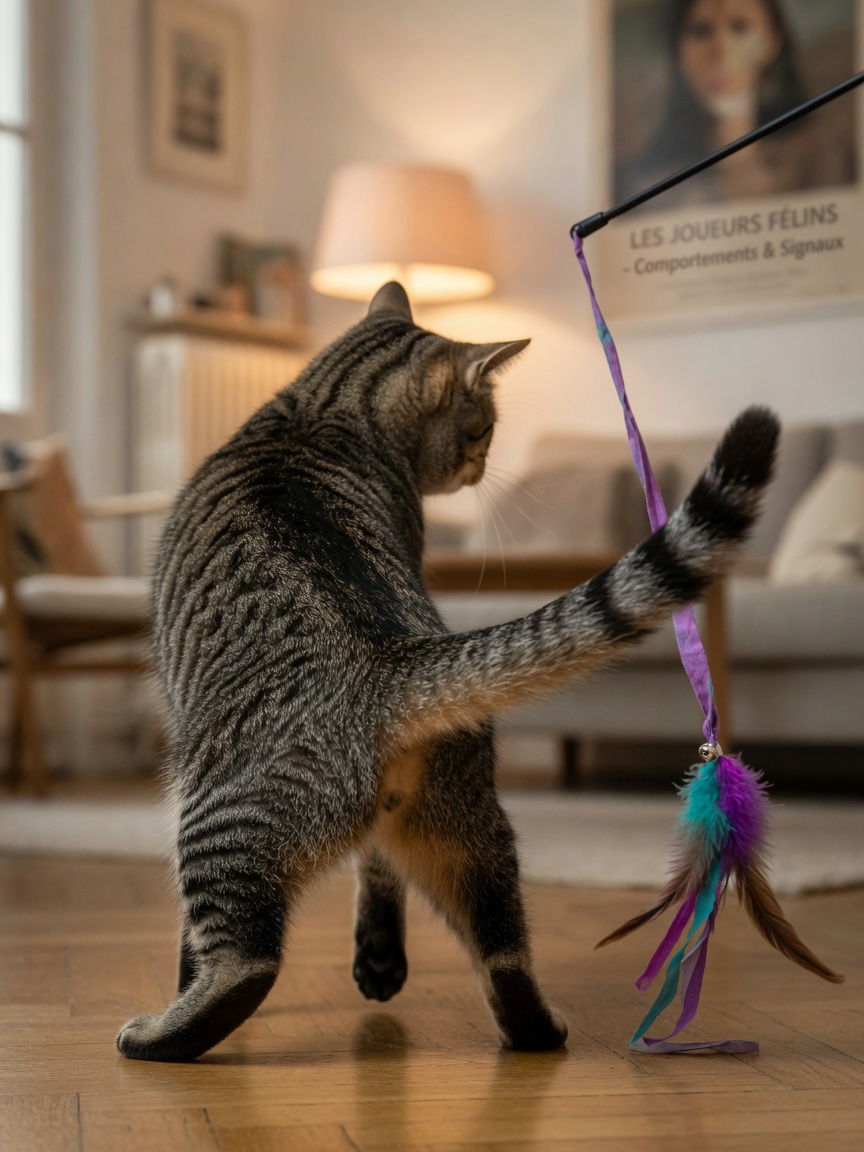
The tail is your clearest real-time indicator of your cat's emotional state during play. A gently swishing tail often simply reflects concentration and excitement — the same movement you see when a cat watches a bird through a window. However, a tail that lashes rapidly and forcefully from side to side is an unmistakable warning. This pattern of movement signals escalating arousal and frustration. If you see a lashing tail, stop the interaction immediately.
Do not wait for your cat to bite or scratch before ending the session. The lashing tail is your advance warning, and responding to it promptly teaches your cat that their communication is understood. Cats that are consistently ignored at this stage may skip the warning signals altogether and go straight to biting, which makes future interactions more difficult to manage.
A puffed tail base or a tail held low and rigid are additional signals that your cat has moved beyond playful arousal into genuine distress or defensiveness. End all interaction and give the cat space to settle.
When to End a Play Session
Timing is everything in feline play. The goal is to keep sessions energetic and engaging without pushing past the point of overstimulation. As a general guide, most cats benefit from several short play sessions of around ten to fifteen minutes spread across the day rather than one long marathon session. This mirrors the natural hunting pattern of multiple small hunts.
End the session on a positive note — ideally just before your cat begins to show signs of overstimulation rather than after. Wind down by slowing the pace of play gradually, allowing the cat to make a final successful catch. This mirrors the end of a hunt and gives the cat a sense of completion. After a successful session, many cats will groom themselves or settle down for a nap; this is a good sign that the session ended at the right moment.
If your cat does become overstimulated, put down the toy, stand up slowly, and walk away without making a fuss. Reacting loudly or pulling away sharply can trigger a chase response that escalates the situation. Give your cat fifteen to twenty minutes to settle before attempting further interaction.
Appropriate Toys for Bunny Kicking
Because the bunny kick is a powerful, instinctive behaviour, providing the right outlet is essential. Well-designed toys protect both your cat and your household, and they make the experience far more satisfying for a cat whose natural instincts are being properly engaged.
Kicker Toys
Kicker toys are elongated, often cylindrical toys — typically around thirty to forty centimetres in length — that are specifically designed to be grabbed and kicked. Their size and shape perfectly match the proportions of prey that would trigger the killing grip in the wild. Many kicker toys contain catnip or silvervine to increase initial interest, and their size means a cat can wrap their whole body around them during an enthusiastic session.
Plush Prey Items
Small to medium plush toys shaped like mice, rabbits, or birds satisfy the grip-and-kick sequence in a way that flat or hard toys cannot. Look for toys that have some give and flex to them, as rigid objects do not respond the way prey would and can be less satisfying. Toys with crinkle filling or rustling sounds add an additional sensory dimension that heightens engagement.
Interactive Wand Toys
Wand toys with feathered or fabric attachments allow you to trigger the bunny kick from a safe distance. Drag the toy across the floor and allow your cat to pounce and grip before gently attempting to pull it away, triggering the kick response. This keeps your hands well away from those working back legs.
Never Use Your Hands as Toys
This point cannot be overstated. Using your fingers, toes, or hands as play objects teaches your cat that human skin is an acceptable target for biting and kicking. Cats do not distinguish between a hand that is playing and a hand that is reaching to stroke them. A cat who has learnt to bunny kick hands will do so reflexively, and the scratches and bites that result can be painful and prone to infection.
If your cat has already developed a habit of attacking hands, redirect them immediately and consistently onto an appropriate toy every single time. Never punish the cat physically — this causes fear and can worsen the behaviour. Consistency and redirection are the most effective tools available.
Is Bunny Kicking Ever a Concern?
In the vast majority of cases, bunny kicking is a completely normal and healthy behaviour that simply needs an appropriate outlet. However, if your cat appears to bunny kick compulsively, targeting their own tail, flanks, or limbs repeatedly, this may indicate a dermatological issue, pain, or a neurological condition. Likewise, if your cat has never bunny kicked before and suddenly begins doing so with apparent distress, a veterinary check is sensible. Context matters: purposeful play-kicking on a toy is healthy; frantic, self-directed kicking is worth investigating.
Providing regular interactive play sessions, appropriate kicker toys, and learning to read your cat's body language will ensure that this instinctive behaviour remains a source of enrichment and enjoyment rather than a management problem.