
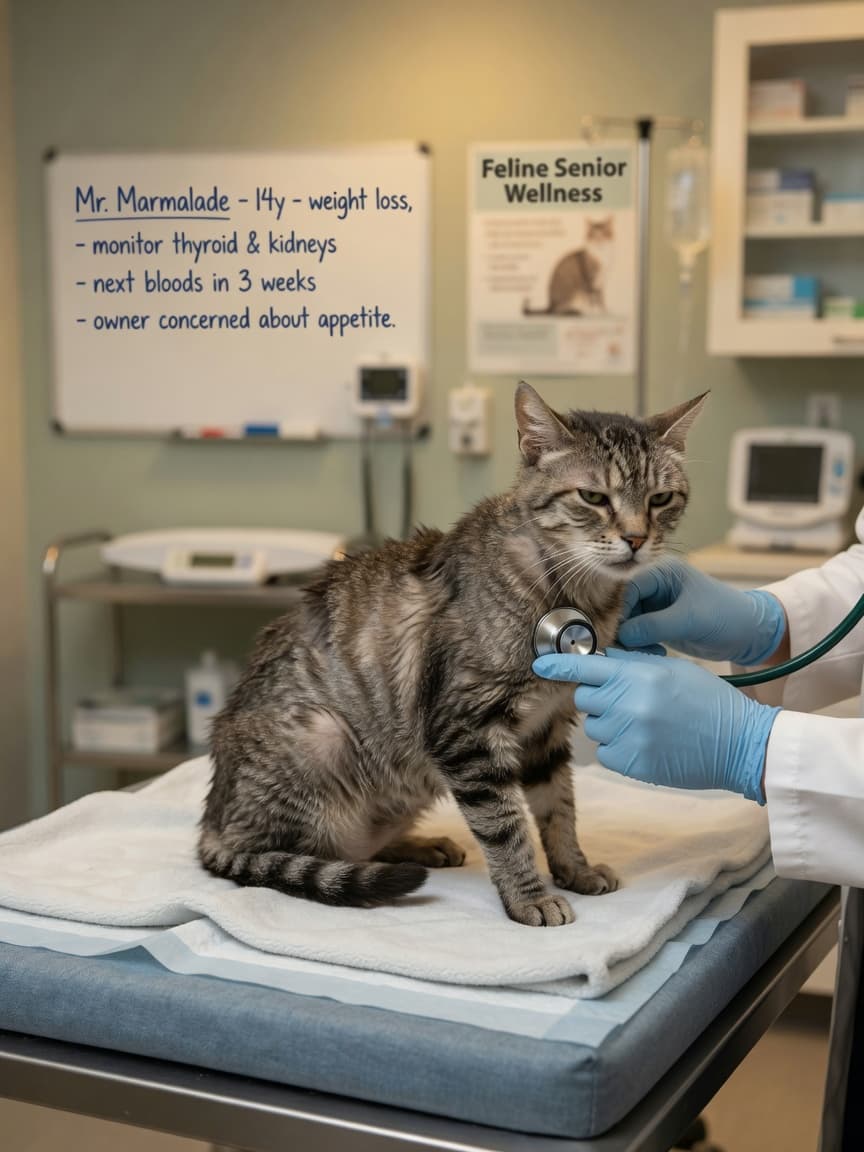
Why Chronic Kidney Disease Is So Common in Cats
Chronic kidney disease (CKD) is one of the most prevalent conditions in cats over the age of seven, and the most common cause of death in elderly cats. Studies suggest that more than 30% of cats over the age of 15 are affected. The kidneys are responsible for filtering waste products from the blood, regulating fluid and electrolyte balance, and producing hormones involved in red blood cell production and blood pressure control. As kidney tissue is progressively lost, these vital functions become increasingly impaired.
What makes feline CKD particularly challenging is that cats can lose up to 75% of their kidney function before showing overt clinical signs. By the time classic symptoms appear, the disease may already be advanced. This is why early detection through routine screening is so important — and why both WSAVA (World Small Animal Veterinary Association) and IRIS (International Renal Interest Society) guidelines place such emphasis on regular kidney biomarker testing in older cats.
Early Warning Signs to Watch For
Because early-stage CKD is largely silent, owners must be alert to subtle changes in their cat's behaviour and habits. The earliest signs are often easy to overlook:
- Increased thirst and urination — the kidneys lose their ability to concentrate urine, so the cat compensates by drinking more
- Gradual weight loss, particularly muscle wasting over the spine and hindquarters
- Reduced appetite or intermittent food refusal
- Lethargy and decreased interest in play or interaction
- Unkempt coat — cats in early renal failure often groom less
- Occasional vomiting, often in the morning
- Bad breath with a faintly ammonia-like or metallic smell
As the disease progresses, more severe signs develop including profound lethargy, complete anorexia, ulcers in the mouth, and neurological signs in very advanced cases. Any cat showing early symptoms should be evaluated promptly.
The SDMA Test: Detecting CKD Years Earlier
Traditionally, kidney disease in cats was diagnosed using blood creatinine levels combined with urine specific gravity. The problem with creatinine is that it does not rise above the normal range until approximately 75% of kidney function has been lost — meaning disease is already quite advanced at diagnosis.
SDMA (symmetric dimethylarginine) is a newer biomarker that has transformed early CKD detection. SDMA rises above normal when only around 40% of kidney function has been lost, providing a much earlier window for intervention. WSAVA guidelines now recommend SDMA as part of routine annual health screening in cats over seven years of age, and it is included in most comprehensive senior blood panels. IRIS has incorporated SDMA into its staging criteria, recognising its superior sensitivity compared to creatinine alone.
IRIS Staging for Feline CKD
The IRIS staging system provides a standardised framework for assessing the severity of CKD and guiding treatment decisions. It is based primarily on fasting blood creatinine and SDMA levels, with additional sub-staging based on urine protein levels (UPC ratio) and systemic blood pressure.
- Stage 1: SDMA elevated, creatinine within normal range — earliest detectable disease, no clinical signs
- Stage 2: Mild elevation in creatinine, mild clinical signs may begin to appear
- Stage 3: Moderate azotaemia, more pronounced clinical signs including weight loss and intermittent vomiting
- Stage 4: Severe azotaemia, often accompanied by uraemic crisis and very poor quality of life without intensive management
IRIS staging is not a one-time assessment — it should be repeated over time as the disease progresses, and treatment adapted accordingly. Your vet will use it to determine which interventions are most appropriate at each stage.
Semintra: An EU-Licensed Treatment for Feline CKD
One of the most significant advances in feline renal medicine in recent years has been the EU licensing of Semintra (telmisartan oral solution) specifically for cats. Telmisartan is an angiotensin receptor blocker (ARB) that reduces protein loss in the urine (proteinuria) and lowers intraglomerular pressure, helping to slow the progression of CKD. It also has blood pressure-lowering properties, making it particularly useful in cats with concurrent hypertension.
Semintra is licensed in the EU for the reduction of proteinuria associated with CKD in cats and for the treatment of systemic hypertension. It is given once daily as an oral liquid, which many owners find easier to administer than tablets. IRIS guidelines recommend treating proteinuria in CKD cats with a UPC ratio above 0.4 at Stage 2 or above, and Semintra has become the first-choice agent for this indication.
Diet, Phosphate Binders and Supportive Care
Dietary management is central to the long-term care of cats with CKD. Renal diets are formulated to be low in phosphorus, moderately protein-restricted, and enriched with omega-3 fatty acids and antioxidants. Hills k/d and Royal Canin Renal are the most widely used prescription renal diets and are available through Zooplus, making it convenient to maintain a consistent supply at home. Both diets are available in wet and dry formulations, with wet food preferred for its higher moisture content, which supports kidney perfusion.
Phosphate restriction is a critical component of CKD management. Elevated blood phosphate accelerates kidney damage, so limiting dietary phosphate intake — and using phosphate binders when diet alone is insufficient — is an IRIS recommendation from Stage 2 onwards. Pronefra is a palatable oral phosphate binder containing calcium carbonate, chitosan, and magnesium hydroxide that is widely used in cats with CKD. It is given with meals to bind dietary phosphate before it is absorbed.
Blood Pressure Monitoring and Potassium Supplementation
Hypertension (high blood pressure) affects a significant proportion of cats with CKD and can cause severe secondary damage to the eyes, kidneys, heart, and brain. WSAVA guidelines recommend blood pressure measurement at every veterinary visit for cats with confirmed or suspected CKD. If hypertension is detected, treatment is indicated — Semintra or amlodipine (a calcium channel blocker) are the most commonly used agents in feline patients.
Potassium depletion is another common complication of feline CKD, particularly as the kidneys lose the ability to conserve electrolytes. Hypokalaemia (low potassium) causes muscle weakness, poor coat condition, and cervical ventroflexion (neck weakness). Potassium supplementation — either through a renal diet or oral potassium gluconate supplements — is recommended in cats with confirmed or suspected hypokalaemia.
With early detection, appropriate dietary management, regular monitoring, and targeted medical therapy, cats with CKD can maintain a good quality of life for many years after diagnosis. Annual screening for cats over seven — including SDMA — is the single most important step owners and vets can take together.