

Cat Weight Loss Diet: Portion Control, Calorie Counts & Timing
Weight management in cats is ultimately a numbers game: calories consumed must be less than calories expended. But getting those numbers right — and applying them correctly day after day — is where most owners struggle. This guide gives you the precise formulas, label-reading skills and meal-planning tools to run an effective, safe weight-loss diet for your cat. As a worked example throughout, we will use a 6 kg cat with a target weight of 4.5 kg.
Step 1 — Calculate Your Cat's Resting Energy Requirement (RER)
The Resting Energy Requirement is the number of kilocalories a cat needs to sustain basic metabolic functions at rest — breathing, circulation, cellular repair — before any activity is factored in. It is the foundation of all feline calorie calculations.
The formula accepted by veterinary nutritionists worldwide is:
This formula is used in WSAVA-endorsed veterinary nutrition guidelines: WSAVA Global Nutrition Guidelines.
Worked example — target weight 4.5 kg
For weight loss, the RER is calculated using the target (ideal) weight, not the current weight. This prevents overfeeding while still allowing safe, gradual loss.
- 4.50.75 = approximately 3.34
- RER = 70 × 3.34 = 234 kcal/day
Step 2 — Apply a Life Stage Multiplier
The RER is then multiplied by a factor that accounts for life stage, neuter status and weight-loss goal. For a neutered adult cat on a weight-loss programme, the standard multiplier is 0.8 × RER:
- Weight-loss target: 0.8 × 234 = 187 kcal/day
Some vets use 1.0 × RER at target weight as a starting point, then reduce if loss stalls. Your vet will advise the appropriate multiplier based on your cat's metabolic history. A clinical review published in Veterinary Clinics of North America: Small Animal Practice validates this approach: PubMed PMID 28550061.
Step 3 — Read Cat Food Labels for kcal
Once you know your cat's daily calorie target (187 kcal in our example), you need to find out how many calories are in the food you are feeding. This information should appear on the label — but knowing where to look and how to interpret it takes practice.
Where to find calorie information
- EU and UK labelling: Calories are listed as "metabolisable energy" in kcal per 100 g (wet foods) or per 100 g (dry foods). Not all manufacturers include this — if absent, check the brand's website or call the helpline.
- US labelling: The AAFCO requires kcal per kg and kcal per cup/can. Divide by 10 to get kcal per 100 g.
Typical calorie densities by food type
| Food type | Typical kcal per 100 g |
|---|---|
| Standard dry kibble | 330–400 kcal |
| Weight-management dry kibble | 280–320 kcal |
| Standard wet / canned | 70–110 kcal |
| Weight-management wet | 55–80 kcal |
| Grain-free high-protein wet | 90–130 kcal |
The Pet Food Manufacturers' Association (PFMA) provides useful guidance on interpreting pet food energy labels for UK consumers.
Wet vs Dry Food for Weight Loss
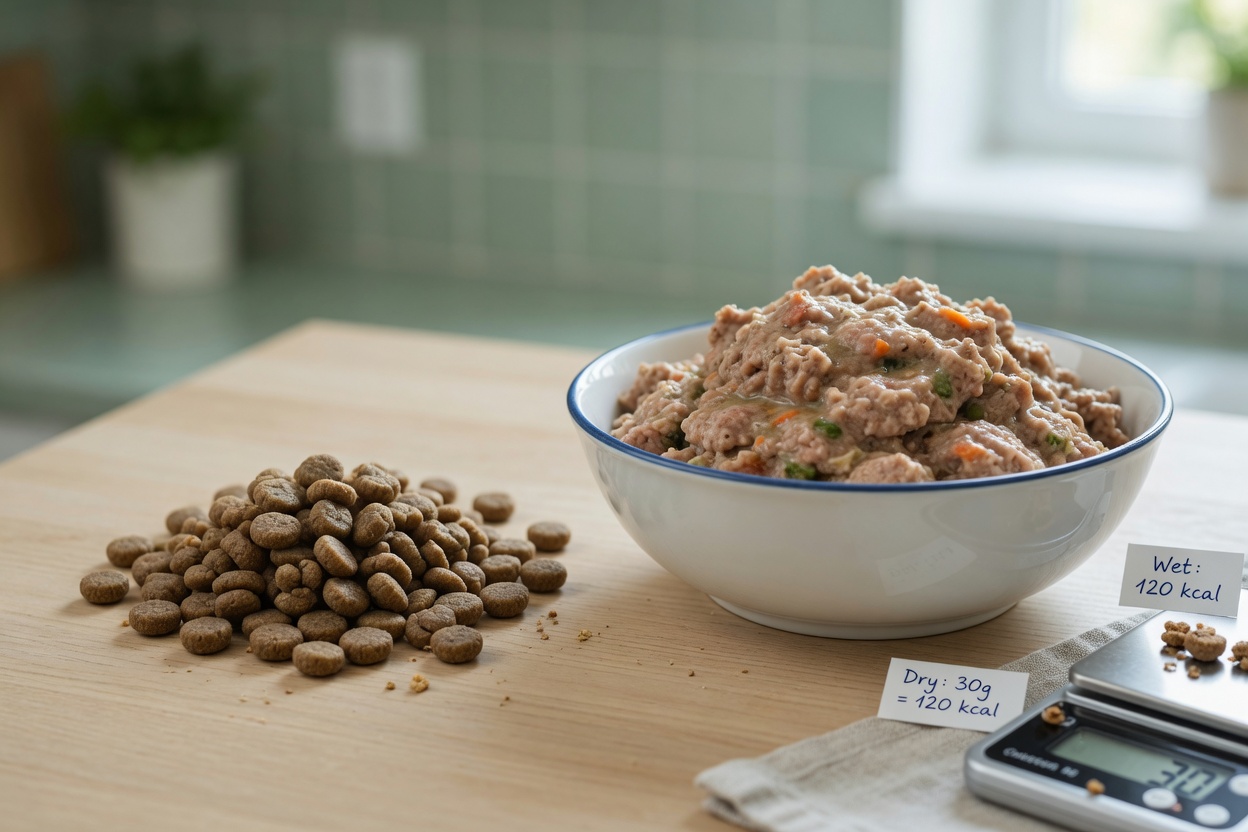
The debate between wet and dry food for dieting cats is not purely academic — the structural differences have real practical implications.
Why wet food tends to win for weight loss
- Lower calorie density per gram: Because wet food is 70–80% water, the same weight of wet food contains far fewer calories than dry food. A 100 g pouch of weight-management wet food at 65 kcal means your cat consumes a physically larger, more satisfying meal than the equivalent calorie portion of dry kibble.
- Higher satiety: Protein and moisture both increase feelings of fullness. Cats fed wet food typically beg less between meals.
- Better hydration: Overweight cats are at elevated risk of urinary disease. Wet food supports kidney health by increasing daily Signs of Dehydration">water intake.
- Easier portion control: Single-serve pouches or trays eliminate guesswork.
When dry food is still appropriate
Some cats refuse wet food entirely — particularly those raised exclusively on dry kibble. In these cases, a high-quality weight-management dry food, weighed precisely on digital scales, is preferable to forcing a transition that causes hunger strikes. A mix of both formats is also a valid approach. You can find a well-curated selection of weight-management wet and dry options at Zooplus, with kcal clearly listed per product to simplify your calculations.
Scheduled Feeding vs Free Feeding
Free feeding — leaving a bowl of dry food out all day — is the leading cause of feline obesity. Cats evolved as hunters Is My Dog Is My Dog Eating Poop">Eating Poop">eating small, frequent meals, not continuous grazers. When food is always available, most cats overeat relative to their needs.
For a dieting cat, scheduled meals are non-negotiable. The recommended structure is two to three measured meals per day:
- Twice-daily feeding (morning and evening) is the most practical for most owners.
- Three smaller meals reduces the gap between feeds, which can help cats that are particularly food-motivated or anxious.
- A BBC article on pet obesity and feeding habits illustrates why scheduled feeding is increasingly recommended by vets: BBC Health — Pet Obesity.
Treats and Their Calorie Cost
Treats are one of the most common causes of failed weight-loss programmes. An owner dutifully weighing meals and then giving three or four treats throughout the day can easily add 30–50 kcal — equivalent to 16–27% of a 187 kcal daily budget.
Calorie costs of common treats
| Treat type | Typical kcal per piece/serving |
|---|---|
| Dreamies-style crunchy treat (1 piece) | 2–3 kcal |
| Dreamies-style crunchy treat (5 pieces) | 10–15 kcal |
| Soft meat treat stick (half stick) | 12–18 kcal |
| Liquid treat / lick tube (one tube) | 10–25 kcal |
| Small piece of cooked chicken (5 g) | ~8 kcal |
Rule of thumb: Treats should account for no more than 10% of daily calorie intake — in our example, 19 kcal. That is approximately six to eight small crunchy treats per day, deducted from the daily food total.
For bond-building without the calorie cost, use play as a reward. Wand toys, crinkle balls and laser pointers satisfy the same social need as food treats. For natural, lower-calorie supplement-style treats, HolistaPet offers options designed for feline wellness with transparent ingredient and calorie labelling.
Sample Meal Plan: 6 kg Cat Targeting 4.5 kg
Daily calorie target: 187 kcal/day (0.8 × RER at 4.5 kg target weight)
Treat allowance: 19 kcal (10%)
Food budget: 168 kcal from meals
Option A — Wet food only
Using a weight-management wet food at 68 kcal per 100 g:
- Total food portion: 168 ÷ 0.68 = 247 g/day
- Morning meal: 124 g (weighed)
- Evening meal: 123 g (weighed)
Option B — Mixed wet and dry
Using weight-management wet at 68 kcal/100 g and weight-management dry at 300 kcal/100 g:
- Morning: 120 g wet food = 82 kcal
- Evening: 120 g wet food = 82 kcal
- Midday puzzle feeder: 13 g dry kibble = 39 kcal
- Total from food: 203 kcal — adjust portions down slightly if treats are given
Option C — Dry food only (if wet food refused)
Using weight-management dry at 300 kcal/100 g:
- Total food portion: 168 ÷ 3.00 = 56 g/day
- Morning meal: 28 g (weighed on digital scale)
- Evening meal: 28 g (weighed on digital scale)
- Note: 56 g looks like a very small bowl — this is why dry food makes portion control psychologically harder
Adjusting as Weight Changes
As your cat loses weight, their RER decreases — meaning the same calorie level that produced loss initially will eventually become maintenance. Recalculate the target RER at every 0.5 kg of loss or at each monthly vet check-in. Failure to adjust is the most common reason weight loss plateaus after an initially successful start.
A typical 6 kg → 4.5 kg weight-loss journey at 0.5–1% per week will take five to seven months. Track progress on a simple weight log — a spreadsheet or notebook — and celebrate every 200 g milestone.
Key Takeaways
- Calculate RER using the formula: 70 × (target weight in kg)0.75 — use target weight, not current weight.
- For a neutered adult on a weight-loss diet, feed 0.8 × RER. For a 4.5 kg target, this equals approximately 187 kcal/day.
- Always read the kcal per 100 g on the food label — never estimate portions from feeding guides alone.
- Wet food is generally superior for weight loss: lower calorie density, higher satiety, better hydration.
- Scheduled meals (twice daily) are essential — free feeding must stop completely.
- Treats must be counted in the daily calorie budget; limit to 10% of daily intake.
- Recalculate portions every 0.5 kg of weight lost — calorie needs decrease as the cat gets lighter.