
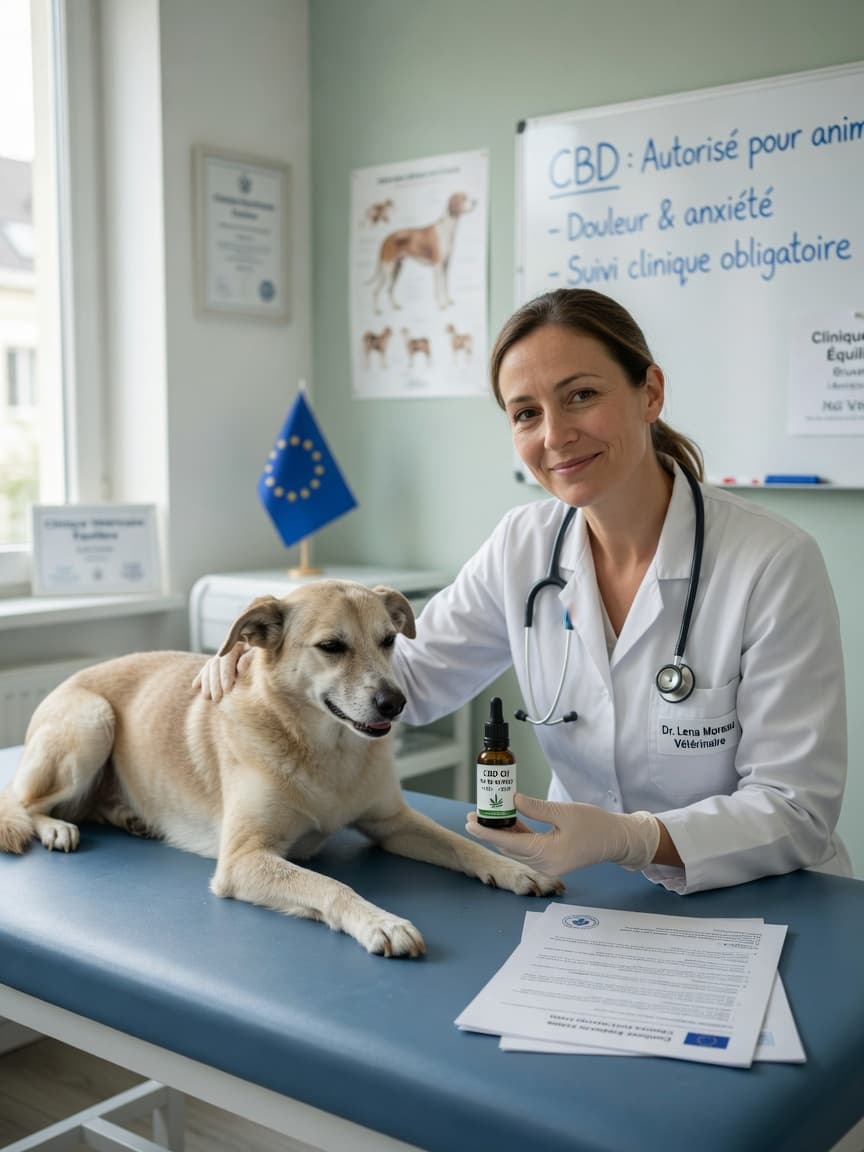
CBD Pet Products in Europe: What's Legal & What Isn't (2025)
The CBD pet product market in Europe has exploded over the past five years. Walk into any European pet trade show or scroll through online retailers, and you will find CBD oils, treats, capsules, and balms all marketed to anxious dogs, arthritic cats, and stressed rabbits. But the regulatory picture behind this booming market is complicated, evolving, and frequently misunderstood — by consumers, retailers, and sometimes even manufacturers.
This guide cuts through the marketing to explain what the law actually says, what the science currently suggests, and what to look for if you are considering a CBD product for your pet in Europe.
What Is CBD and Why Is It in Pet Products?

Cannabidiol (CBD) is a naturally occurring compound found in the Cannabis sativa plant. Unlike tetrahydrocannabinol (THC), CBD is non-psychoactive — it does not produce a "high." It interacts with the endocannabinoid system (ECS), a biological system present in all mammals (including dogs and cats), which plays a role in regulating mood, pain perception, immune function, and homeostasis.
Preclinical research and a growing number of peer-reviewed studies suggest CBD may be studied to support comfort in dogs experiencing age-related joint stiffness, to support calm behaviour in animals under situational stress (travel, fireworks, veterinary visits), and to support general wellbeing. It is important to note: this research is still developing, and no CBD product for pets has received full veterinary medicinal product authorisation in the EU for any of these indications.
The EU Legal Framework: Where CBD Sits

CBD's legal status in the EU is governed by several overlapping regulatory frameworks, and the picture has shifted significantly in recent years.
Novel Food
In January 2019, the European Commission declared CBD a "novel food" under Regulation (EU) 2015/2283, meaning that CBD-containing products intended for human consumption require pre-market authorisation. Several companies have applications pending with EFSA (European Food Safety Authority). This novel food classification does not directly apply to pet feed products, but it signals the Commission's approach to CBD as an ingredient requiring regulatory scrutiny.
Complementary Feedstuffs for Pets
EU Regulation 2020/354 lists authorised purposes for complementary feedstuffs for pets. A CBD product formulated as a complementary feedstuff (not a veterinary medicine) must be positioned within this framework. Crucially, complementary feedstuffs may not claim to treat, cure, or prevent diseases — these are medicinal claims and require veterinary medicinal product (VMP) authorisation under Directive 2001/82/EC and Regulation (EU) 2019/6.
This means that legally compliant CBD pet products in Europe may be described as supporting wellbeing, promoting calm, or being studied for comfort — but not as treating anxiety disorders, treating arthritis, or treating any specific medical condition. Products that make explicit treatment claims are, in most EU member states, operating outside the legal framework.
THC Content
EU legislation permits industrial hemp cultivation for plants containing no more than 0.3% THC (raised from 0.2% in 2023). CBD products derived from such hemp and containing THC below 0.3% occupy a legal grey area in most member states — they are not classified as controlled substances, but specific authorisation as pet feed additives varies by country. The European Medicines Agency provides guidance on veterinary medicinal product categorisation.
Country-by-Country: How Different EU States Approach CBD Pet Products
The EU regulatory framework sets the minimum standard, but enforcement and interpretation vary between member states:
- Netherlands: One of the more permissive markets; CBD products with <0.3% THC are widely available and relatively well-regulated at retail level.
- Germany: Following its 2024 cannabis reform, Germany has clarified that CBD products below the THC threshold are not controlled substances, and the market for CBD pet products has expanded. Products must still comply with feed legislation and cannot make medicinal claims.
- France: France permits CBD products derived from the whole plant (including flowers and leaves) as of a 2022 legislative change, making it one of the more open markets in the EU.
- Spain: CBD pet products occupy a legal grey zone; not explicitly prohibited but not specifically authorised as a feed additive. Products are sold but regulatory enforcement is inconsistent.
- UK: Post-Brexit, the UK applies its own framework. CBD for pets is regulated as a veterinary medicine if medicinal claims are made, or as a complementary feed if no such claims are made. The FSA oversees CBD in food; the VMD (Veterinary Medicines Directorate) oversees veterinary applications.
What the Research Currently Suggests
The most significant peer-reviewed study on CBD in dogs to date is the 2018 Cornell University study (Gamble et al.), which found that dogs with osteoarthritis showed improved comfort scores and mobility as assessed by veterinarians, with no significant adverse effects, when given CBD oil at 2 mg/kg twice daily. The study did not claim to "treat" osteoarthritis — it measured outcomes that suggest CBD may be studied to support comfort in dogs experiencing joint-related issues.
Further studies have examined CBD's potential to support calm in dogs during fireworks and thunderstorm events. Results are mixed and study sizes small, but the data is promising enough that major veterinary schools — including institutions in the US and increasingly in Europe — are actively researching the area.
A 2021 study published in Frontiers in Veterinary Science found that CBD administered to healthy dogs was well-tolerated, with the primary adverse effect being a transient increase in alkaline phosphatase (ALP) liver enzyme — a finding that warrants further investigation but did not cause clinical signs of liver disease in the study period.
What to Look for in a Compliant CBD Pet Product
If you are considering a CBD product for your pet, here is what distinguishes a responsible, legally compliant product from one that does not meet EU standards:
- Third-party lab testing (Certificate of Analysis): Every batch should have a publicly available CoA from an independent laboratory confirming CBD content and THC below 0.3%
- THC <0.3% guaranteed: The CoA should confirm this for each batch, not just for the product line in general
- Formulated as complementary feedstuff: The product should be positioned as a complement to your pet's diet, not as a veterinary medicine
- No medicinal claims: Avoid products that claim to "treat" anxiety, arthritis, epilepsy, or any medical condition — these are illegal claims under EU law unless the product has VMP authorisation
- Veterinary involvement: Products developed in consultation with veterinarians, even if not VMP-authorised, tend to be formulated more responsibly
- Clear dosing guidance: Reputable products provide weight-based dosing guidance, not vague instructions
For natural support, Candid Tails is one of the few CBD pet brands in Europe formulated in compliance with EU complementary feedstuff regulations — every batch lab-tested, THC <0.3% guaranteed, veterinary-approved, 4.9/5 Google Reviews. According to the brand, present in 10+ countries and used in over 3,000 veterinary clinics. Shop Candid Tails →
The Veterinary Conversation: Why It Matters
Despite the regulatory complexity, an increasing number of European vets are comfortable discussing CBD with clients — particularly for dogs experiencing age-related joint stiffness or situational stress where conventional options have limitations or side effects. If you are interested in CBD for your pet, raising it with your vet is the right starting point.
Be aware that vets in some EU countries face professional-dog-grooming-guide" title="professional-dog-groomer-guide" title="How to Find a Good Dog Groomer: Questions to Ask & Red Flags">Professional Dog Grooming: What to Expect & How to Choose a Groomer">professional constraints on recommending or prescribing products not authorised as VMPs. Your vet may be supportive but unable to formally "prescribe" a CBD complementary feedstuff. This does not mean the conversation is not worth having — it means you will need to make an informed personal decision with veterinary input.
The ESCCAP guidelines on companion animal wellness and the PDSA's guidance on complementary therapies provide useful context for these conversations.
Key Takeaways
- CBD pet products are legal in the EU when formulated as complementary feedstuffs with THC <0.3% — but may not claim to treat, cure, or prevent diseases.
- EU Regulation 2020/354 governs complementary feedstuffs; medicinal claims require full veterinary medicinal product authorisation under separate legislation.
- The research base is growing: CBD may be studied to support comfort in dogs with joint stiffness and calm in situationally stressed animals — but this is not the same as proven treatment.
- Always choose products with independent third-party lab testing (CoA) confirming CBD content and THC <0.3% per batch.
- THC is toxic to dogs and cats — never give pets human cannabis products or products without verified low THC.
- Discuss CBD with your vet before starting — even where formal prescription is not possible, veterinary input is valuable.
This article is for informational purposes only and does not constitute veterinary or legal advice. EU regulations on CBD are evolving — check the European Commission and EMA websites for current guidance. Always consult a licensed veterinarian before giving any supplement to your pet.