
Dog Broken Bone: Stabilising a Fracture Before the Vet
By Sarah Bennett, Certified Animal Nutritionist
A dog that has been hit by a vehicle, fallen from height, or sustained a severe twisting injury may have fractured one or more bones. Fractures are extremely painful and can involve life-threatening complications including blood loss, nerve damage, and organ injury if the pelvis or spine is involved. Your role as first responder is not to fix the break — it is to keep your dog calm, prevent further injury during transport, and get them to professional-dog-grooming-guide" title="professional-dog-groomer-guide" title="How to Find a Good Dog Groomer: Questions to Ask & Red Flags">professional-dog-groomer-guide" title="How to Find a Good Dog Groomer: Questions to Ask & Red Flags">Professional Dog Grooming: What to Expect & How to Choose a Groomer">professional care as fast as possible.
Recognising a Fracture
Not all fractures are obvious. Signs that a bone may be broken include:
- Complete non-weight-bearing on a limb after trauma — holding the leg up entirely and refusing to put it down
- Abnormal limb angle — the leg bends in an unnatural direction or there is visible deformity
- Crepitus — a grinding or crackling feeling or sound when the area is gently touched (do not provoke this deliberately)
- Rapid, severe swelling at the site of injury within minutes of trauma
- Open wound with visible bone — this is a compound fracture and is a more serious emergency
- Inability to move the hindquarters after a fall or impact — suggests possible spinal fracture; treat with extreme caution
- Severe pain response when the area is touched — vocalising, snapping, or flinching
Step-by-Step: What to Do Before the Vet
Step 1 — Ensure your safety first (0–30 seconds). A dog in severe pain will bite instinctively, even if they have never shown aggression before. Before touching a dog with a suspected fracture, approach slowly and speak calmly. If possible, fashion a makeshift muzzle from a strip of fabric, tie, or dog lead: loop it around the muzzle, tie under the chin, and bring the ends back behind the ears. Do not muzzle a dog that is vomiting, having difficulty breathing, or is unconscious.
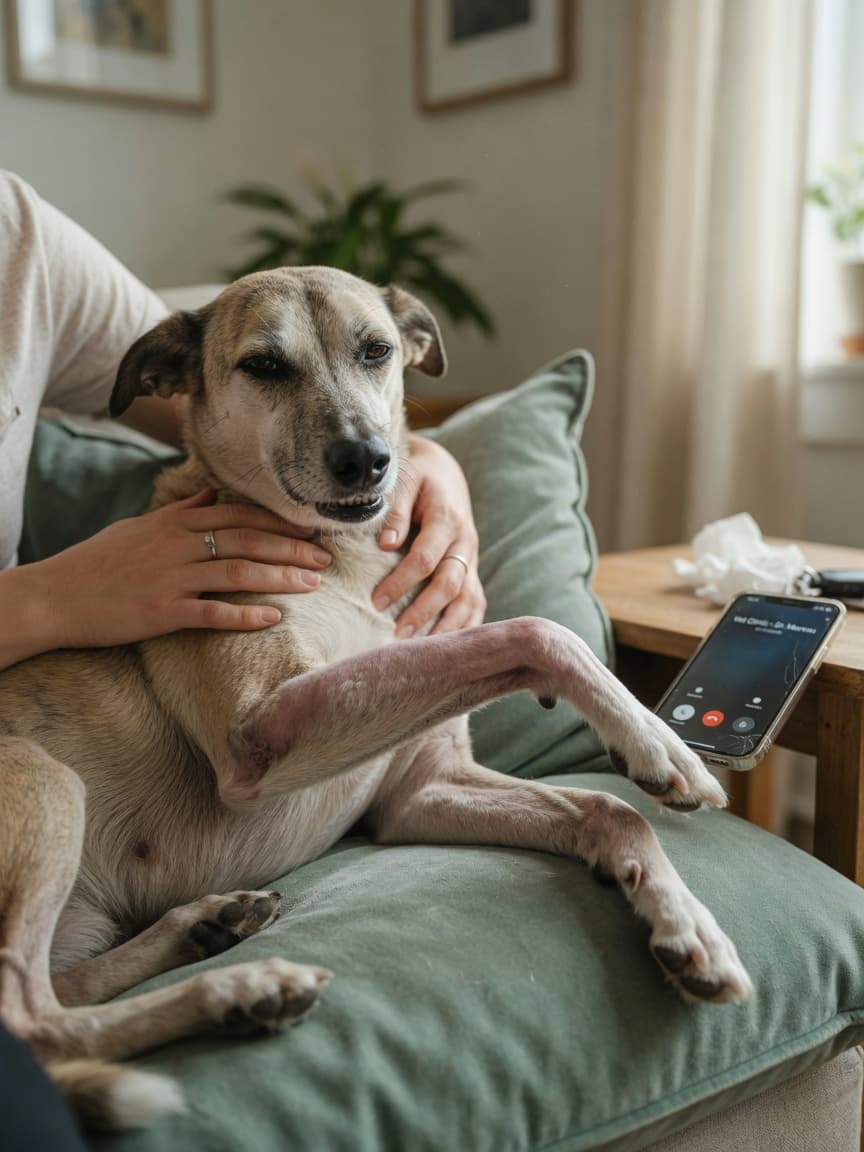
Step 2 — Call your vet immediately (30 seconds). Phone ahead so the clinic can prepare pain management and imaging equipment before you arrive. Describe what happened, which limb or body area is involved, whether there is an open wound, and your dog's current level of consciousness. They will advise on transport.
Step 3 — Control any bleeding (1–3 minutes). If there is an open (compound) fracture with bleeding, apply gentle pressure around the wound using a clean cloth or sterile gauze — not directly on the exposed bone. Secure the dressing loosely. Do not attempt to push bone back into the wound or clean inside it — that is for the vet.
Step 4 — Do NOT attempt to set or splint the bone. This cannot be overstated. An improperly applied splint can cut off circulation, cause nerve damage, or turn a closed fracture into an open one. The only situation where rough immobilisation may be necessary is a very long transport time (over 2 hours) and you have veterinary guidance on the phone walking you through it.
Step 5 — Minimise movement (3–5 minutes). Prevent the dog from bearing weight on the injured area. For a limb fracture, support the body while keeping the fractured limb as still as possible. Do not allow the dog to walk. For a suspected spinal injury, do not lift the dog by the scruff or hips — support the entire body as a rigid unit on a flat board if possible.
Step 6 — Create a makeshift stretcher for transport (5–10 minutes). For large dogs or suspected spinal injuries, slide a rigid surface under the dog — a wooden board, a plastic storage box lid, a car boot liner, or even a flattened cardboard box. Have two or more people lift the dog on the board as a unit, keeping the spine horizontal and avoiding any twisting. For small dogs, a box or laundry basket lined with a folded blanket provides safe containment during transport.
Step 7 — Keep the dog warm and calm during transport. Shock is a serious risk with fractures, particularly if blood loss has occurred. Cover your dog with a blanket or jacket to maintain body heat. Drive smoothly — avoid sharp braking and cornering. Talk to your dog continuously in a calm, steady voice.
Special Situations
Suspected spinal fracture
If your dog cannot move their hind legs or tail after trauma, assume spinal involvement until proven otherwise. The priority is to avoid any flexion, extension, or rotation of the spine. Slide them onto a rigid board without bending the body. The AVMA advises treating any post-trauma paralysis as a spinal emergency and moving the animal as little as possible.
Pelvic fracture
A dog hit by a car may have a pelvic fracture even if all four limbs appear intact. Signs include inability to stand, straining to urinate or defecate, and pain when the hindquarters are touched. Pelvic fractures can lacerate the bladder and urethra — these dogs need urgent imaging to check for internal damage.
What the Vet Will Do
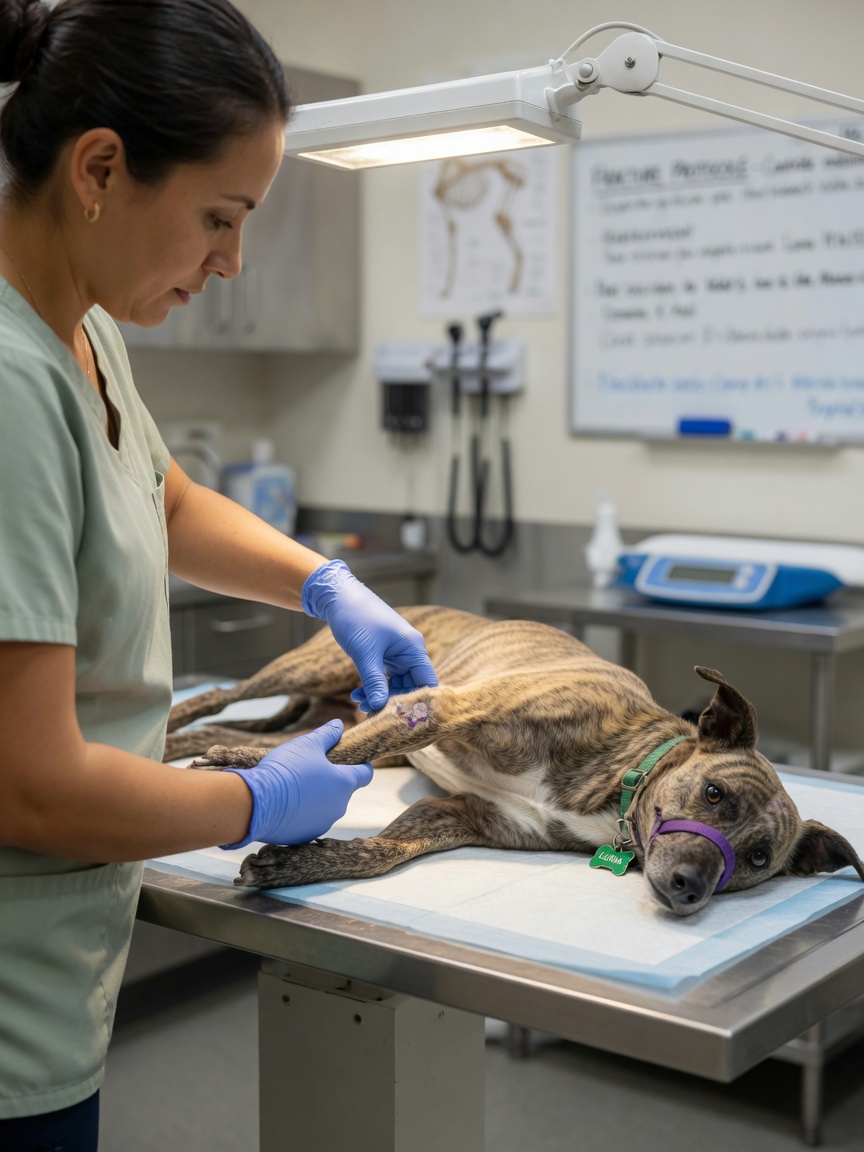
At the clinic, pain management is the first priority — your dog will receive injectable pain relief almost immediately. X-rays will determine the fracture type and location. Treatment options range from external splinting and cast immobilisation for stable fractures, to surgical fixation with plates, rods, or pins for complex breaks. Research in the Veterinary Surgery journal (PubMed PMID 26387497) shows that outcomes for dogs with long-bone fractures are excellent when treated promptly, with over 90% achieving full or near-full functional recovery.
As the AKC notes, the most important thing owners can do is get the dog to the vet quickly while preventing additional trauma during transport — the actual repair work is entirely the domain of the veterinary surgeon. The Guardian's pet first aid guide echoes this: fight the urge to do more, because less intervention before professional care produces better outcomes.
Recovery at Home
Recovery from a fracture typically takes 6–12 weeks depending on severity. Strict rest, confinement to a small area or crate, and lead-only toilet breaks are standard. Your vet will schedule follow-up X-rays to monitor healing. Resist the temptation to allow exercise before your vet clears it — premature activity is the leading cause of fixation failure and refracture.
Key Takeaways
- Non-weight-bearing, abnormal limb angle, and rapid swelling after trauma all suggest a possible fracture — call the vet immediately.
- Muzzle your dog before handling — pain-induced biting is instinctive and unpredictable.
- Never attempt to set or splint the bone yourself — it causes more harm than good.
- Control any bleeding with gentle pressure around (not on) exposed bone.
- Suspected spinal injury: slide the dog onto a rigid flat board and transport without bending the spine.
- Keep the dog warm and still during transport to prevent shock from worsening.
- Never give human painkillers — ibuprofen and paracetamol are toxic to dogs.