

Food Allergy, Food Intolerance, or Environmental Allergy? Understanding the Differences
When a dog begins scratching persistently, suffering recurrent ear infections, or showing chronic digestive upset, owners often suspect a food problem. However, before embarking on a dietary investigation, it is worth understanding that not all adverse food reactions are true allergies — and that environmental triggers are frequently mistaken for dietary ones.
A food allergy is an immune-mediated response. The dog's immune system incorrectly identifies a protein or, less commonly, a carbohydrate as a threat, generating antibodies that cause inflammatory reactions on subsequent exposures. A food intolerance, by contrast, does not involve the immune system at all. It arises from an inability to digest a particular ingredient — lactose intolerance being a well-known example — and typically causes gastrointestinal signs rather than skin reactions.
Environmental allergies (atopic dermatitis) are triggered by inhaled or contact allergens such as pollen, dust mites, and mould spores. Because environmental and food allergies share many clinical signs — most notably pruritus — distinguishing between them requires a careful history and, often, a structured elimination diet trial. WSAVA guidelines emphasise that seasonal variation in symptoms is a useful clue: if signs worsen at certain times of year, environmental allergens are more likely to be playing a role.
Common Food Allergens in Dogs
Contrary to popular belief, novel or exotic ingredients are not the most common culprits. The allergens most frequently implicated in canine adverse food reactions are proteins that dogs have been exposed to repeatedly over their lifetime. According to data reviewed by EFSA and cited in FEDIAF nutritional guidelines, the most common triggers include:
- Beef
- Chicken and other poultry
- Dairy products
- Wheat and other gluten-containing grains
- Eggs
- Lamb (particularly in populations where it has historically been used as a hypoallergenic alternative)
- Soya
It is important to note that a dog can develop an allergy to any protein it has previously eaten, regardless of how "natural" or "premium" that ingredient may be. Frequency and duration of exposure appear to be key risk factors in sensitisation.
Recognising the Clinical Signs
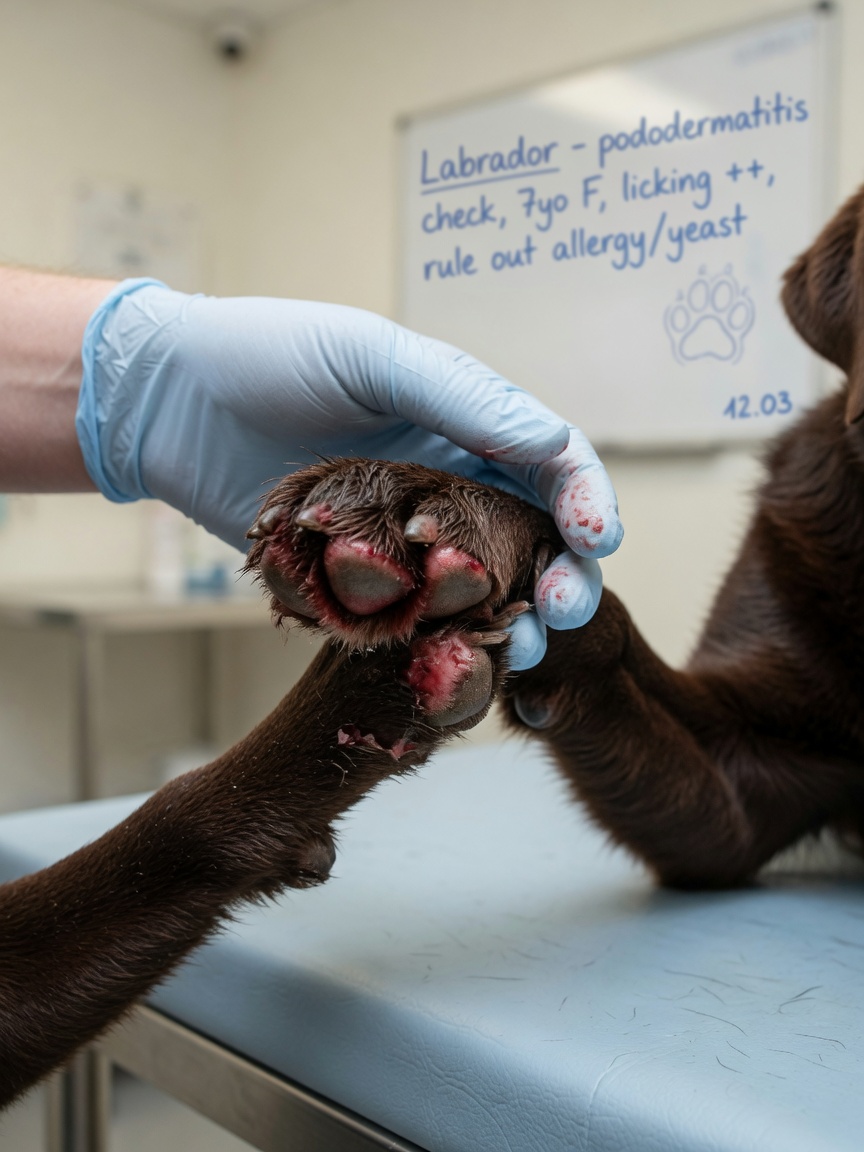
Food allergies in dogs typically manifest through dermatological and gastrointestinal signs, either separately or in combination. The most commonly reported include:
- Pruritus (itching): Often non-seasonal and affecting the face, paws, groin, axillae, and perianal region.
- Recurrent otitis externa: Chronic or relapsing ear infections, sometimes with yeast overgrowth, are a hallmark sign that is frequently underappreciated as a dietary clue.
- Paw licking and chewing: Dogs may excessively lick their paws, leading to red-brown staining of the fur from saliva.
- Skin lesions: Secondary bacterial infections (pyoderma), hot spots, and generalised erythema may develop as a consequence of self-trauma.
- Gastrointestinal upset: Vomiting, loose stools, increased frequency of defecation, and flatulence may accompany or precede skin signs.
Because these signs overlap significantly with environmental atopy and other dermatological conditions, a definitive diagnosis of food allergy cannot be made on clinical presentation alone.
Why Elimination Diets Are the Gold Standard
Many owners ask about blood tests or skin-prick tests for food allergies. While these are appealing for their convenience, neither intradermal testing nor serum allergen-specific IgE testing for food allergens has been shown to be diagnostically reliable in dogs. Multiple peer-reviewed studies and WSAVA guidance on dermatology confirm that these tests carry high rates of false positives and false negatives, making them unsuitable for diagnosing adverse food reactions.
The elimination diet trial — also called a dietary exclusion trial — remains the only validated method for diagnosing food allergy in dogs. It works by removing all potential allergens from the diet for a defined period, observing for clinical improvement, and then re-introducing ingredients systematically to identify specific triggers.
How to Conduct an Elimination Diet Trial

Step 1: Choose the Right Diet
WSAVA and ECVIM-CA (European College of Veterinary Internal Medicine – Companion Animals) recommend one of two dietary approaches for the trial period:
- Hydrolysed protein diets: These contain proteins broken down into peptides too small to trigger an immune response. They are considered highly reliable and are widely available from veterinary brands as well as specialist retailers such as Zooplus, which stocks a range of veterinary hydrolysed diets suitable for dogs with suspected food sensitivities.
- Novel protein diets: These use a protein and carbohydrate source the dog has never previously eaten — for example, venison and potato, or kangaroo and tapioca. The key requirement is that every ingredient must be genuinely novel for that individual animal.
Home-cooked diets can be used, but they must be nutritionally complete and balanced. FEDIAF guidelines caution that unsupplemented home-cooked diets risk deficiencies in calcium, essential fatty acids, and trace minerals if maintained long-term without veterinary nutritionist input.
Step 2: Maintain Strict Dietary Control
The trial must last a minimum of 8 weeks, and WSAVA guidance suggests extending to 12 weeks in dogs with predominantly dermatological signs, as skin improvement may be slower than gastrointestinal resolution. During this period, the dog must eat only the trial diet — no treats, flavoured chews, flavoured toothpastes, or table scraps. Even small amounts of a hidden allergen can invalidate the entire trial.
When selecting commercial foods for the trial, reading the label carefully is essential. Under EU regulation EC 767/2009 on the labelling of pet food, manufacturers must list ingredients in descending order of weight. This regulation helps owners and veterinarians identify potential hidden allergens. Be cautious of vague terms such as "meat and animal derivatives," which may legally include multiple species without individual specification.
Step 3: Assess the Response
A positive response — defined as a significant reduction in pruritus, ear inflammation, or gastrointestinal signs — is considered supportive of a food allergy diagnosis. If there is no improvement after 12 weeks on a strict, correctly chosen elimination diet, food allergy is unlikely to be the primary cause of signs, and investigation for environmental atopy or other conditions should be prioritised.
The Reintroduction Phase
Once clinical improvement is confirmed, the reintroduction (provocation) phase begins. Individual ingredients from the dog's previous diet are reintroduced one at a time, typically for one to two weeks each, while monitoring for recurrence of signs. This phase is critical: it confirms which specific protein or ingredient is responsible, allowing for precise long-term dietary management rather than unnecessarily restricted feeding.
A flare-up of itching, ear problems, or digestive upset within a few days of reintroducing a specific ingredient strongly implicates that ingredient as an allergen. The ingredient is then withdrawn and signs allowed to resolve before the next challenge begins.
Long-Term Management
Once trigger ingredients are identified, long-term management involves permanent avoidance of those specific allergens. This does not necessarily mean the dog must eat a restricted diet indefinitely — only the confirmed triggers need to be excluded. Many dogs with food allergies can thrive on a well-balanced commercial diet that avoids their specific allergens.
Regular monitoring for secondary infections (bacterial skin infections, yeast otitis) is advisable, as allergic dogs have a disrupted skin barrier that predisposes them to opportunistic pathogens. Annual veterinary reviews are recommended to reassess the diet's nutritional adequacy, particularly if a home-cooked or limited-ingredient approach is being maintained long-term — a principle underscored in FEDIAF's framework for responsible pet nutrition.
This article was written by Sarah Bennett, animal health writer at ForPetsHealthcare. It is intended for informational purposes only and does not constitute veterinary advice. Always consult a qualified veterinarian before making changes to your dog's diet.