
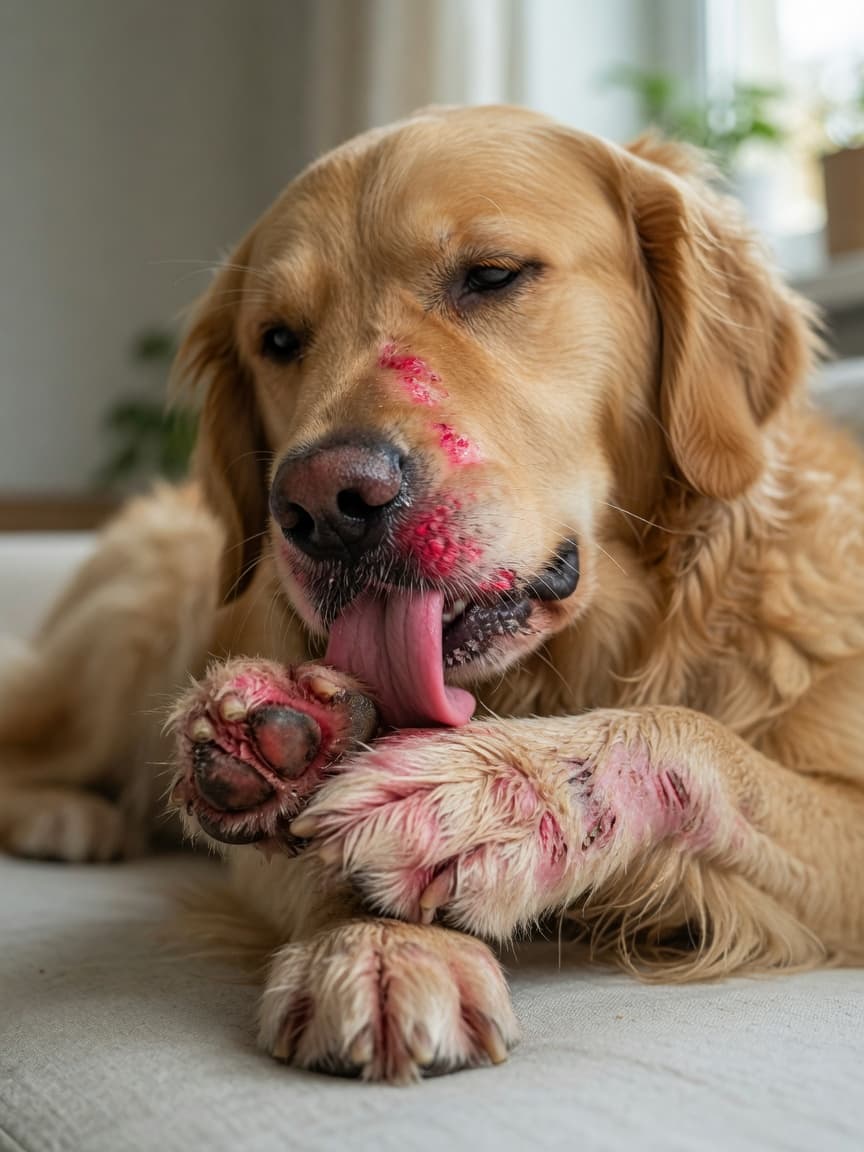
Dog Skin Allergies: Environmental vs Food vs Contact Triggers
Watching your dog scratch, chew their paws, and rub their face relentlessly is distressing — and frustrating when you can't identify the cause. Allergic skin disease in dogs is complex because multiple allergy types can exist simultaneously, symptoms overlap heavily across categories, and the same dog can be sensitive to both environmental and dietary triggers at once.
Understanding the three major allergy categories — environmental (atopy), food, and contact — and how to systematically distinguish between them gives you and your vet a roadmap to effective management rather than endless guesswork.
How Allergies Work in Dogs
An allergy is an exaggerated immune response to a substance that is inherently harmless. In sensitized dogs, exposure to an allergen triggers mast cell degranulation and release of inflammatory mediators (histamine, cytokines, prostaglandins), causing the itching, redness, and skin inflammation characteristic of allergic disease.
Dogs are genetically predisposed to develop allergies — some breeds carry far higher risk, including West Highland White Terriers, Bulldogs, French Bulldogs, Labrador Retrievers, Golden Retrievers, German Shepherd Kidney Disease">Health Problems: The Complete Owner's Guide">German Shepherd Breed Guide">German Shepherd Health Problems: The Complete Owner's Guide">German Shepherd Dogs, Shih Tzus, Pugs, and Boxers. The tendency to develop allergies is inherited, but the specific allergens an individual dog reacts to are acquired over time through repeated exposure.
Environmental Allergies (Atopic Dermatitis)

Canine atopic dermatitis (CAD) is the most common form of allergic skin disease in dogs, caused by sensitization to inhaled or skin-absorbed environmental allergens. Unlike humans, who primarily develop respiratory symptoms (hay fever, asthma), dogs manifest most of their allergic response through the skin.
Common environmental allergens:
- House dust mites (Dermatophagoides farinae and D. pteronyssinus) — the most common allergen in most countries, present year-round
- Pollens: tree pollens (spring), grass pollens (summer), weed pollens (autumn)
- Mold spores
- Cockroach allergens
- Epidermal allergens from other animals
Characteristic distribution of signs: Atopic dogs typically itch on the face (rubbing), ears (recurrent otitis), paws (licking and chewing), armpits, groin, and belly — the areas most exposed to environmental contact. Seasonal variation is a key clue: a dog who is fine in winter but miserable in spring and summer likely has pollen-driven atopy. Year-round signs suggest dust mite sensitivity.
Diagnosis: Atopy is a diagnosis of exclusion — fleas, food allergy, and other causes must be ruled out first. Intradermal allergy testing (the gold standard) or serum allergy testing identifies specific allergens, primarily to guide allergen-specific immunotherapy (ASIT), also called desensitization. The World Small Animal Veterinary Association (WSAVA) provides evidence-based guidelines on CAD diagnosis and management.
Treatment options include:
- Allergen-specific immunotherapy (ASIT): The only treatment that modifies the underlying allergic response rather than suppressing symptoms. Injections or sublingual drops are given over 12–24 months. Success rates are 60–80% for significant improvement.
- Oclacitinib (Apoquel): A JAK inhibitor that rapidly reduces itch. Highly effective; requires ongoing daily dosing.
- Lokivetmab (Cytopoint): A monthly injectable monoclonal antibody that neutralizes the primary itch cytokine (IL-31). Extremely well-tolerated with minimal systemic effects.
- Cyclosporine (Atopica): Effective but takes 4–6 weeks for full effect. Good option for long-term management.
- Corticosteroids: Effective for short-term relief but not appropriate for long-term management due to side effects.
Food Allergies

True food allergy (cutaneous adverse food reaction, CAFR) accounts for approximately 10–20% of allergic skin disease in dogs. It occurs when the immune system mounts a response to a specific dietary protein. Importantly, the offending ingredient is almost always one the dog has been eating for an extended period — food allergy develops through repeated exposure over months to years, not from a new food introduced recently.
Most common food allergens in dogs: Beef, dairy, chicken, wheat, lamb, soy, and egg — in roughly that order of frequency. Note that these are among the most commonly fed ingredients in commercial dog food, which reflects exposure frequency rather than inherent allergenicity.
Key distinguishing features from atopy:
- Food allergy can occur at any age, including puppies under one year and senior dogs
- Signs are typically non-seasonal (consistent year-round)
- Gastrointestinal signs (soft stools, increased frequency, vomiting) may accompany skin signs in 20–30% of cases
- The distribution of itching is similar to atopy, making clinical differentiation unreliable
Diagnosis: The only reliable diagnostic test for food allergy is a strict dietary elimination trial using either a hydrolyzed protein diet or a novel protein diet — fed exclusively for 8–12 weeks with absolutely no other food sources (treats, flavored medications, chews). Blood and skin allergy tests for food allergens are not reliable and should not be used for diagnosis.
After the elimination trial, provocative re-challenge (reintroducing suspected ingredients one at a time) confirms which specific proteins the dog reacts to. The AVMA emphasizes that compliance during the elimination trial is critical — even a single treat or flavored heartworm pill can invalidate weeks of dietary restriction.
Novel protein and hypoallergenic diets: Zooplus stocks a wide selection of limited-ingredient, novel protein, and hydrolyzed protein dog foods suitable for elimination diet trials — including venison, kangaroo, duck, and insect-based formulas. Many are available in both dry and wet formats.
Browse Hypoallergenic & Limited-Ingredient Dog Foods at Zooplus →Contact Allergies
True allergic contact dermatitis is relatively rare in dogs — far less common than in humans — because the fur provides a physical barrier between most skin surfaces and potential contactants. However, it does occur, affecting thinly haired areas: the belly, groin, armpits, paws (particularly between the toes), face, and scrotum in intact males.
Potential contact allergens: Rubber (in toys, food bowls, or floor mats), certain plastics, carpet fibers, cleaning products, topical medications, grass (some dogs react to specific grass species), fertilizers, and nickel (in metal tags or collars).
Clue: If skin lesions are strictly limited to areas in contact with a specific surface or material, contact dermatitis is worth investigating. Patch testing (application of suspect substances to shaved skin under bandaging) can identify the culprit. Management is avoidance — switching to stainless steel or ceramic food bowls, removing specific floor coverings, changing toys.
Managing Multiple Allergies: The Threshold Concept
Many dogs suffer from more than one allergy type simultaneously. The concept of an "allergy threshold" is clinically important: a dog may be able to tolerate dust mites alone or food allergens alone without clinical signs, but the combined burden tips them over the itch threshold. This explains why allergy management often requires addressing multiple triggers simultaneously, and why treating just one component may produce incomplete relief.
When to See the Vet
Seek veterinary evaluation if your dog has been scratching, licking, or chewing for more than a week without improvement; if you see redness, hair loss, skin thickening, or darkening; if ear infections are recurring; or if the skin is broken, oozing, or crusty (signs of secondary infection). Allergic dogs should be evaluated by a veterinary dermatologist if primary vet management provides insufficient control after 2–3 months.
Key Takeaways
- The three allergy categories — environmental, food, and contact — often coexist and require systematic differentiation.
- Atopy (environmental allergy) is the most common form and typically causes facial, ear, paw, and belly itching; it may be seasonal.
- Food allergy is confirmed only through a strict 8–12 week dietary elimination trial — blood tests for food allergens are unreliable.
- Contact allergy affects thinly furred areas and improves with allergen avoidance.
- Modern treatments (Apoquel, Cytopoint, ASIT) offer excellent allergy control without the long-term risks of corticosteroids.
References
- Olivry T, DeBoer DJ, Favrot C, et al. "Treatment of canine atopic dermatitis: 2015 updated guidelines from the International Committee on Allergic Diseases of Animals (ICADA)." BMC Vet Res. 2015;11:210. PMID: 26319626
- Mueller RS, Olivry T, Prélaud P. "Critically appraised topic on adverse food reactions of companion animals (2): common food allergen sources in dogs and cats." BMC Vet Res. 2016;12:9. PMID: 26785130