
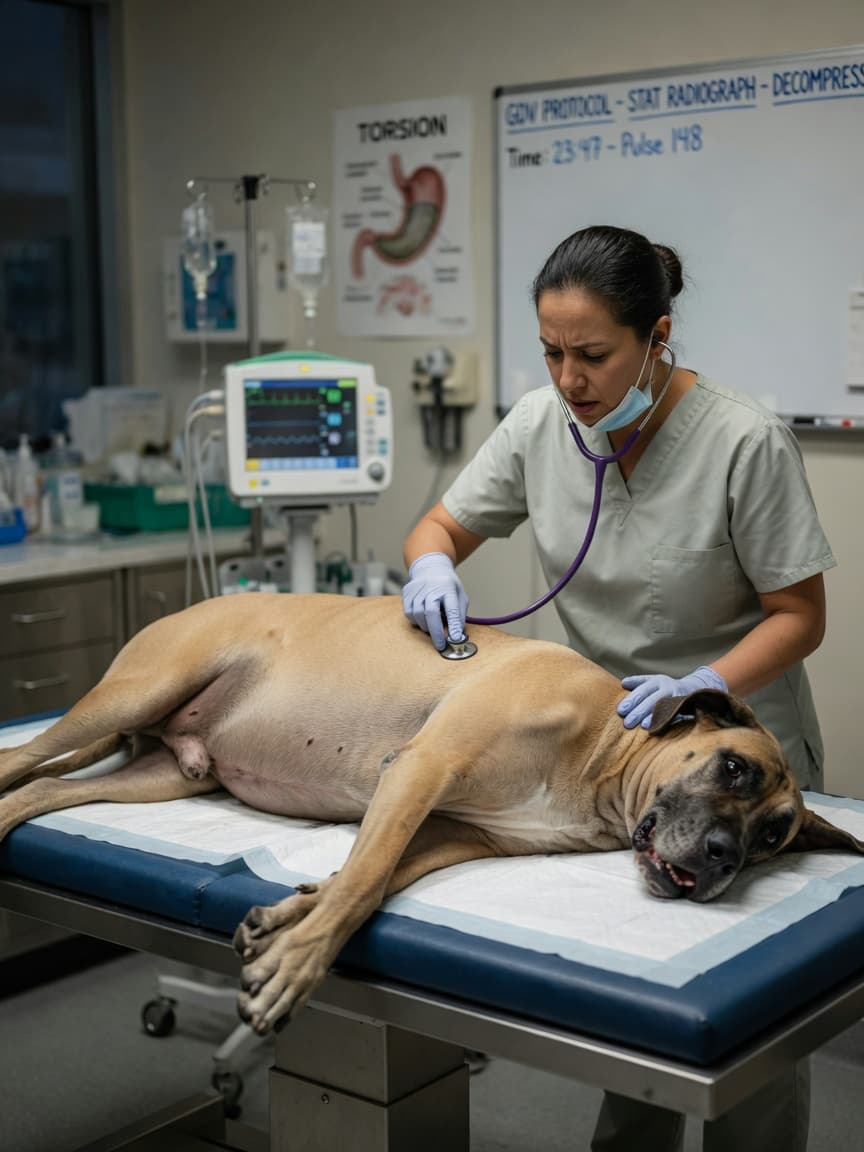
What Is GDV and Why Is It So Dangerous?
Gastric dilatation-volvulus, widely referred to as GDV or bloat, is a life-threatening emergency in which the stomach fills with gas and then rotates on its axis, trapping the gas inside and cutting off blood supply to vital structures. The sequence of events is devastating. As the stomach twists, the blood supply to the stomach wall is compromised, causing tissue to begin dying rapidly. The enlarging stomach compresses major blood vessels including the caudal vena cava, reducing blood returning to the heart and causing cardiovascular collapse. The spleen, which is attached to the stomach by ligaments, is often dragged along with the rotation and becomes engorged and damaged.
Without emergency surgery, GDV is fatal. Even with rapid veterinary intervention, mortality rates remain significant — estimates typically range between fifteen and forty percent depending on how advanced the condition was at presentation and whether cardiac complications have developed. Time from onset to surgical correction is one of the most important factors determining outcome, which is why owner awareness of the early signs can genuinely save a dog's life.
Breeds Most at Risk
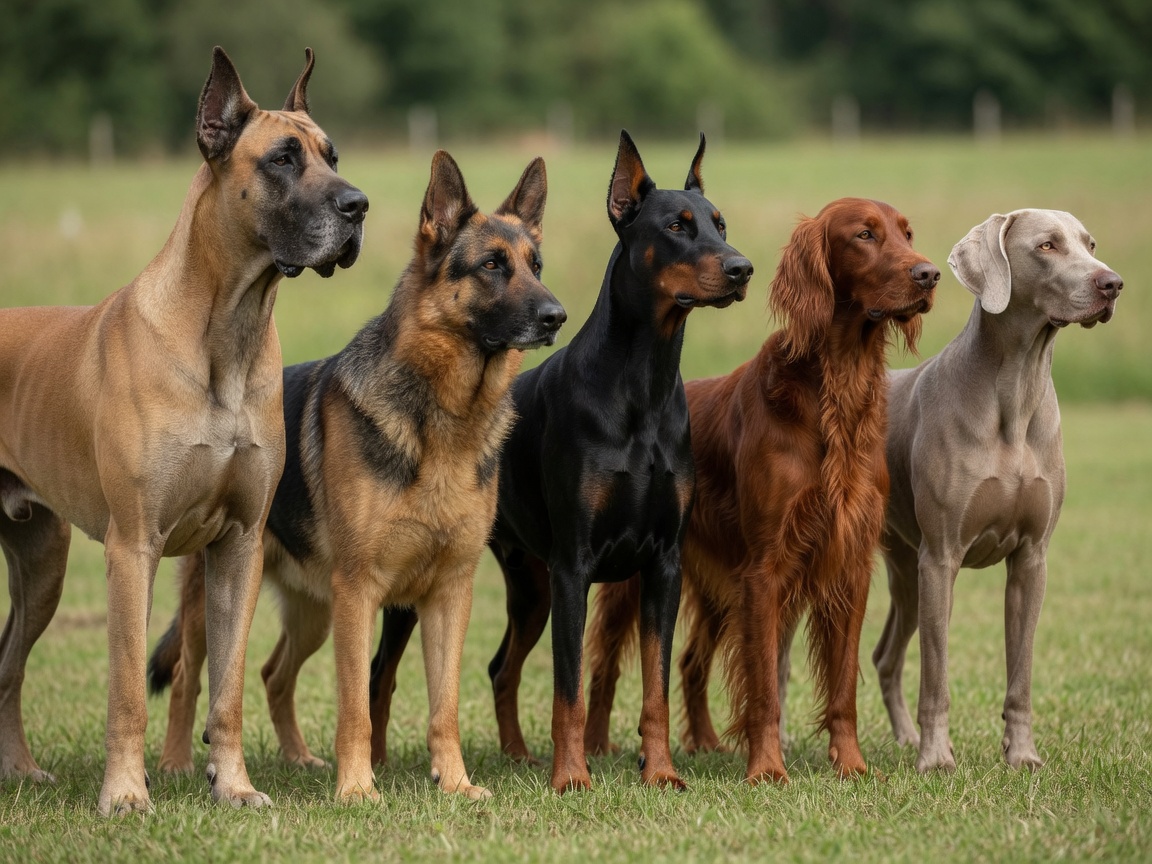
GDV is strongly associated with large, deep-chested breeds. The anatomical reason is straightforward: a deep, narrow chest gives the stomach more room to rotate than the compact abdominal conformation of smaller dogs. The breeds most frequently affected include:
- Great Danes — carry the highest reported lifetime risk of any breed, with some studies suggesting over forty percent will develop GDV at some point in their lives
- German Shepherd Dogs — one of the most commonly presented breeds in emergency GDV cases
- Dobermann Pinschers — deep-chested conformation and documented predisposition
- Irish Setters — among the earliest breeds in which GDV was extensively studied
- Weimaraners — size and body shape place them firmly in the high-risk category
- Standard Poodles, Rottweilers, Akitas, and Saint Bernards — all significantly over-represented in GDV statistics
Age also plays a role. Older dogs of predisposed breeds are at greater risk than younger animals, possibly because the ligaments supporting the stomach become laxer over time. Male dogs appear to be affected more frequently than females in some studies, though GDV certainly occurs in both sexes.
Recognising the Signs
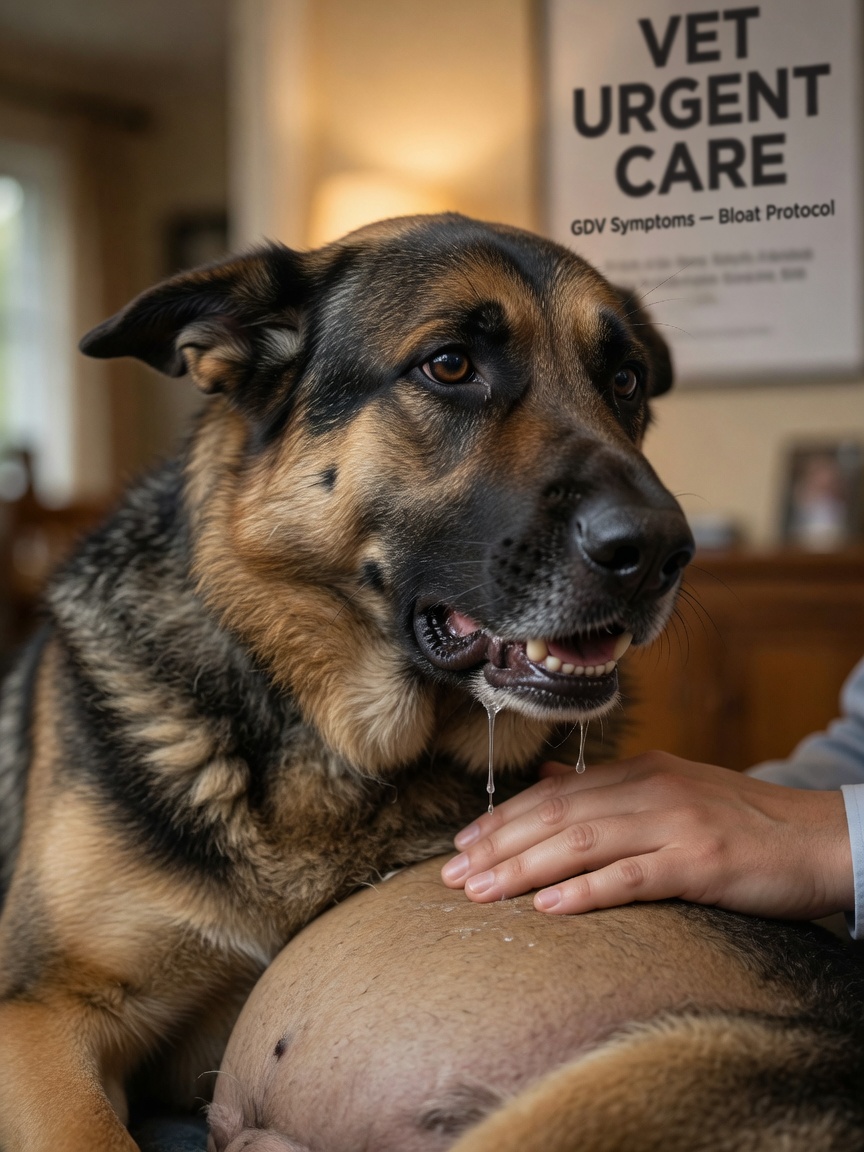
The challenge with GDV is that the early signs can appear deceptively mild before the situation deteriorates rapidly. Every owner of a high-risk breed should know the following warning signs by heart.
- Unproductive retching — the most important early sign. The dog repeatedly tries to vomit but produces nothing, or brings up only a small amount of white foam or saliva. This happens because the twisted stomach has sealed off the normal exit routes for gas and gastric contents.
- Abdominal distension — the abdomen appears visibly swollen, particularly on the left side behind the ribcage. In some dogs with deep chests this may be difficult to detect visually and is better appreciated by feeling or tapping the abdomen, which produces a drum-like hollow sound.
- Restlessness and distress — the dog is unable to settle, paces, and appears obviously uncomfortable. Some dogs adopt a prayer position with front legs extended and hind end raised.
- Drooling excessively — hypersalivation is common and relates to nausea and distress.
- Rapid deterioration — within an hour or two of the first signs, the dog may show signs of shock including pale or greyish gums, rapid shallow breathing, a weak rapid pulse, and collapse.
If you observe unproductive retching combined with any abdominal distension in a large-breed dog, do not wait. This presentation should be treated as GDV until proven otherwise.
What to Do in an Emergency
There is nothing you can do at home to treat GDV — this is a surgical emergency requiring immediate veterinary attention. Do not attempt to walk the dog to encourage it to pass wind, do not give any medications, and do not wait to see if the dog improves on its own. Call your vet or the nearest emergency veterinary clinic immediately and explain that you suspect GDV. This allows the team to prepare for your arrival and ensures you are seen as a priority the moment you walk through the door.
During transport, try to keep the dog calm and as still as possible. Avoid unnecessary handling. If the dog wants to lie down, allow it. The priority is reaching the vet as quickly as safely possible.
At the clinic, initial treatment will focus on stabilising the dog — decompressing the stomach by passing a tube or placing a needle through the body wall to release the gas, and supporting blood pressure with intravenous fluids. Once the dog is stable enough to withstand anaesthesia, emergency surgery is performed to untwist the stomach and assess and remove any tissue that has died.
Prophylactic Gastropexy: Prevention for High-Risk Breeds
Gastropexy is a surgical procedure in which the stomach is permanently tacked to the abdominal wall, preventing it from rotating. This procedure does not prevent simple gastric dilatation — the stomach can still fill with gas — but it eliminates the ability of the stomach to undergo volvulus, which is the life-threatening component. Dogs that have undergone gastropexy can still experience bloating and discomfort from gas accumulation, but the cascade of events that leads to death is prevented.
Prophylactic gastropexy — that is, performing the procedure on a healthy dog before any emergency occurs — is now widely recommended for breeds at highest risk. The procedure is frequently performed at the time of routine neutering, which means no additional anaesthetic event is required. Laparoscopic gastropexy is increasingly available, offering a minimally invasive option with a faster recovery time.
If you own a Great Dane, German Shepherd, Dobermann, Irish Setter, Weimaraner, or any other large, deep-chested breed, speak to your vet about prophylactic gastropexy. For many of these dogs, the conversation is not whether to consider it but when.
Other Preventative Measures
While gastropexy is the only reliable way to prevent volvulus, some general management strategies may reduce the risk of gastric dilatation occurring in the first place. Feeding multiple small meals per day rather than a single large meal reduces the volume of food in the stomach at any one time. Avoiding vigorous exercise for at least an hour before and after meals is sensible precaution. Using a slow-feeder bowl can reduce the rate at which food is consumed and may decrease the amount of air swallowed during eating.
Raised food bowls were historically recommended for GDV prevention but have since been questioned — some research has suggested they may actually increase risk in certain breeds. Current guidance is generally to feed at floor level, though owners should discuss this with their vet given the evolving evidence.