
How to Help an Overweight Dog Lose Weight Safely
Most dog owners know when their pet is overweight. What they often don't know is how to help their dog lose weight effectively — and safely. Canine weight loss isn't simply a matter of feeding less of the same food. Done incorrectly, rapid calorie restriction can cause muscle loss, nutritional deficiencies, and even hepatic lipidosis in susceptible dogs. Done correctly, it's one of the highest-impact interventions you can make for your dog's longevity and quality of life.
This guide walks through the complete process: assessing your dog's current weight, calculating a safe calorie target, choosing the right food strategy, incorporating exercise, and monitoring progress.
Step 1 — Confirm the Problem With Body Condition Scoring
The scale tells you a number, but body condition scoring (BCS) tells you whether that number is appropriate for your individual dog's frame. The 9-point BCS system is the veterinary standard:
- BCS 1–3: Underweight — ribs, spine, and hip bones visible from a distance
- BCS 4–5: Ideal — ribs easily felt but not seen; waist visible from above; abdominal tuck visible from the side
- BCS 6–7: Overweight — ribs felt with firm pressure; waist barely discernible; abdominal tuck minimal
- BCS 8–9: Obese — ribs cannot be felt without significant pressure; no waist; pendulous abdomen
A dog at BCS 7 is approximately 20–30% above ideal body weight; BCS 8–9 represents 30–40% or more excess weight. The WSAVA Global Nutrition Guidelines include illustrated BCS charts that are a useful reference for owners learning to assess their dog at home.
Before starting any weight loss program, a veterinary checkup is strongly recommended to rule out underlying metabolic causes of weight gain — particularly hypothyroidism and Cushing's disease, both of which cause weight gain that will not respond to diet restriction until the hormonal disorder is treated.
Step 2 — Rule Out Medical Causes First
Not every overweight dog is simply over-fed. Certain medical conditions directly cause or contribute to weight gain:
- Hypothyroidism: Reduced metabolic rate; dogs gain weight even on normal caloric intake. A thyroid panel should be run in middle-aged overweight dogs, especially those showing lethargy or hair loss.
- Hyperadrenocorticism (Cushing's disease): Excessive cortisol causes fat redistribution and a pot-bellied appearance alongside increased appetite.
- Spaying and neutering: Gonadectomy reduces resting metabolic rate by 20–30% in both male and female dogs. This is well-documented and explains why spayed/neutered dogs require fewer calories than intact dogs of the same size — but it is manageable with appropriate calorie adjustment.
- Certain medications: Long-term corticosteroids, phenobarbital, and some other drugs can cause weight gain as a side effect.
Step 3 — Calculate a Calorie Target
The starting point for calculating a dog's weight loss calorie allowance is the Resting Energy Requirement (RER) calculated at the dog's target (ideal) body weight — not the current weight. Using current weight over-estimates calorie needs.
The RER formula: RER (kcal/day) = 70 × (ideal body weight in kg)0.75
For weight loss, most veterinary nutritionists recommend feeding 80% of the RER at ideal body weight as a starting point. For example, a dog currently weighing 35 kg with an ideal weight of 27 kg would have an RER of approximately 70 × (27)0.75 = 70 × 11.8 = 826 kcal/day. The weight loss target would be approximately 660 kcal/day.
In practice, calorie content varies significantly between foods, and individual metabolic rates vary between dogs. The calculated target is a starting point — actual progress should guide adjustments. Never reduce calories below 60% of RER at ideal body weight without direct veterinary supervision, as this risks nutritional inadequacy and rapid muscle loss.
Step 4 — Choose the Right Food Strategy
There are two primary dietary approaches to canine weight loss, each with advantages:
Approach 1 — Reduce portion of current food: Simple and inexpensive, but often inadequate. Most maintenance dog foods are calorie-dense; reducing to weight-loss portions leaves dogs feeling hungry and owners feeling guilty. Dogs begging constantly undermines compliance. This approach works best for dogs who only need to lose 5–10% of body weight.
Approach 2 — Switch to a purpose-formulated weight management or prescription weight loss diet: These diets are designed to provide satiety at a reduced calorie density, typically through higher fiber content (which increases volume and promotes fullness), higher protein content (which maintains lean muscle mass during calorie restriction), and reduced fat. Prescription veterinary weight loss diets (Hill's Metabolic, Royal Canin Satiety, Purina OM) are the most rigorously formulated and have clinical trial data supporting their efficacy.
Regardless of approach, all family members must be on board. Covert treat-giving by one household member can completely negate a carefully calibrated feeding plan. According to the AVMA, treating compliance is the primary reason weight loss programs fail in practice.
Managing treats: Treats should account for no more than 10% of total daily calories. Low-calorie options include raw carrot sticks, cucumber" title="Can Dogs Eat Cucumber">cucumber slices, green beans, and small pieces of apple (seeds removed). Measure kibble treats by weight, not by "handful."
Weight management food options: Zooplus stocks a comprehensive range of light, weight management, and high-protein reduced-calorie dog foods across all major brands — including both dry and wet formats. Wet food can be particularly useful for weight loss as its high moisture content increases satiety per calorie.
Browse Weight Management Dog Foods at Zooplus →Step 5 — Build an Exercise Plan
Exercise supports weight loss primarily by maintaining lean muscle mass during calorie restriction and improving cardiovascular fitness — but its direct calorie-burning contribution is often over-estimated. A 30-kg dog burns only approximately 50–80 kcal during a 30-minute walk. Dietary restriction does the heavy lifting; exercise provides important metabolic and psychological benefits.
For significantly overweight dogs, start gently. Obese dogs are at higher risk of joint injury, heat intolerance, and exercise-induced respiratory distress. Begin with two short, flat walks daily and increase duration gradually — adding 5 minutes per week — rather than attempting long hikes immediately. Swimming is an excellent low-impact option for dogs with arthritis or joint problems secondary to obesity.
Mental stimulation also helps: food puzzle toys, nose work, and training sessions use caloric energy without the orthopedic stress of forced physical exercise, and they prevent the boredom-driven begging that undermines dietary compliance.
Step 6 — Monitor Progress Correctly
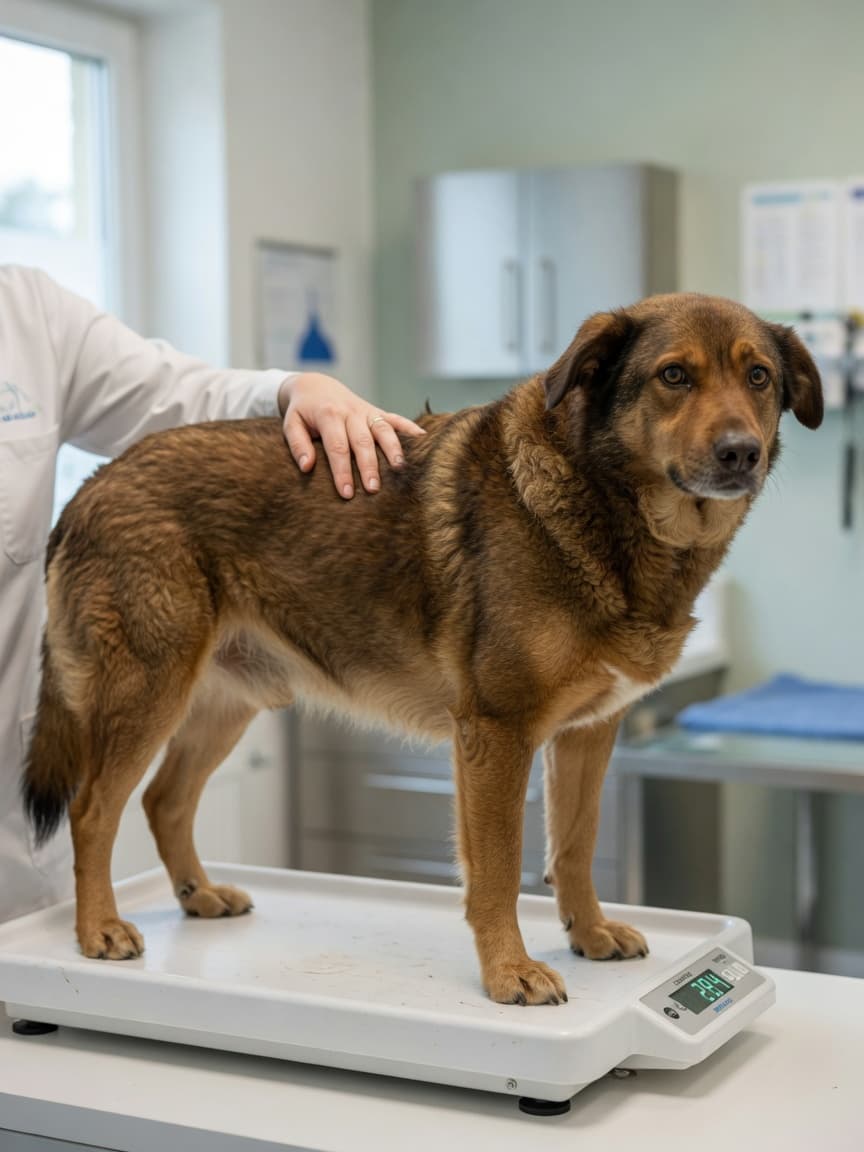
Weigh your dog every 2–4 weeks, always at the same time of day (before morning feeding is ideal), on the same scale. A safe rate of weight loss is 1–2% of current body weight per week. For a 30-kg dog, that's 300–600 g per week. Faster than this risks muscle loss and nutritional deficiency; slower is frustrating but safe — reduce calories by a further 10% if no loss is seen after 4 weeks.
Repeat body condition scoring monthly to assess whether the loss is fat (BCS improving) or lean muscle (weight loss without BCS improvement). Muscle loss during weight reduction suggests insufficient dietary protein — a common pitfall of simply restricting regular maintenance food rather than using a high-protein weight loss formula.
Supplement support for joint health during weight loss: Overweight dogs often have concurrent joint pain that limits exercise. HolistaPet's joint support supplements — formulated with glucosamine, chondroitin, and CBD — can support mobility in dogs exercising more as part of their weight loss journey.
Explore HolistaPet Joint Support Supplements →What to Expect and How Long It Takes
Patience is essential. A dog who needs to lose 5 kg at a safe rate of 300–400 g/week will take 3–4 months to reach goal weight. Rushing the process backfires both metabolically and behaviorally — dogs who lose weight too rapidly often regain it faster.
The transition to a maintenance diet after reaching goal weight is equally important. Resuming the old feeding routine that caused the weight gain in the first place will result in regain within months. Work with your vet to establish a maintenance calorie target based on the new ideal weight — typically 100–110% of RER at ideal body weight for a less active dog, higher for active dogs.
When to See the Vet
Consult your vet before starting a weight loss program if your dog is losing weight despite adequate food intake (which suggests disease rather than dietary excess), if weight isn't changing after 6 weeks despite strict dietary compliance, if your dog shows signs of hypothyroidism or Cushing's disease, or if your dog has significant arthritis or heart or respiratory disease that may limit exercise capacity. A board-certified veterinary nutritionist can create a precisely tailored plan for complex cases.
Key Takeaways
- Canine obesity affects over half of dogs in Western countries and significantly shortens lifespan — addressing it is one of the most impactful health interventions available.
- Always rule out hypothyroidism and Cushing's disease before starting a weight loss program, as these require treatment first.
- Calculate calorie targets based on ideal body weight, not current weight, and aim for 1–2% body weight loss per week.
- Purpose-formulated high-protein, high-fiber weight loss diets outperform simple portion restriction of maintenance food by preserving lean muscle and increasing satiety.
- Household compliance is the most common barrier to success — every person who interacts with the dog must follow the plan consistently.
- After reaching goal weight, establish a new maintenance calorie target — don't return to the feeding habits that caused the weight gain.
References
- German AJ, Holden SL, Mason SL, et al. "Imprecision when using measuring cups to weigh out extruded dry kibble breakfast cereal and pellet animal feeds." Vet Rec. 2011;169(10):252. PMID: 21724557
- Linder DE, Mueller MK. "Pet obesity management: beyond calories." Vet Clin North Am Small Anim Pract. 2014;44(4):789–806. PMID: 24951341