

What Is Mitral Valve Disease in Dogs?
Mitral valve disease, often shortened to MVD, is the most common heart condition affecting dogs. It accounts for the vast majority of heart disease diagnoses in the canine population, particularly in small and medium-sized breeds. The mitral valve sits between the left atrium and left ventricle of the heart, and its job is to keep blood flowing in one direction. When this valve deteriorates, blood leaks backwards — a process known as regurgitation — and the heart has to work harder to compensate.
Over time, the extra workload causes the heart to enlarge and, eventually, to struggle. Understanding this condition is one of the most important things you can do as a dog owner, especially if you have a breed that is particularly prone to it.
Which Breeds Are Most Affected?
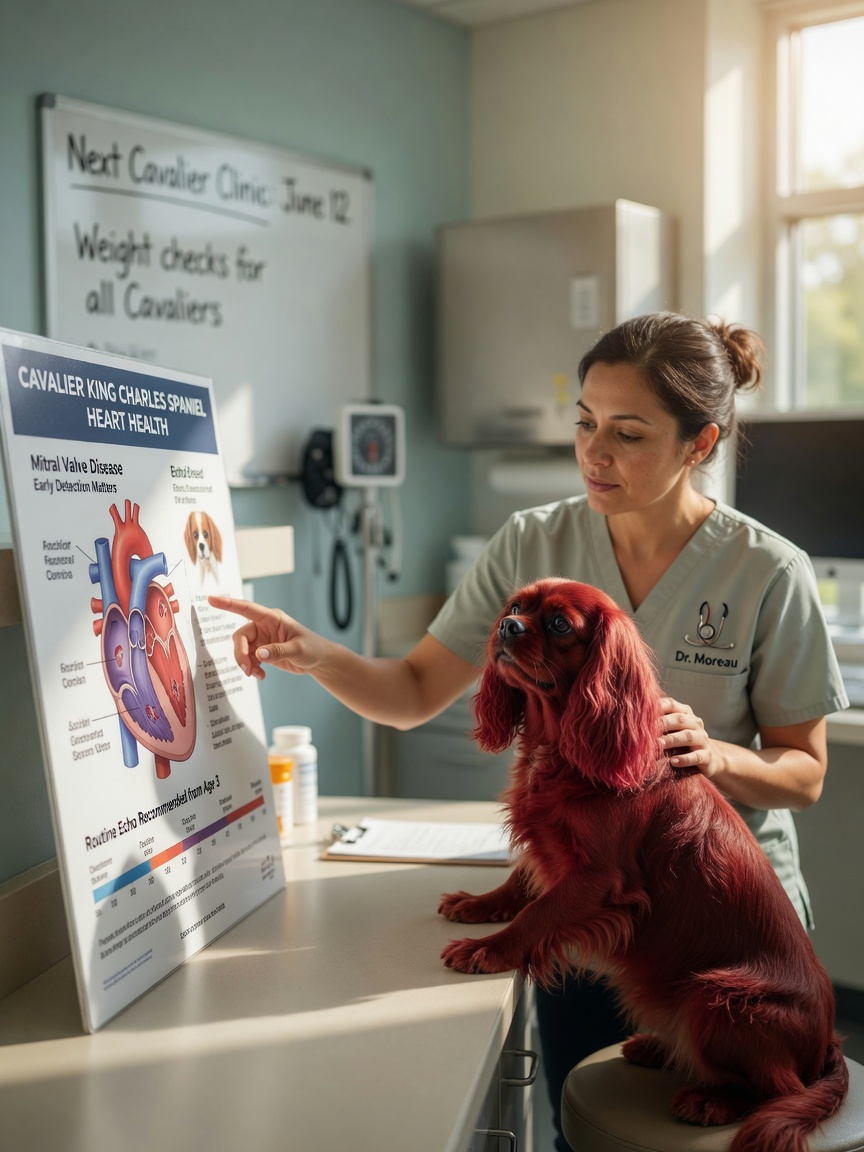
While MVD can affect any dog, Cavalier King Charles Spaniels are by far the most commonly affected breed. Studies suggest that nearly all Cavaliers will develop some degree of mitral valve disease by the time they reach ten years of age. This has led to dedicated breeding screening programmes — most notably the Veterinary Cardiovascular Society scheme — aimed at reducing the frequency of early-onset MVD in the breed.
Other breeds with elevated risk include Dachshunds, Miniature Schnauzers, Chihuahuas, Poodles, and Cocker Spaniels. Larger breeds can also develop MVD, though dilated cardiomyopathy is more typical in giant breeds.
The ACVIM Staging System
In 2019, the American College of Veterinary Internal Medicine published updated consensus guidelines for MVD that are now used by cardiologists and vets worldwide. These guidelines introduced a clear staging system to help describe how advanced the disease is in any individual dog.
- Stage A: Dogs at high risk for developing heart disease due to breed or genetics, but with no current signs of disease and no murmur detected.
- Stage B1: A murmur is present but the heart has not yet changed in size. The dog shows no clinical signs.
- Stage B2: A murmur is present and the heart has become enlarged, but the dog still shows no clinical signs. This is a critical staging point.
- Stage C: The dog is showing clinical signs of heart failure, either currently or in the recent past, including coughing, difficulty breathing, or fluid accumulation.
- Stage D: End-stage heart failure that no longer responds adequately to standard doses of medication.
Pre-Clinical Treatment: Why Stage B2 Matters

One of the most significant findings from the 2019 ACVIM guidelines relates to Stage B2 dogs. Previously, treatment was only started once a dog showed symptoms. Research — particularly the EPIC trial — demonstrated that starting treatment with pimobendan (sold under the brand name Vetmedin) before symptoms develop can meaningfully delay the onset of heart failure.
To qualify for Stage B2 treatment, your vet needs to confirm heart enlargement. This is done either through chest X-rays measuring the vertebral heart score, or through echocardiography (a cardiac ultrasound). Not every dog with a murmur will have heart enlargement, so proper assessment is essential before starting medication.
Pimobendan works by making the heart muscle contract more effectively and by reducing the pressure the heart has to pump against. It is generally very well tolerated and has been shown to add months — sometimes over a year — to a dog's life before heart failure develops.
Screening for Cavalier King Charles Spaniels
Because MVD is so prevalent in Cavaliers, breed clubs and veterinary bodies have developed specific screening protocols. The VetScan protocol, used widely in the UK, involves auscultation (listening to the heart) and, in some programmes, echocardiography. Responsible breeders should have their breeding dogs screened annually to reduce the risk of passing on early-onset MVD to offspring. If you own a Cavalier, annual cardiac assessments from a young age are strongly recommended even if your dog appears perfectly healthy.
Symptoms to Watch For at Each Stage
Dogs in Stages A and B1 typically show no symptoms at all — the condition is only discovered during a routine veterinary check when a murmur is heard through a stethoscope. This is one reason why annual health checks are so valuable.
As the disease progresses into Stage B2, the dog may still appear completely normal. However, once a dog reaches Stage C, symptoms begin to appear. These commonly include:
- A persistent cough, particularly at night or after lying down
- Increased breathing rate or effort
- Reduced willingness to exercise or tiring more quickly than usual
- Restlessness at night, reluctance to settle
- Fainting or collapsing episodes
- Reduced appetite and weight loss
Stage D dogs show these symptoms despite being on maximum medication, and quality of life becomes the primary concern.
Treatment Options
Treatment depends on the stage. Stage B2 dogs are started on pimobendan. Once a dog reaches Stage C, the medication regime typically expands to include a diuretic such as furosemide to remove fluid from the lungs, an ACE inhibitor to ease the workload on the heart, and sometimes spironolactone as an additional diuretic with heart-protective properties. Your vet or a veterinary cardiologist will tailor the exact combination and doses to your dog's needs.
Monitoring Your Dog at Home
One of the most practical things you can do as an owner is to monitor your dog's resting respiratory rate. A healthy resting respiratory rate in dogs is generally under 30 breaths per minute. Count the number of times your dog's chest rises in 30 seconds while they are sleeping, then double it to get breaths per minute.
Many cardiologists recommend checking this daily and keeping a log. If the rate consistently exceeds 30 breaths per minute, or if you notice a sudden increase, contact your vet promptly — this can be an early sign that fluid is building up in the lungs.
Prognosis
MVD is a progressive condition, but many dogs live comfortably for years after diagnosis with the right treatment and monitoring. Dogs in Stage B2 who are started on pimobendan typically have a significantly extended period before heart failure develops. Once at Stage C, prognosis varies depending on how well the dog responds to medication, but survival of one to two years is not uncommon in well-managed cases. Open communication with your vet and regular check-ups are the most important tools at your disposal.