
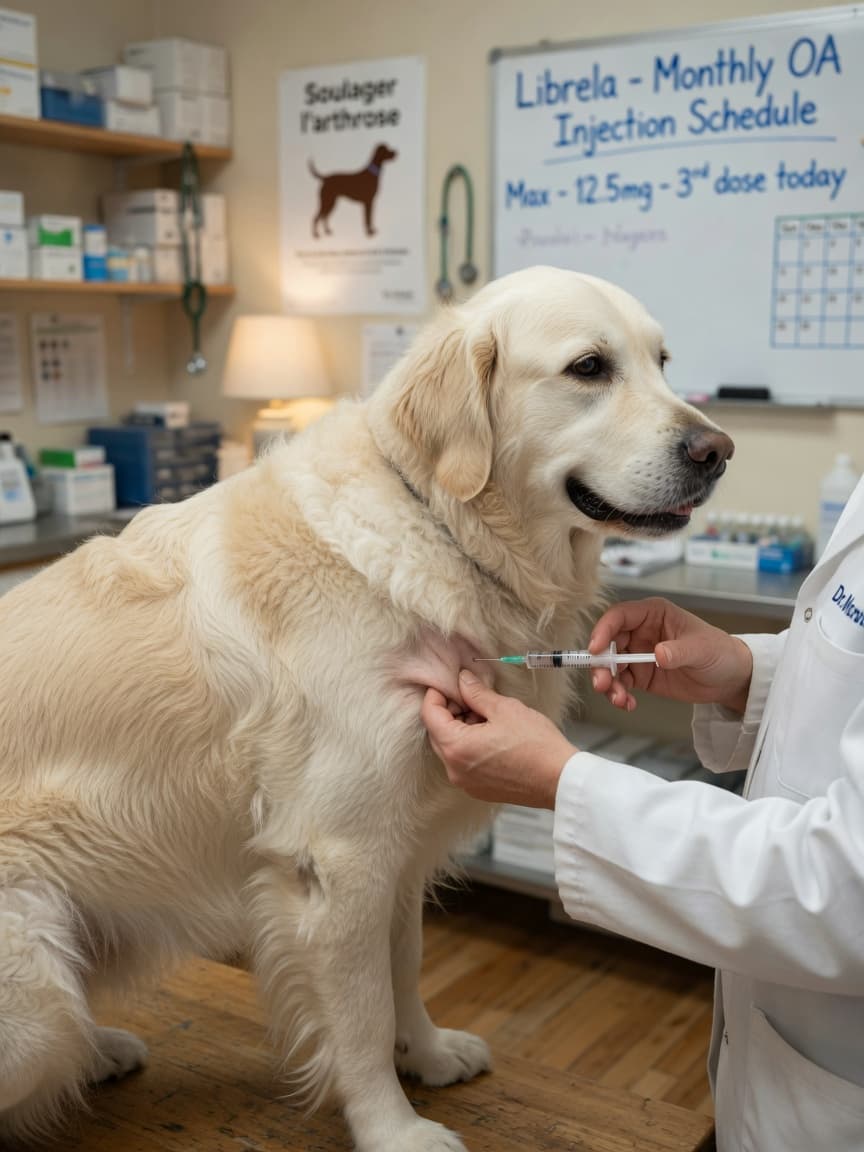
A Monthly Injection That Targets Pain at Its Source
For the estimated 35% of dogs affected by osteoarthritis at some point in their lives, pain management has historically meant daily non-steroidal anti-inflammatory drugs — effective for many, but carrying risks of gastrointestinal and renal side effects with long-term use. The approval of bedinvetmab, sold under the name Librela, marked the first time a monoclonal antibody treatment had been licensed specifically for pain in dogs, and it works in a fundamentally different way to anything that came before it.
What Monoclonal Antibodies Are
Monoclonal antibodies are laboratory-produced proteins designed to bind to a single, specific target in the body with high precision. They are widely used in human medicine to treat conditions ranging from rheumatoid arthritis to certain cancers. The underlying concept is to intercept a specific molecule involved in a disease process before it can cause its downstream effects — a targeted approach that contrasts sharply with the broader action of conventional drugs.
In the context of canine pain, the target is nerve growth factor, or NGF. This protein plays a central role in sensitising pain receptors, and elevated levels of NGF are consistently found in dogs with osteoarthritis. By binding to NGF and preventing it from activating its receptor, Librela reduces the pain signal at a fundamental level rather than simply suppressing inflammation.
How Librela Is Administered and What to Expect
Dosing and Schedule
Librela is administered as a subcutaneous injection once a month by a veterinarian. The dose is calculated according to body weight. Because it is a biological molecule rather than a small-molecule drug, it is not given orally — the digestive system would break it down before it could act.
Onset and Duration of Effect
Clinical trials submitted for regulatory approval showed that many dogs demonstrated measurable improvement in mobility and pain scores within the first month, with effects continuing and in some cases improving over subsequent doses. The monthly rhythm reflects the half-life of the antibody in canine circulation rather than an arbitrary schedule.
Monitoring
Unlike NSAIDs, which require periodic blood tests to monitor kidney and liver function, Librela does not carry the same profile of organ-related risks. However, your vet will still wish to assess your dog's overall response and watch for any adverse reactions, particularly in the early months of treatment.
The Evidence Behind the Treatment
Librela was approved by the European Medicines Agency in 2021 and subsequently by regulatory bodies in other markets. The approval was based on randomised, controlled clinical trials in dogs with confirmed osteoarthritis. These trials used both owner-assessed pain scores and veterinary locomotion assessments to measure outcomes.
Real-world data gathered since approval have broadly supported the trial findings, with a significant proportion of dogs showing clinically meaningful improvement. As with any treatment, response rates are not universal — some dogs show substantial benefit, others more modest gains. Factors such as the severity and location of arthritis and the presence of concurrent conditions can influence outcomes.
Safety Profile and Considerations
Reported Side Effects
The most commonly reported adverse events in trials and post-marketing surveillance have been mild — transient injection-site reactions and, in a small number of cases, dermatological changes. Serious adverse events have been uncommon. The absence of kidney and liver concerns that characterise long-term NSAID use is a meaningful advantage for older dogs or those with pre-existing organ vulnerabilities.
Dogs Who May Not Be Suitable Candidates
Dogs with certain immune-mediated conditions or those receiving other biological therapies may not be appropriate candidates for monoclonal antibody treatment. Pregnant or lactating females are typically excluded. Your vet will review your dog's full medical history before recommending Librela.
Using Librela Alongside Other Treatments
Librela is not necessarily an either/or choice. Many dogs with arthritis benefit from a multimodal approach that combines pharmaceutical pain management with physiotherapy, hydrotherapy, weight management, and joint-supportive nutrition. Discuss with your vet how Librela fits into a broader care plan for your dog.
What This Means for Dogs with Arthritis
- Librela (bedinvetmab) targets nerve growth factor to interrupt the pain signalling pathway in osteoarthritis — a mechanism distinct from NSAIDs and steroids.
- It is given once monthly by subcutaneous injection at the veterinary practice, with dose determined by body weight.
- Clinical trial data support meaningful pain and mobility improvements in a significant proportion of treated dogs.
- The safety profile is favourable for long-term use, particularly in dogs where NSAID use is complicated by organ disease.
- It works best as part of a comprehensive arthritis management plan that includes weight control, appropriate exercise, and physiotherapy support.
- Consult your vet to establish whether your dog is a suitable candidate and to discuss realistic expectations for their individual case.