

Most Pet-Friendly Airlines 2026: Policies, Costs & Restrictions
Key Takeaways
- Most European airlines permit small pets in the cabin (combined weight of pet plus carrier typically 8–10 kg), while larger animals must travel as checked cargo.
- Brachycephalic (snub-nosed) breeds face cargo bans on most major carriers, particularly during summer; some are banned year-round regardless of temperature.
- Pet fees vary from around €40 for short intra-European routes to over €200 each way for intercontinental cargo shipments.
- Health certificates are required for international flights and must be issued within a specific window — usually 10 days — before departure.
- Booking your pet's place early is essential: airlines impose strict limits on the number of animals per flight, and spots fill quickly during peak season.
IATA Live Animal Regulations: The Baseline Standard
Before reviewing individual airline policies, it is important to understand the regulatory floor that all carriers must meet. The International Air Transport Association (IATA) publishes its Live Animal Regulations (LAR) — a comprehensive set of standards covering container specifications, labelling requirements, stacking instructions, environmental conditions, and handling procedures for animals transported by air. The IATA LAR is updated annually and is the de facto global standard; most national aviation authorities and individual carriers reference or incorporate it directly into their own rules.
Under IATA LAR, the carrier (crate or soft bag) must be large enough for the animal to stand, turn around, and lie down in a natural position. For cabin travel, it must fit under the seat in front of the passenger. For cargo, it must meet IATA Container Requirement 1 (CR1) specifications, with adequate ventilation on at least three sides, a leak-proof floor lined with absorbent material, secure fastening that cannot be opened accidentally, and food and water access ports. Carriers that do not meet IATA specifications may be refused at check-in, leaving you stranded with your pet at the departure airport.
Cabin vs Cargo: Understanding the Distinction
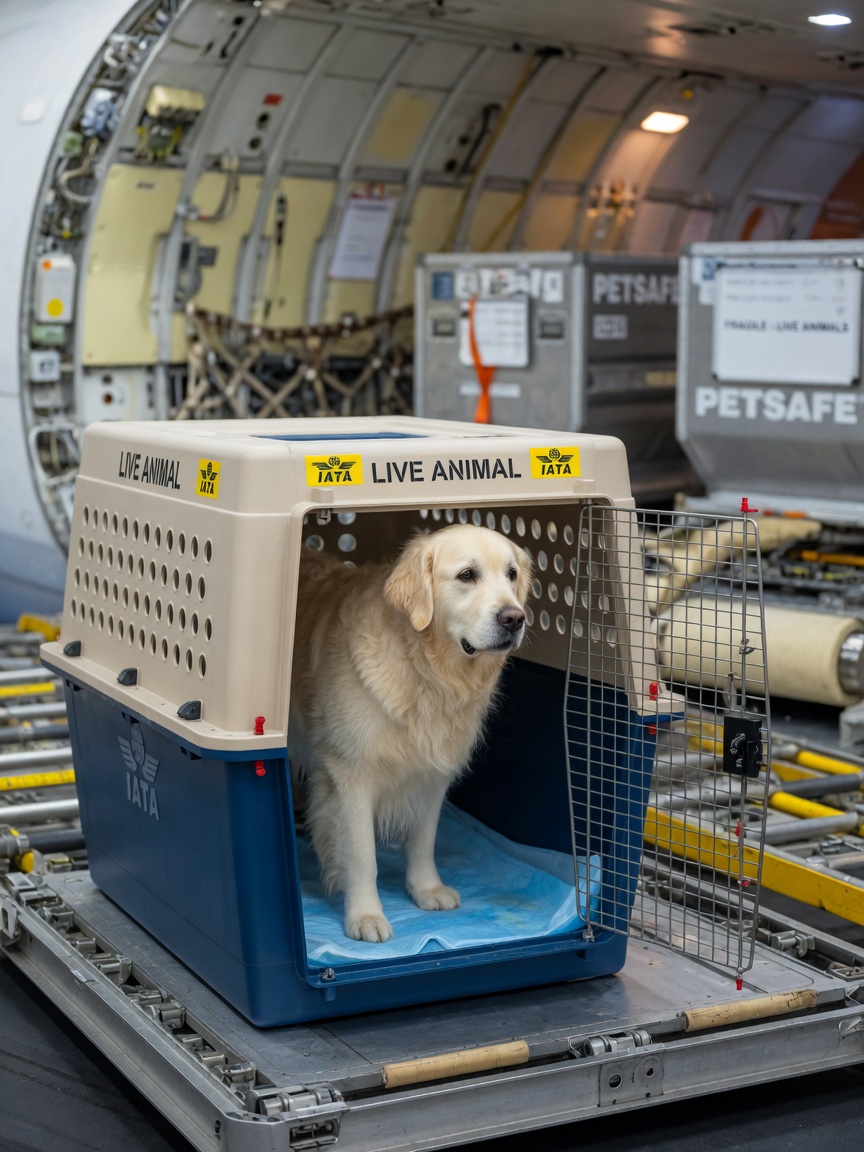
Airlines draw a hard line between pets that travel in the passenger cabin and those that travel in the temperature-controlled hold as checked baggage or freight. In the cabin, the pet remains with you under the seat for the duration of the flight. In cargo, the animal is loaded into the hold of the aircraft — a pressurised, temperature-regulated space, but one that the owner cannot monitor during the flight.
Cabin travel is generally restricted to small cats and dogs whose combined weight with the carrier does not exceed the airline's limit, typically 8 kg on European carriers and 8–10 kg on long-haul carriers. Large dogs, most medium-sized breeds, and any animal exceeding the weight limit must travel in cargo. Some routes — particularly short intra-European hops — do not permit cargo pet transport at all, effectively prohibiting large dogs from those services entirely. For cargo shipments, the IATA-compliant crate must be purchased or rented in advance and is not typically included in the pet fee.
European Carriers: Iberia, Vueling, and Ryanair
Iberia, Spain's flag carrier, permits small dogs and cats in the cabin on most routes within Europe and on transatlantic services operated by Iberia Express. The combined weight limit is 8 kg (pet plus carrier). The carrier must have rigid or semi-rigid sides and a waterproof bottom. Iberia charges approximately €50–€70 each way for cabin pets on European routes and €100–€120 for transatlantic services. Cargo transport of larger animals is available but must be arranged separately through Iberia Cargo, with fees starting around €150 depending on the animal's weight, crate size, and route.
Vueling, also part of the IAG group and operating from Barcelona's El Prat airport, follows a similar framework to Iberia but with some route-specific restrictions. Cabin pets are accepted on flights of up to five hours, with an 8 kg combined limit. Vueling's cabin pet fee is around €40–€60 for short-haul European routes. Vueling does not generally offer in-hold pet transport on its own metal; customers requiring cargo transport are typically redirected to specialist animal shippers.
Ryanair does not permit pets in the cabin on any of its routes, with the sole exception of recognised assistance animals meeting specific criteria. This is a firm policy that has been in place for many years and shows no sign of changing. Customers Travelling with Your Cat in Europe: What You Actually Need">Travelling with Your Cat in Europe: What You Actually Need">travelling with Ryanair who have a pet must make alternative arrangements — either booking another carrier for their animal or using a ground transport option where feasible.
German and Dutch Carriers: Lufthansa and KLM
Lufthansa is widely regarded as one of the most pet-accommodating European full-service carriers. Small dogs and cats (combined weight up to 8 kg) are accepted in the cabin on most routes, with a fee of approximately €70–€95 for European flights and €120–€200 for intercontinental services. Larger animals travel in the climate-controlled hold as checked baggage or cargo under Lufthansa's Animals & Live Animals service, with fees calculated based on the animal's total weight (including IATA crate) and the route. Lufthansa also publishes a clear French Bulldog, Pug & Bulldog Guide">brachycephalic breed list on its website, and affected breeds are not accepted in cargo on certain routes or during summer months.
KLM Royal Dutch Airlines permits small cats and dogs (combined weight up to 8 kg) in the cabin on most routes it operates. The cabin fee ranges from €50 to €100 depending on the flight length. Larger pets travel as checked baggage or air cargo under KLM's petcare service. KLM requires that all travel documents — including vaccination records and, where required, health certificates — be verified at a KLM City office or airport check-in desk at least two hours before departure. KLM has a clearly documented list of restricted breeds and does not accept flat-faced breeds in cargo during summer.
UK Carrier: British Airways
British Airways does not allow pets in the passenger cabin on any of its routes, with the exception of trained assistance dogs on UK domestic flights. All pet transport is handled through its partner IAG Cargo under the "Animals by British Airways" service. This means both cats and dogs — regardless of size — must travel in cargo. Fees start at around £100–£200 each way for domestic and short-haul routes and can exceed £400–£600 for long-haul intercontinental cargo, depending on the crate dimensions and total weight. British Airways has detailed breed restrictions for snub-nosed animals and suspends cargo transport of brachycephalic breeds during summer on routes to/from hot destinations.
US Carriers: Delta and United
Delta Air Lines permits small dogs, cats, and household birds in the cabin on US domestic flights and a limited number of international routes (excluding those into the UK, where the no-cabin-pet rule mirrors the British Airways policy). The combined cabin weight limit is approximately 8 kg (approximately 17.6 lbs). Delta's cabin pet fee is $95–$200 USD each way, depending on the destination. Cargo transport of larger pets is available through Delta Cargo's PetFirst service, but Delta suspended cargo pet transport on certain routes in recent years due to safety concerns. Owners should check the current Delta website for route-specific availability, as this policy has changed multiple times.
United Airlines allows small cats and dogs in the cabin on most domestic and select international routes, with a combined weight limit of approximately 10 kg. The cabin fee is $125 USD each way for domestic routes. United operates a PetSafe programme for cargo transport of larger animals, with fees based on the total kennel weight and route. Like Delta, United maintains a list of restricted breeds — including all brachycephalic dogs and cats — that are banned from cargo transport regardless of season, making United's policy one of the stricter ones among US majors for flat-faced breeds.
Brachycephalic Breeds: Understanding the Cargo Ban
Brachycephalic, or snub-nosed, breeds — including Bulldogs, Pugs, French Bulldogs, Boston Terriers, Shih Tzus, Boxers, Persian cats, and Himalayan cats among others — face specific restrictions on virtually all major carriers. The reason is physiological: these breeds have anatomically shortened nasal passages and skulls that make breathing difficult in normal conditions, and the stress, reduced oxygen levels, and temperature variation of cargo travel create a significantly elevated risk of respiratory distress, heat stroke, and death.
Many airlines ban brachycephalic breeds from cargo entirely, year-round. Others implement a seasonal ban, typically from May to September, covering routes where destination or transit temperatures are likely to exceed 27°C. In the cabin, these breeds are typically accepted without restriction as long as they meet the weight limit, since the passenger cabin is pressurised and temperature-controlled to human comfort standards. Owners of brachycephalic breeds travelling on a route that would require cargo transport for a larger animal should recognise that this may not be a viable option and should plan accordingly.
Health Certificates, Booking Tips, and Carrier Acclimation
For international travel, most destinations require an official veterinary health certificate issued within 10 days of departure (the exact window varies by destination country). This certificate must be signed by an accredited official veterinarian and, for EU entry or UK entry, endorsed by the national competent authority. In the UK this is APHA; in Spain it is the Subdirección General de Acuerdos Sanitarios y Control en Frontera. Allow at least two to three weeks to arrange the official endorsement, as processing times vary seasonally.
Pet spaces on any given flight are strictly limited — most airlines cap cabin pets at one or two per flight section, and cargo capacity is also finite. Book your pet's place at the same time as your own ticket and confirm by phone that the reservation has been registered in the airline's system; online booking systems do not always correctly record pet reservations. Reconfirm 48 hours before departure.
Begin acclimating your pet to its carrier at least four to six weeks before travel. Feed meals inside the carrier, place familiar bedding inside it, and take the pet on short car journeys in the carrier to reduce travel anxiety. A calm, carrier-habituated pet is significantly less likely to vocalise, overheat, or develop stress-related Kidney Disease in Dogs: Diet, Supplements & Quality of Life">Kidney Disease in Dogs: Diet, Supplements & Quality of Life">Kidney Disease in Cats: Diet, Symptoms & Prognosis">Kidney Disease Diet">Kidney Disease in Dogs: Diet, Supplements & Quality of Life">Kidney Disease">health problems during the flight. Consult your veterinarian about whether a mild sedative or anxiety supplement is appropriate — note that sedation is not recommended by IATA for air travel, as it can affect respiratory function, but some anti-anxiety supplements (such as pheromone sprays) are considered safe and may help.
References & Sources
- International Air Transport Association (IATA). Live Animals Regulations (LAR), 51st Edition. Montreal: IATA, 2024. Overview available at: iata.org
- European Union Aviation Safety Agency (EASA) & individual carrier General Conditions of Carriage. For Iberia: iberia.com/travelling-with-pets; for Lufthansa: lufthansa.com/travelling-with-animals