
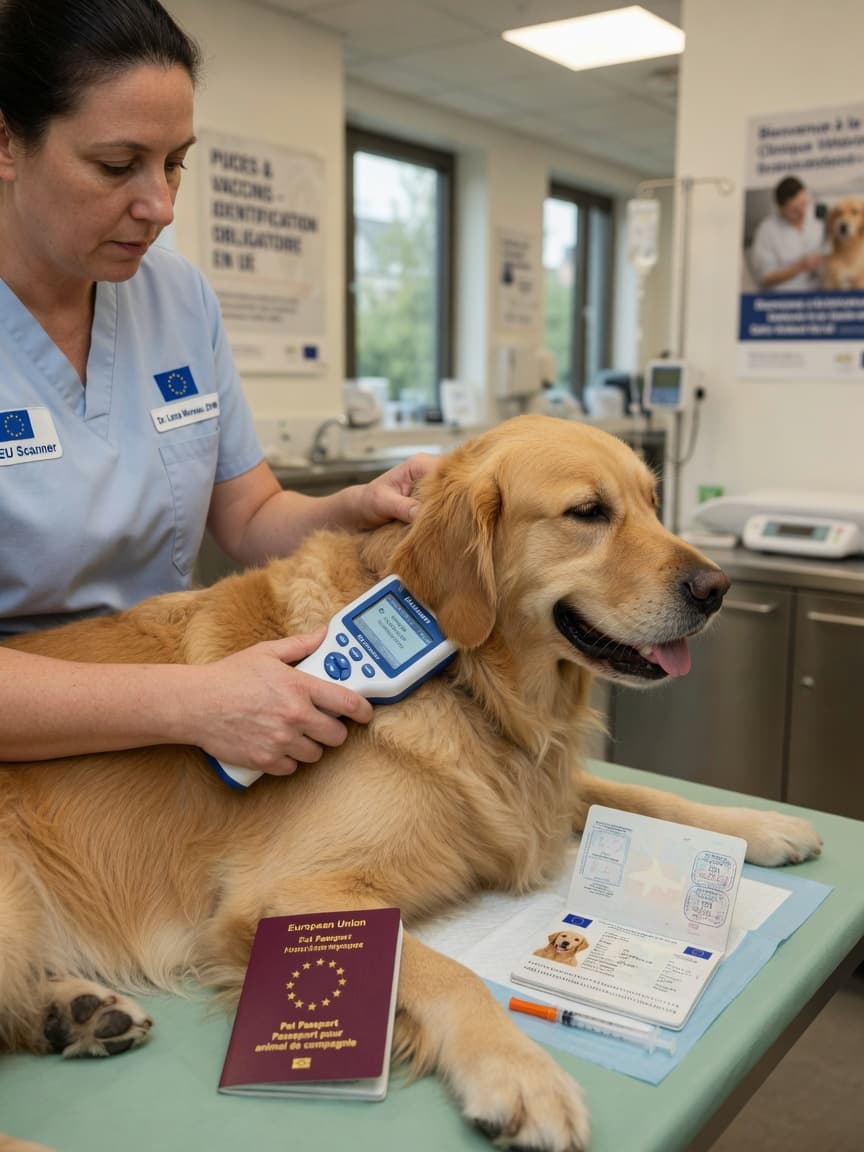
Bringing Pets to Europe: Import Rules, Microchip & Rabies Titre Test
Key Takeaways
- All pets entering the EU must be microchipped to ISO 11784/11785 standard before receiving a rabies vaccination.
- Pets from non-listed (unlisted) countries must pass a rabies antibody titre test and wait a mandatory three-month standstill period before travel.
- Post-Brexit, the UK is treated as a third country, making UK-to-EU travel significantly more complex than it was before 2021.
- Dogs entering the UK, Ireland, Finland, Norway, and Malta must receive a tapeworm (Echinococcus) treatment within a specific window before arrival.
- Several EU member states apply additional breed-specific restrictions; always verify destination-country rules before booking travel.
The EU Pet Travel Scheme: An Overview
The guide" title="Pet Insurance in Europe: Country-by-Country Comparison">European Union's pet travel framework is governed by EU Regulation 576/2013 on the non-commercial movement of pet animals. This regulation applies to dogs (Canis lupus familiaris), cats (Felis silvestris catus), and ferrets (Mustela putorius furo) and sets out the minimum conditions that must be met before an animal can cross an EU border for non-commercial purposes (i.e., accompanying their owner on holiday or relocation rather than being sold or transferred).
At its core, the scheme rests on three pillars: a compliant microchip, a valid rabies vaccination administered after that chip was implanted, and an official EU Pet Passport or, for animals coming from outside the EU, a third-country health certificate issued by an accredited official veterinarian. Without all three elements aligned, border officials have legal authority to refuse entry or, in serious cases, place the animal in quarantine at the owner's expense.
Microchipping: ISO 11784/11785 Standard Explained
The microchip must conform to ISO standards 11784 and 11785, which define the 15-digit code format and the 134.2 kHz read frequency used across EU member states. If your pet carries an older-generation chip — common in the United States, Australia, and parts of Asia — that operates at 125 kHz, EU scanners may not read it automatically. In that case, you have two options: implant a second compliant chip alongside the existing one, or carry a compatible reader yourself (though border officials are under no obligation to use a reader you supply).
Crucially, the microchip must be implanted before the rabies vaccination. If a vet administers the vaccine first and chips the animal afterwards, the vaccination is legally invalid for travel purposes and must be repeated following the correct sequence. This error is more common than owners realise and can delay travel plans by months.
Rabies Vaccination Requirements
A valid rabies vaccination must be administered by a licensed veterinarian after the microchip is implanted and recorded in the EU Pet Passport or health certificate. The vaccine must be administered at the appropriate age (generally 12 weeks or older, depending on the vaccine product and national rules) and must still be within its validity period at the time of entry.
Booster vaccinations must be given within the interval specified by the vaccine manufacturer. A lapse — even by a single day — invalidates the continuity of protection, and the animal may then need to undergo the full titre-test and waiting-period process again, as though starting from scratch as a pet arriving from a non-listed country.
Rabies Titre Test: Third-Country and Non-Listed Country Requirements
EU Regulation 576/2013 distinguishes between "listed" countries (those recognised by the EU as having equivalent animal health standards, such as the United States, Canada, Japan, Australia, and a number of others) and "non-listed" countries. Pets travelling from non-listed countries — which include many nations in Asia, Africa, and South America — must pass a rabies antibody titre test before they are permitted to enter the EU.
The titre test, formally called the Rabies Neutralising Antibody Titre Test (RNATT), measures whether the animal has developed adequate immune protection following vaccination. The blood sample must be taken by an official veterinarian at least 30 days after the rabies vaccination and must be analysed by an EU-approved laboratory. The result must show a serum titre of at least 0.5 IU/ml — the threshold defined by the World Organisation for Animal Health (WOAH, formerly OIE).
Once a passing titre result is confirmed, the animal must then wait a mandatory three-month (90-day) standstill period before it is permitted to enter the EU. This waiting period runs from the date the blood sample was taken, not from the date the results were received. Careful date tracking is essential, and any miscalculation will result in refusal at the border.
UK Post-Brexit: Now Treated as a Third Country
Since the UK's departure from the European Union, UK-resident pets are no longer covered by the EU Pet Travel Scheme as participating members. As of 2021, the UK is classified as a third country — specifically, it holds "listed Part 2" status for dogs and cats, which means its pet travel rules are slightly more streamlined than those applied to non-listed countries, but substantially stricter than the rules that applied pre-Brexit.
UK pets travelling to the EU must now carry an Animal Health Certificate (AHC) issued by an official veterinarian (OV) no more than 10 days before travel. The EU Pet Passport issued before 2021 is no longer valid for travel from the UK to the EU (though EU-issued passports held by EU-resident pets are still valid). A new AHC is required for each trip, and it must be issued within the 10-day window — it cannot be reused for a subsequent journey.
Pets travelling from the EU to the UK must comply with UK-specific import rules, including a health certificate issued by an EU official veterinarian, and microchip and rabies vaccination documentation aligned with UK requirements. Pet owners planning frequent cross-Channel travel should consult both APHA (UK) and their destination EU country's competent authority in advance, as requirements can shift with policy updates.
Tapeworm Treatment: UK, Ireland, Finland, Norway, and Malta
Several countries — the United Kingdom, Ireland, Finland, Norway (not an EU member but part of the EEA), and Malta — require that all dogs be treated against the tapeworm Echinococcus multilocularis before entry. This requirement does not apply to cats or ferrets.
The treatment must be administered by a licensed veterinarian using a product containing praziquantel or an approved equivalent. Timing is strict: the treatment must be given no more than 120 hours (five days) and no less than 24 hours before the scheduled arrival time at the port of entry. A margin of even a few hours outside these bounds is sufficient grounds for refusal. The treatment date and time, the veterinarian's details, and the product name and dosage must be recorded in the animal's health documentation.
Breed-Specific Restrictions Within the EU
EU Regulation 576/2013 harmonises the movement framework, but it does not override individual member states' national laws on breed-specific legislation (BSL). Countries such as Germany, France, Denmark, and Portugal maintain varying lists of restricted or banned breeds, often including American Pit Bull Terriers, Rottweilers, Staffordshire Bull Terriers, Dogo Argentinos, and Fila Brasileiros. Rules differ: some countries permit entry with conditions (muzzling, sterilisation certificate, liability insurance), while others impose outright import bans.
Owners of any breed that could be categorised under BSL must verify the specific rules of every EU country through which they will transit, not only their final destination. Transit through a country that bans the breed — even briefly, such as a road crossing — can result in confiscation of the animal. The European Commission's TRACES system and the national competent authority of each destination country are the authoritative sources for current breed restrictions.
Practical Steps Before You Travel
Begin preparations at least six months in advance if your pet is currently unvaccinated or if you are travelling from a non-listed country — the three-month titre-test standstill alone consumes that buffer. Book an appointment with an Official Veterinarian (OV) or accredited veterinarian well in advance, since OV appointments can be scarce. Keep certified copies of all documentation, including the microchip implantation certificate, vaccination records with batch numbers, laboratory titre results, and the health certificate or EU Pet Passport. Digital copies stored in a cloud service provide a useful backup. On the day of travel, arrive early at your port of departure, as pet document checks can add considerable time to your boarding process.
References & Sources
- European Parliament and Council of the European Union. Regulation (EU) No 576/2013 of 12 June 2013 on the non-commercial movement of pet animals and repealing Regulation (EC) No 998/2003. Official Journal of the European Union, L 178, 28 June 2013. Available at: eur-lex.europa.eu
- European Food Safety Authority (EFSA). Scientific Opinion on the public health risks of rabies control programmes for dogs and other carnivores in the EU. EFSA Journal, 2015;13(7):4197. Available at: efsa.onlinelibrary.wiley.com