

What the Pet Food Industry Doesn't Want You to Know
Warning: The information in this article is not intended to alarm you or discourage feeding commercial pet food — many products on the market are safe and nutritionally complete. The goal is to help you read labels critically, understand regulatory gaps, and make more informed purchasing decisions for your dog or cat.
The global pet food market is worth over $100 billion annually and growing. Feeding our pets has become a sophisticated, emotionally charged consumer category — and with that has come sophisticated marketing. Phrases like "human-grade," "natural," "ancestral diet," and "premium ingredients" are plastered across packaging, but what do they actually mean? In many cases, surprisingly little.
After years working in animal nutrition and consulting with pet food manufacturers, I've developed a clear-eyed view of the gap between how pet food is marketed and what regulatory oversight actually ensures. Here is what the industry would rather you didn't examine too closely — and what you can do with that knowledge.
Labelling Regulations Are Weaker Than You Think
In the United States, pet food is regulated by the FDA and, at the state level, by AAFCO (Association of American Feed Control Officials). The FDA's pet food page outlines the requirements: pet food must be safe, produced under sanitary conditions, free from harmful substances, and truthfully labelled. These are reasonable baseline requirements — but the enforcement and pre-market approval processes are nothing like those applied to human food or pharmaceuticals.
AAFCO sets nutrient profiles that define what "complete and balanced" means, and manufacturers can claim this status either through formulation (calculating nutrient content on paper) or through feeding trials. The feeding trial standard is more meaningful, but most companies use formulation alone. A food can be mathematically "complete" based on ingredient composition while never having been actually fed to a live animal in a clinical setting.
In Europe, pet food is regulated under the EU Feed Hygiene Regulation and the complementary feed directive, with member states having their own enforcement bodies. While EU standards are somewhat more prescriptive in certain areas, the same fundamental challenge applies: the bar for market entry is significantly lower than for human food products.
Ingredient Naming: The Legal Sleight of Hand
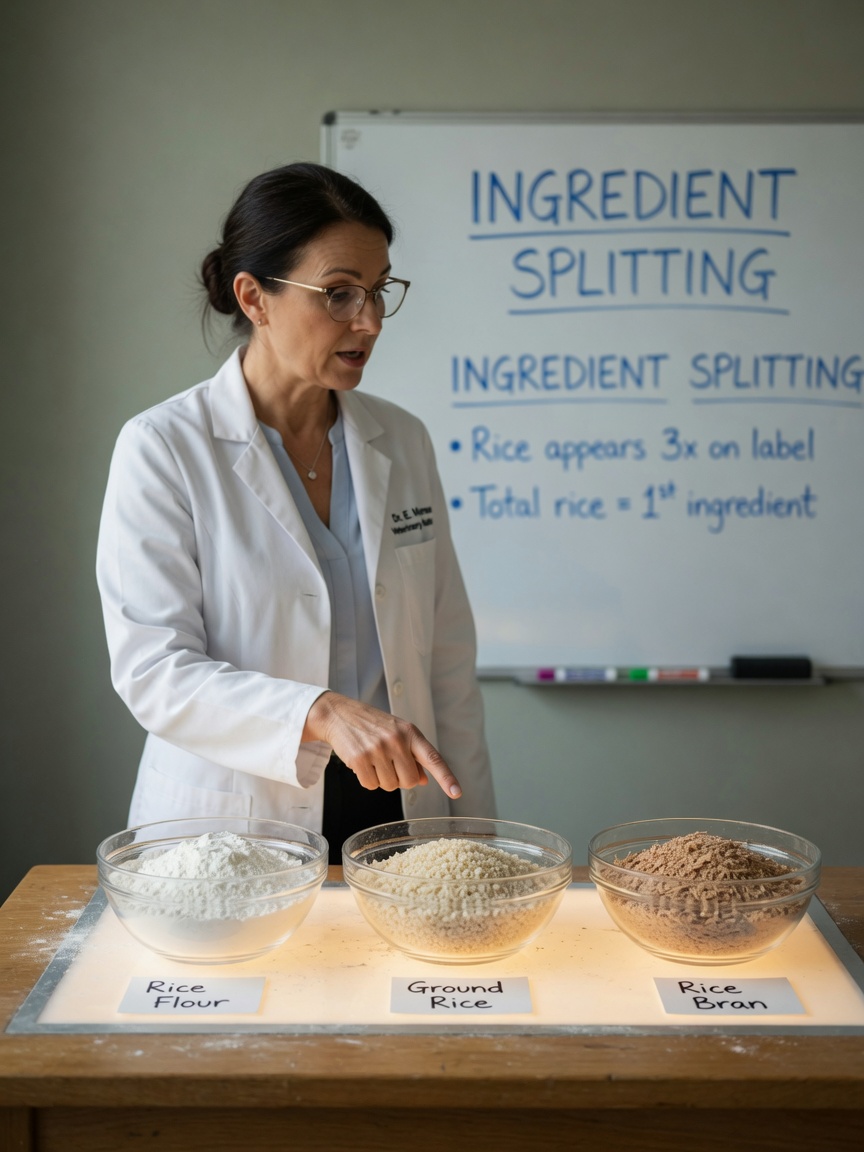
Pet food ingredient lists follow specific rules — but those rules allow for considerable flexibility that obscures what you're actually buying. Research published and summarised on Science Daily has highlighted persistent issues with ingredient transparency in the pet food sector, including the use of ingredient splitting, vague terminology, and misleading front-of-pack claims.
Here's what you should know about the most common labelling tactics:
- Ingredient splitting: If a manufacturer wants to avoid listing "rice" as the primary ingredient, they might list it as "rice flour," "ground rice," and "rice bran" separately. This pushes each rice fraction down the list, making a named protein source appear to be the primary ingredient when carbohydrates may actually dominate by weight.
- "Meat meal" vs. named protein: "Chicken meal" tells you the source species. "Poultry meal" or "meat meal" does not — it could be any combination of species, including rendered by-products from multiple origins.
- "Natural" means almost nothing: AAFCO defines "natural" as derived from plant, animal, or mined sources without synthetic or chemical alteration — a definition so broad it encompasses virtually everything in pet food. Artificial preservatives like BHA and BHT technically don't qualify, but "natural preservatives" like mixed tocopherols vary enormously in efficacy and freshness.
- "Human-grade" is largely unregulated: Unless a manufacturer can demonstrate that their entire production facility is licensed for human food processing, this claim has no legal backing. Many use it freely.
The Marketing Influence on Veterinary Recommendations

An often-overlooked dimension of the pet food industry is its relationship with veterinary education and clinical practice. As The Guardian's investigative report revealed, major pet food companies have historically had significant influence over veterinary nutrition curricula and have provided substantial sponsorship to veterinary schools. This doesn't mean every veterinary recommendation is compromised, but it does mean that the nutritional information vets receive during training may not be entirely neutral.
Prescription diets — sold only through veterinary clinics — are a particularly profitable segment. Some of these diets have excellent evidence bases for managing specific conditions (renal disease, Royal Canin vs Hill's vs Purina">Urinary Health: Royal Canin vs Hill's vs Purina">Urinary Health: What to Look For">urinary health, gastrointestinal disorders). Others charge premium prices for formulations that could be closely approximated with over-the-counter foods at a fraction of the cost. The prescription requirement is not always a reflection of clinical necessity; in many jurisdictions, it's a commercial arrangement.
Contaminants and Quality Control Gaps
Peer-reviewed research has repeatedly identified contaminants in commercial pet food that should concern owners. A significant study available at PubMed (PMID 32059747) examined the accuracy of pet food labelling, finding discrepancies between declared and actual ingredient content in a meaningful proportion of tested products. DNA testing has revealed undeclared species in products, potentially problematic for dogs with food allergies managed through elimination diets.
Heavy metal contamination (lead, cadmium, arsenic), mycotoxins from improperly stored grains, and excessive mineral supplementation have all been documented in commercial pet food recalls and research studies. As BBC reporting on pet food safety has shown, recalls are more common than many owners realise, and the gap between a product being identified as unsafe and it being removed from shelves can be uncomfortably wide.
The DCM Controversy: A Case Study in Industry Influence
The grain-free pet food controversy that emerged around 2018-2019 — when the FDA reported potential links between grain-free diets and dilated cardiomyopathy (DCM) in dogs — is a useful case study in how the pet food industry responds to safety signals. The FDA investigation is ongoing, and causality has not been definitively established. What became apparent was how rapidly segments of the pet food industry mobilised to contest and contextualise the FDA's preliminary findings, funding research, hiring public relations firms, and influencing veterinary societies. The science may ultimately vindicate grain-free foods, or it may not — but the episode illustrates how commercial interests can shape the public narrative around pet food safety.
What You Can Actually Do
This isn't a counsel of despair. Most commercial pet foods are safe, and many are genuinely excellent. The goal is to be a more informed consumer rather than a paranoid one. Here's practical advice:
- Choose brands with named protein sources (chicken, salmon, lamb) rather than generic "meat" or "poultry."
- Check for WSAVA-endorsed nutritional principles: The World Small Animal Veterinary Association has published guidelines on selecting quality pet food that cut through marketing language.
- Look for companies with on-staff nutritionists who have published research — this signals genuine investment in formulation quality.
- Sign up for FDA recall alerts at the FDA's pet food page to be notified if a product you buy is recalled.
- Ask the right questions: What feeding trials has this food undergone? What are the digestibility coefficients for the main ingredients? Can you provide batch-level nutrient analysis? Quality companies will answer these questions; those with something to hide often won't.
Looking for quality pet nutrition? Zooplus offers Europe's widest range of science-backed pet food and supplements, with free delivery on orders over €29. Shop now →
Key Takeaways
- "Natural," "human-grade," and "premium" are largely unregulated marketing terms in pet food — they carry little legal guarantee of quality.
- Ingredient splitting is a legal tactic that can make lower-quality ingredients appear less prominent on labels.
- Research has found discrepancies between declared and actual ingredient content in commercial pet foods, including undeclared species.
- Major pet food companies have historically had significant influence over veterinary nutrition education — a conflict of interest worth knowing.
- The most effective tools for consumers: choose brands with named proteins, WSAVA-aligned practices, on-staff nutritionists, and a transparent recall history.
References
- Morelli G, Bastianello S, Catellani P, Ricci R. Raw meat-based diets for dogs: a comprehensive review of current knowledge. Vet Sci. 2019;6(3). PMID 32059747
- van der Fels-Klerx HJ, Camenzuli L, Belluco S, et al. Food safety issues related to insect production and processing as feed for poultry and swine. J Insects Food Feed. 2018. PMID 30691639