

The Most Over-Fed Patient in Your Home
Surveys consistently estimate that between 40 and 60 percent of pet cats in the UK and US are overweight or obese. Given that excess body fat in cats is directly linked to diabetes, joint disease, urinary problems, and shortened lifespan, this represents a genuine public health crisis for the species — one largely created by those who love them most. The difficult truth is that an overweight cat is not a well-loved cat; it is a cat at increased medical risk, and addressing that risk is one of the most important things an owner can do.
Health Consequences of Feline Obesity
Diabetes Mellitus
Obese cats are four times more likely to develop type 2 diabetes mellitus than cats at healthy body weight. Excess fat tissue creates insulin resistance, impairing the body's ability to regulate blood glucose. The connection is so strong that weight loss alone, when achieved early enough, can result in diabetic remission in some cats — meaning diabetes is not always permanent if the underlying obesity is addressed promptly.
Hepatic Lipidosis Risk
As discussed in the context of feline anorexia, overweight cats face a significantly elevated risk of hepatic lipidosis if food intake drops suddenly for any reason. Their larger fat stores are mobilised rapidly, overwhelming the liver's processing capacity. This is why weight loss in cats must always be gradual and medically supervised.
Orthopaedic and Urinary Disease
Excess body weight places sustained mechanical load on joints, accelerating the development and progression of osteoarthritis. Obese cats are also more likely to develop feline idiopathic cystitis and urinary obstruction — conditions in male cats that can be life-threatening. The links between excess weight and chronic inflammation provide a plausible biological mechanism for many of these associations.
Assessing Your Cat's Body Condition
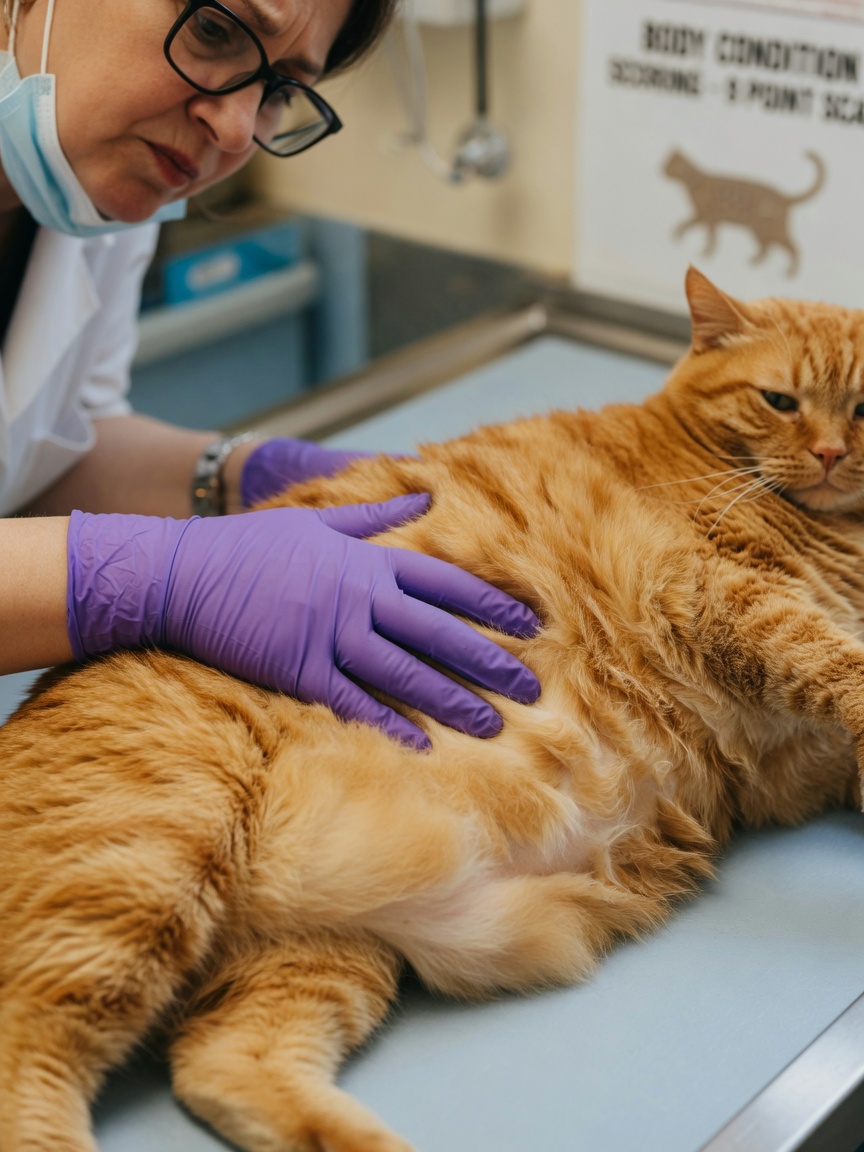
Scales alone do not tell the whole story, as healthy weight varies significantly with frame size and breed. Body Condition Scoring (BCS) systems provide a more reliable assessment. On a standard 1-to-9 scale, a cat at ideal condition (score 4 to 5) has ribs that are easily felt but not prominently visible, a visible waist when viewed from above, and a small amount of abdominal fat. A score of 7 or above indicates obesity. Your vet can assess BCS at routine appointments, and many practices have nurses who offer free weight clinics. Muscle condition should also be assessed separately from fat — a cat can be obese yet still have significant muscle loss.
Calorie Counting for Cats

Weight loss in cats requires a genuine caloric deficit — portion estimation and free-choice feeding are the two most common reasons weight loss programmes fail. The starting point for a weight loss calculation is the cat's ideal body weight, not its current weight. Calories are then calculated for slow, steady loss — typically no more than one to two percent of body weight per week. Faster restriction risks triggering hepatic lipidosis.
Practical Feeding Guidance
- Weigh food using kitchen scales rather than measuring cups — cup volumes vary significantly and almost always result in overfeeding.
- Calculate calories from the food packaging (kcal per 100g or per can) and divide the daily allowance into multiple small meals.
- In multi-cat households, feed separately or use microchip-activated feeders to prevent one cat consuming another's portion.
- High-protein, moderate-fat, lower-carbohydrate diets are generally preferred for feline weight loss as they help preserve lean muscle mass during caloric restriction.
- Prescription weight loss diets are formulated to deliver adequate protein, vitamins, and minerals at reduced calorie levels — these are often the most reliable option for significant weight loss.
Safe Weight Loss: Timelines and Monitoring
A cat losing weight should be reassessed by a vet or veterinary nurse every four to six weeks. Regular weigh-ins allow the calorie prescription to be adjusted as body weight changes, catch any unexpected health issues, and provide the owner with accountability and encouragement. If a cat loses weight faster than anticipated or appetite drops significantly during the programme, veterinary review is needed promptly to rule out illness and assess hepatic lipidosis risk. Weight loss in cats is a slow process — reaching an ideal weight from significantly obese may take six months to over a year. Patience is not optional.
Practical Summary
- Weigh your cat monthly and have your vet score its body condition at annual check-ups — do not rely on visual assessment alone.
- Switch from free-choice feeding to measured meals immediately if your cat is overweight.
- Calculate calories using the food manufacturer's data and your vet's guidance on target weight — do not guess.
- Never restrict a cat's food by more than the veterinary-advised amount — too rapid a reduction risks hepatic lipidosis.
- Introduce environmental enrichment alongside dietary change — food puzzles and play increase activity and reduce boredom eating.
- Always work with your vet throughout a weight loss programme; this is medical management, not simply feeding less.